1,267 posters, 47 videos, 13 topics, 4 sessions, 853 authors
ePostersLive by SciGen Technologies S.A. All rights reserved.
SOHO 2026 Annual Meeting
September 9 - 12, 2026 | George R. Brown Convention Center, Houston, Texas

MPN - 875
Upfront Pemigatinib for Chronic-Phase Myeloid/Lymphoid Neoplasm with a Novel FGFR1 Rearrangement Presenting as Transient Bilateral Vision Loss: A Case Report.
Poster Presenter
Authors
Part of Topic
Myeloproliferative Neoplasms (MPN)
Context: Myeloid/lymphoid neoplasms with eosinophilia and FGFR1 rearrangements (MLN-FGFR1) are rare, aggressive hematologic malignancies driven by constitutive FGFR1 activation and associated with a high risk of transformation to acute leukemia. Clinical presentation is heterogeneous and frequently overlaps with other myeloproliferative neoplasms, often resulting in delayed diagnosis. Outcomes have historically been poor, with allogeneic hematopoietic stem cell transplantation (allo-HSCT) representing the only potentially curative option. Pemigatinib, a selective FGFR1-3 inhibitor, has recently demonstrated promising activity in FGFR1-rearranged neoplasms; however, data regarding its use as upfront therapy in treatment-naïve chronic-phase disease remain limited, particularly in patients harboring rare fusion partners such as ZNF198-FGFR1.
Objective: To describe the clinical presentation, molecular findings, and therapeutic response of a treatment-naïve patient with chronic-phase MLN-FGFR1 harboring a rare ZNF198–FGFR1 fusion who achieved rapid hematologic and cytogenetic remission with upfront pemigatinib as a bridge to allo-HSCT.
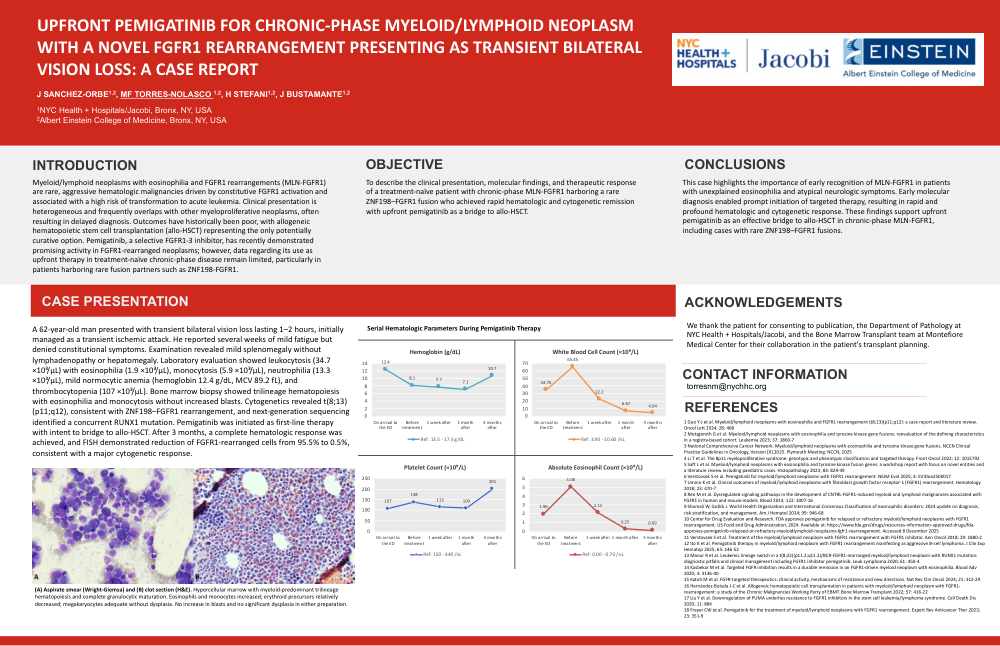
Case Presentation: A 62-year-old man presented with transient bilateral vision loss lasting 1–2 hours, initially managed as a transient ischemic attack. He reported several weeks of mild fatigue but denied constitutional symptoms. Examination revealed mild splenomegaly without lymphadenopathy or hepatomegaly. Laboratory evaluation showed leukocytosis (34.7 ×10³/µL) with eosinophilia (1.9 ×10³/µL), monocytosis (5.9 ×10³/µL), neutrophilia (13.3 ×10³/µL), mild normocytic anemia (hemoglobin 12.4 g/dL, MCV 89.2 fL), and thrombocytopenia (107 ×10³/µL). Bone marrow biopsy showed trilineage hematopoiesis with eosinophilia and monocytosis without increased blasts. Cytogenetics revealed t(8;13) (p11;q12), consistent with ZNF198–FGFR1 rearrangement, and next-generation sequencing identified a concurrent RUNX1 mutation. Pemigatinib was initiated as first-line therapy with intent to bridge to allo-HSCT. After 3 months, a complete hematologic response was achieved, and FISH demonstrated reduction of FGFR1-rearranged cells from 95.5% to 0.5%, consistent with a major cytogenetic response.
Conclusion: This case highlights the importance of early recognition of MLN-FGFR1 in patients with unexplained eosinophilia and atypical neurologic symptoms. Early molecular diagnosis enabled prompt initiation of targeted therapy, resulting in rapid and profound hematologic and cytogenetic response. These findings support upfront pemigatinib as an effective bridge to allo-HSCT in chronic-phase MLN-FGFR1, including cases with rare ZNF198–FGFR1 fusions.