1,267 posters, 47 videos, 13 topics, 4 sessions, 853 authors
ePostersLive by SciGen Technologies S.A. All rights reserved.
SOHO 2026 Annual Meeting
September 9 - 12, 2026 | George R. Brown Convention Center, Houston, Texas

AML - 867
Postmarketing Safety Signals of Revumenib (Menin-KMT2A Inhibitor) vs Acute Myeloid Leukemia-Targeted Therapies: A Class-Restricted Disproportionality Analysis of the FDA Adverse Event Monitoring System (2016-2026)
Poster Presenter
Authors
Part of Topic
Acute Myeloid Leukemia (AML)
Introduction
Revumenib, a first-in-class menin-KMT2A inhibitor, received FDA accelerated approval in November 2024 for relapsed/refractory KMT2A-rearranged acute leukemia. Although differentiation syndrome and QTc prolongation are established toxicities for AML therapies, real-world comparative data for revumenib remain limited. This study utilized the FDA AEMS to compare revumenib's safety profile with other AML treatments.
Methods
AE reports (January 2016–April 2026) were extracted for revumenib (n=716) and eight targeted AML therapies (n=70179): ziftomenib, enasidenib, ivosidenib, olutasidenib, gilteritinib, midostaurin, quizartinib, and venetoclax. Disproportionality was assessed using ROR, PRR, IC, and EBGM. Robust signals required all four statistical thresholds and three or more reports.
Results
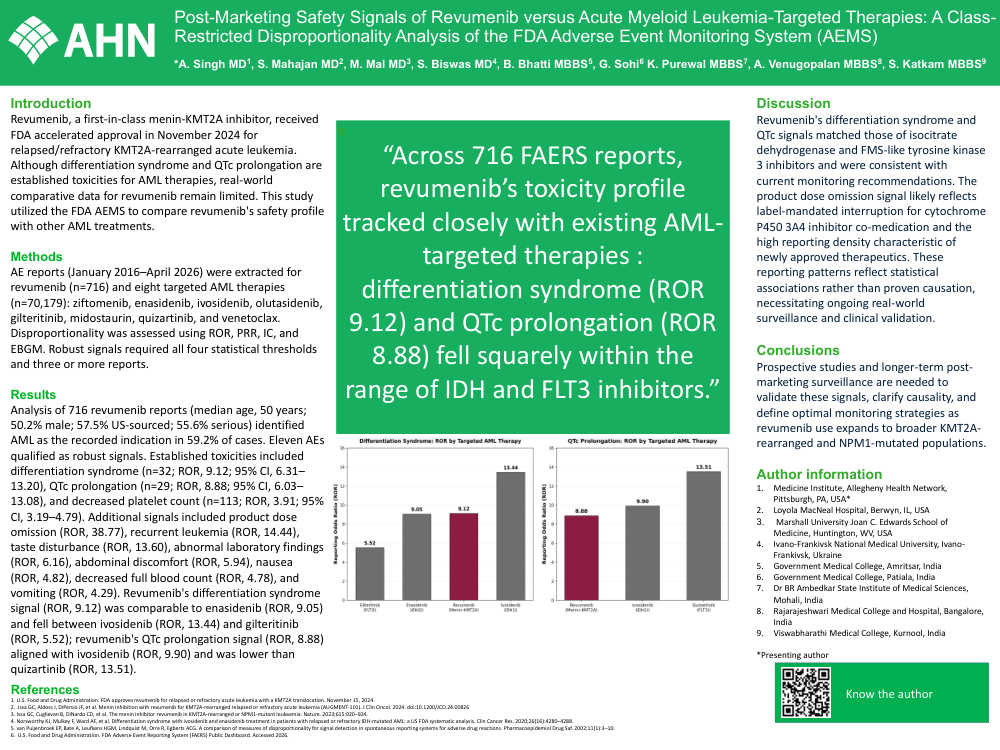
Analysis of 716 revumenib reports (median age, 50 years; 50.2% male; 57.5% US-sourced; 55.6% serious) identified AML as the recorded indication in 59.2% of cases. Eleven AEs qualified as robust signals. Established toxicities included differentiation syndrome (n=32; ROR, 9.12; 95% CI, 6.31–13.20), QTc prolongation (n=29; ROR, 8.88; 95% CI, 6.03–13.08), and decreased platelet count (n=113; ROR, 3.91; 95% CI, 3.19–4.79). Additional signals included product dose omission (ROR, 38.77), recurrent leukemia (ROR, 14.44), taste disturbance (ROR, 13.60), abnormal laboratory findings (ROR, 6.16), abdominal discomfort (ROR, 5.94), nausea (ROR, 4.82), decreased full blood count (ROR, 4.78), and vomiting (ROR, 4.29). Revumenib's differentiation syndrome signal (ROR, 9.12) was comparable to enasidenib (ROR, 9.05) and fell between ivosidenib (ROR, 13.44) and gilteritinib (ROR, 5.52); revumenib's QTc prolongation signal (ROR, 8.88) aligned with ivosidenib (ROR, 9.90) and was lower than quizartinib (ROR, 13.51).
Discussion
Revumenib's differentiation syndrome and QTc signals matched those of isocitrate dehydrogenase and FMS-like tyrosine kinase 3 inhibitors and were consistent with current monitoring recommendations. The product dose omission signal likely reflects label-mandated interruption for cytochrome P450 3A4 inhibitor co-medication and the high reporting density characteristic of newly approved therapeutics. These reporting patterns reflect statistical associations rather than proven causation, necessitating ongoing real-world surveillance and clinical validation.
Conclusions
Prospective studies and longer-term postmarketing surveillance are needed to validate these signals, clarify causality, and define optimal monitoring strategies as revumenib use expands to broader KMT2Arearranged and NPM1-mutated populations.