1,267 posters, 47 videos, 13 topics, 4 sessions, 853 authors
ePostersLive by SciGen Technologies S.A. All rights reserved.
SOHO 2026 Annual Meeting
September 9 - 12, 2026 | George R. Brown Convention Center, Houston, Texas

IBCL - 740
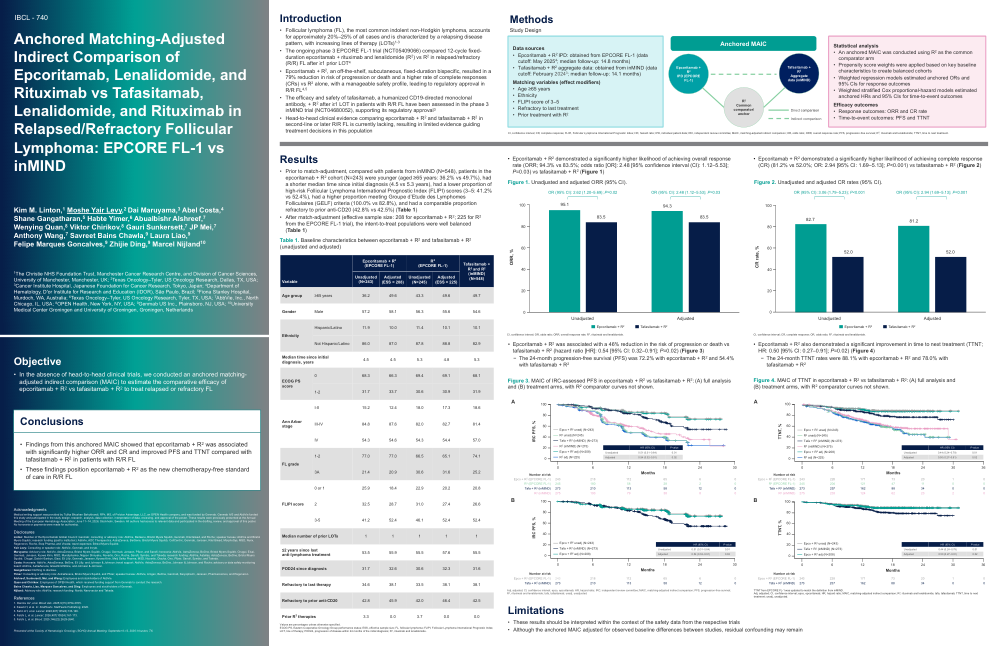
Anchored Matching-Adjusted Indirect Comparison of Epcoritamab, Lenalidomide, and Rituximab vs Tafasitamab, Lenalidomide, and Rituximab in Relapsed/Refractory Follicular Lymphoma: EPCORE FL-1 vs inMIND
Poster Presenter
Authors
Part of Topic
Indolent B-Cell Lymphoma (IBCL)
IBCL - 740
Anchored Matching-Adjusted Indirect Comparison of Epcoritamab, Lenalidomide, and Rituximab vs Tafasitamab, Lenalidomide, and Rituximab in Relapsed/Refractory Follicular Lymphoma: EPCORE FL-1 vs inMIND
Kim M. Linton,1 Moshe Yair Levy,2 Dai Maruyama,3 Abel Costa,4 Shane Gangatharan,5 Habte Yimer,6 Abualbishr Alshreef,7 Wenying Quan,8 Viktor Chirikov,8 Gauri Sunkersett,7 JP Mei,7 Anthony Wang,7 Savreet Bains Chawla,9 Laura Liao,9 Felipe Marques Goncalves,9 Zhijie Ding,9 Marcel Nijland10
1The Christie NHS Foundation Trust, Manchester Cancer Research Centre, and Division of Cancer Sciences, University of Manchester, Manchester, UK; 2Texas Oncology–Tyler, US Oncology Research, Dallas, TX, USA; 3Cancer Institute Hospital, Japanese Foundation for Cancer Research, Tokyo, Japan; 4Department of Hematology, D'or Institute for Research and Education (IDOR), São Paulo, Brazil; 5Fiona Stanley Hospital, Murdoch, WA, Australia; 6Texas Oncology–Tyler, US Oncology Research, Tyler, TX, USA; 7AbbVie, Inc., North Chicago, IL, USA; 8OPEN Health, New York, NY, USA; 9Genmab US Inc., Plainsboro, NJ, USA; 10University Medical Center Groningen and University of Groningen, Groningen, Netherlands
Objective
In the absence of head-to-head clinical trials, we conducted an anchored matching-adjusted indirect comparison (MAIC) to estimate the comparative efficacy of epcoritamab + R2 vs tafasitamab + R2 to treat relapsed or refractory FL.
Introduction
-Follicular lymphoma (FL), the most common indolent non-Hodgkin lymphoma, accounts for approximately 20%–25% of all cases and is characterized by a relapsing disease pattern, with increasing lines of therapy (LOTs)1-3
-The ongoing phase 3 EPCORE FL-1 trial (NCT05409066) compared 12-cycle fixed-duration epcoritamab + rituximab and lenalidomide (R2) vs R2 in relapsed/refractory (R/R) FL after ≥1 prior LOT4
-Epcoritamab + R2, an off-the-shelf, subcutaneous, fixed-duration bispecific, resulted in a 79% reduction in risk of progression or death and a higher rate of complete responses (CRs) vs R2 alone, with a manageable safety profile, leading to regulatory approval in R/R FL4,5
-The efficacy and safety of tafasitamab, a humanized CD19-directed monoclonal antibody, + R2 after ≥1 LOT in patients with R/R FL have been assessed in the phase 3 inMIND trial (NCT04680052), supporting its regulatory approval3
-Head-to-head clinical evidence comparing epcoritamab + R2 and tafasitamab + R2 in second-line or later R/R FL is currently lacking, resulting in limited evidence guiding treatment decisions in this population
Methods
Study Design: See figure in poster
Data sources
-Epcoritamab + R2 IPD: obtained from EPCORE FL-1 (data cutoff: May 20254; median follow-up: 14.8 months)
-Tafasitamab + R2 aggregate data: obtained from inMIND (data cutoff: February 20243; median follow-up: 14.1 months)
Matching variables (effect modifiers)
-Age ≥65 years
-Ethnicity
-FLIPI score of 3–5
-Refractory to last treatment
-Prior treatment with R2
Statistical analysis
-An anchored MAIC was conducted using R2 as the common comparator arm
-Propensity score weights were applied based on key baseline characteristics to create balanced cohorts
-Weighted regression models estimated anchored ORs and 95% CIs for response outcomes
-Weighted stratified Cox proportional-hazard models estimated anchored HRs and 95% CIs for time-to-event outcomes
Efficacy outcomes
-Response outcomes: ORR and CR rate
-Time-to-event outcomes: PFS and TTNT
Results
-Prior to match-adjustment, compared with patients from inMIND (N=548), patients in the epcoritamab + R2 cohort (N=243) were younger (aged ≥65 years: 36.2% vs 49.7%), had a shorter median time since initial diagnosis (4.5 vs 5.3 years), had a lower proportion of high-risk Follicular Lymphoma International Prognostic Index (FLIPI) scores (3–5: 41.2% vs 52.4%), had a higher proportion meeting Groupe d’Etude des Lymphomes Folliculaires (GELF) criteria (100.0% vs 82.8%), and had a comparable proportion refractory to prior anti-CD20 (42.8% vs 42.5%) (Table 1)
-After match-adjustment (effective sample size: 208 for epcoritamab + R2; 225 for R2 from the EPCORE FL-1 trial), the intent-to-treat populations were well balanced (Table 1)
Table 1. Baseline characteristics between epcoritamab + R2 and tafasitamab + R2 (unadjusted and adjusted): See poster
Epcoritamab + R2 demonstrated a significantly higher likelihood of achieving overall response rate (ORR; 94.3% vs 83.5%; odds ratio [OR]: 2.48 [95% confidence interval (CI): 1.12–5.53]; P=0.03) vs tafasitamab + R2 (Figure 1)
Figure 1. Unadjusted and adjusted ORR (95% CI): See poster
Epcoritamab + R2 demonstrated a significantly higher likelihood of achieving complete response (CR) (81.2% vs 52.0%; OR: 2.94 [95% CI: 1.69–5.13]; P<0.001) vs tafasitamab + R2 (Figure 2)
Figure 2. Unadjusted and adjusted CR rates (95% CI): See poster
Epcoritamab + R2 was associated with a 46% reduction in the risk of progression or death vs tafasitamab + R2 (hazard ratio [HR]: 0.54 [95% CI: 0.32–0.91]; P=0.02) (Figure 3)
−The 24-month progression-free survival (PFS) was 72.2% with epcoritamab + R2 and 54.4% with tafasitamab + R2
Figure 3. MAIC of IRC-assessed PFS in epcoritamab + R2 vs tafasitamab + R2: (A) full analysis and (B) treatment arms, with R2 comparator curves not shown: See poster
Epcoritamab + R2 also demonstrated a significant improvement in time to next treatment (TTNT; HR: 0.50 [95% CI: 0.27–0.91]; P=0.02) (Figure 4)
−The 24-month TTNT rates were 88.1% with epcoritamab + R2 and 78.0% with tafasitamab + R2
Figure 4. MAIC of TTNT in epcoritamab + R2 vs tafasitamab + R2: (A) full analysis and (B) treatment arms, with R2 comparator curves not shown: See poster
Limitations
-These results should be interpreted within the context of the safety data from the respective trials
-Although the anchored MAIC adjusted for observed baseline differences between studies, residual confounding may remain
Conclusions
-Findings from this anchored MAIC showed that epcoritamab + R2 was associated with significantly higher ORR and CR and improved PFS and TTNT compared with tafasitamab + R2 in patients with R/R FL
-These findings position epcoritamab + R2 as the new chemotherapy-free standard of care in R/R FL
Acknowledgments
Medical writing support was provided by Tulika Bhushan Bahukhandi, RPh, MS, of Peloton Advantage, LLC, an OPEN Health company, and was funded by Genmab. Genmab A/S and AbbVie funded this study and participated in the study design, research, analysis, data collection, interpretation of data, reviewing, and approval of the poster. These results were previously presented at the Annual Meeting of the European Hematology Association; June 11–14, 2026; Stockholm, Sweden. All authors had access to relevant data and participated in the drafting, review, and approval of this poster. No honoraria or payments were made for authorship.
References
1.Danilov AV, et al. Blood Adv. 2025;9(15):3754-3765.
2. Kaseb H, et al. In: StatPearls. StatPearls Publishing; 2026.
3. Sehn LH, et al. Lancet. 2026;407(10524):133-146.
4. Falchi L, et al. Lancet. 2026;407(10524):161-173.
5. Falchi L, et al. Blood. 2025;146(22):2629-2640.