1,267 posters, 47 videos, 13 topics, 4 sessions, 853 authors
ePostersLive by SciGen Technologies S.A. All rights reserved.
SOHO 2026 Annual Meeting
September 9 - 12, 2026 | George R. Brown Convention Center, Houston, Texas

CT - 681
Remote Monitoring for Early Detection of CRS and ICANS in CAR-T Therapy: A Systematic Review With Geriatric Considerations
Poster Presenter
Part of Topic
Cellular Therapy (CT)
Remote Monitoring for Early Detection of CRS and ICANS in CAR-T Therapy:
A Systematic Review with Geriatric Considerations
S. Ali 1,2; Y. Ismail 1; F. Ahmed 1,2; L. Khalafallah 1; D. Hashim 1,2; N. Naqvi 1; R. Nasraldeen 1; M. Salah 1; N. Abdelrahman 1
1Tele-Geriatric Research Fellowship, Okemos, MI, USA ; 2 University of Medical Sciences and Technology, Khartoum, Sudan
BACKGROUND RESULTS
GERIATRIC CONSIDERATIONS
Cytokine release syndrome (CRS) and immune effector cell-
associated neurotoxicity syndrome (ICANS) are potentially life-
threatening toxicities of CAR-T therapy.
Given their use in malignancies affecting older adults, the
applicability of remote monitoring in this population warrants
evaluation.
OBJECTIVES
Primary Objective:
To assess whether remote monitoring facilitates early detection
of CRS and/or ICANS in patients receiving CAR-T therapy, with
considerations in older adults.
Secondary Objectives:
To characterize remote monitoring modalities used across
studies
To evaluate adherence and feasibility rates in older adult
populations
To assess availability of diagnostic performance metrics
To identify gaps in geriatric-specific evidence for remote
monitoring in CAR-T therapy
METHODOLOGY
Design: Systematic Review following PRISMA-2020 guidelines
Period: 2011-2025
FIGURE 1. PRISMA FLOW
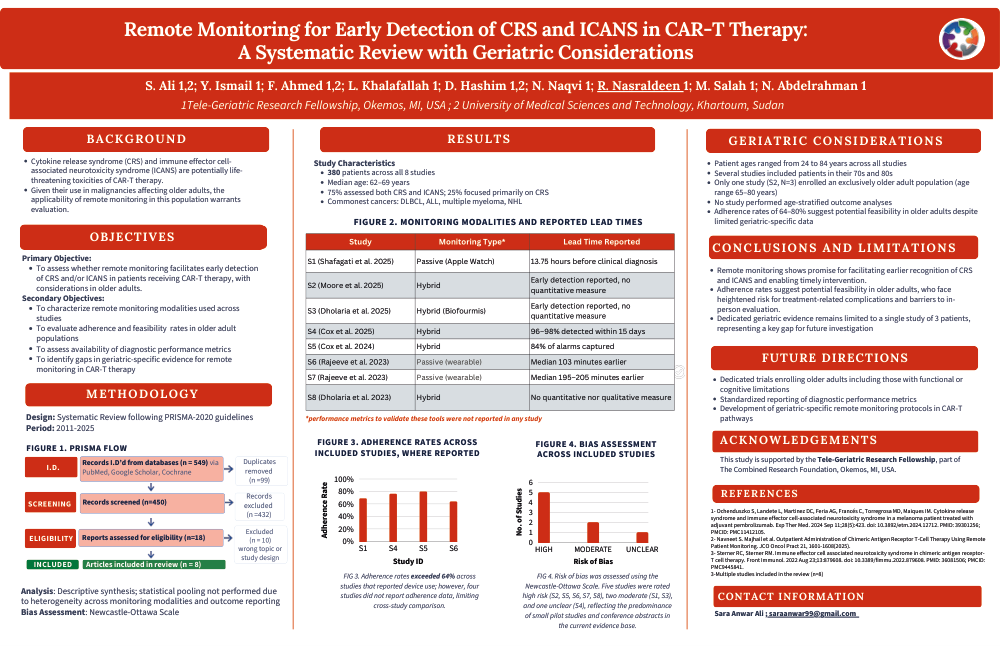
Study Characteristics
380 patients across all 8 studies
Median age: 62–69 years
75% assessed both CRS and ICANS; 25% focused primarily on CRS
Commonest cancers: DLBCL, ALL, multiple myeloma, NHL
FIGURE 2. MONITORING MODALITIES AND REPORTED LEAD TIMES
Study Monitoring Type* Lead Time Reported
S1 (Shafagati et al. 2025) Passive (Apple Watch) 13.75 hours before clinical diagnosis
S2 (Moore et al. 2025) Hybrid S3 (Dholaria et al. 2025) Hybrid (Biofourmis) S4 (Cox et al. 2025) S5 (Cox et al. 2024) S6 (Rajeeve et al. 2023) S7 (Rajeeve et al. 2023) S8 (Dholaria et al. 2023) Hybrid Hybrid Passive (wearable) Passive (wearable) Hybrid Early detection reported, no
quantitative measure
Early detection reported, no
quantitative measure
96–98% detected within 15 days
84% of alarms captured
Median 103 minutes earlier
Median 195–205 minutes earlier
No quantitative nor qualitative
measure
*performance metrics to validate these tools were not reported in any study
FIGURE 3. ADHERENCE RATES
ACROSS INCLUDED STUDIES,
FIGURE 4. RISK OF BIAS
ACROSS INCLUDED STUDIES
Patient ages ranged from 24 to 84 years across all studies
Several studies included patients in their 70s and 80s
Only one study (S2, N=3) enrolled an exclusively older adult population
(age range 65–80 years)
No study performed age-stratified outcome analyses
Adherence rates of 64–80% suggest potential feasibility in older adults
despite limited geriatric-specific data
CONCLUSIONS AND LIMITATIONS
Remote monitoring shows promise for facilitating earlier recognition
of CRS and ICANS and enabling timely intervention.
Adherence rates suggest potential feasibility in older adults, who face
heightened risk for treatment-related complications and barriers to
in-person evaluation.
Dedicated geriatric evidence remains limited to a single study of 3
patients, representing a key gap for future investigation
FUTURE DIRECTIONS
Dedicated trials enrolling older adults including those with functional
or cognitive limitations
Standardized reporting of diagnostic performance metrics
Development of geriatric-specific remote monitoring protocols in
CAR-T pathways
ACKNOWLEDGEMENTS
WHERE REPORTED
I.D.
Records I.D’d from databases (n = 549)
via PubMed, Google Scholar, Cochrane
Duplicates
removed
(n =99)
SCREENING
Records screened (n=450)
Records
excluded
(n =432)
Adherence Rate
ELIGIBILITY
Excluded
(n = 10)
wrong topic or
study design
INCLUDED Reports assessed for eligibility (n=18)
Articles included in review (n = 8)
Analysis: Descriptive synthesis; statistical pooling not performed
due to heterogeneity across monitoring modalities and outcome
reporting
Bias Assessment: Newcastle-Ottawa Scale
100%
80%
60%
40%
20%
0%
S1 S4 S5 S6
Study ID
FIG 3. Adherence rates exceeded 64% across
studies that reported device use; however, four
studies did not report adherence data, limiting
cross-study comparison.
This study is supported by the Tele-Geriatric Research Fellowship, part of
The Combined Research Foundation, Okemos, MI, USA.
NO. OF STUDIES
6
5
4
3
2
1
0
REFERENCES
HIGH MODERATE UNCLEAR
RISK OF BIAS
1- Ochenduszko S, Landete L, Martinez DC, Feria AG, Francés C, Torregrosa MD, Maiques IM. Cytokine
release syndrome and immune effector cell‑associated neurotoxicity syndrome in a melanoma patient
treated with adjuvant pembrolizumab. Exp Ther Med. 2024 Sep 11;28(5):423. doi:
10.3892/etm.2024.12712. PMID: 39301256; PMCID: PMC11412105.
2- Navneet S. Majhail et al. Outpatient Administration of Chimeric Antigen Receptor T-Cell Therapy Using
Remote Patient Monitoring. JCO Oncol Pract 21, 1601-1608(2025).
3- Sterner RC, Sterner RM. Immune effector cell associated neurotoxicity syndrome in chimeric antigen
receptor-T cell therapy. Front Immunol. 2022 Aug 23;13:879608. doi: 10.3389/fimmu.2022.879608. PMID:
36081506; PMCID: PMC9445841.
3-Multiple studies included in the review (n=8)
FIG 4. Risk of bias was assessed using the
Newcastle-Ottawa Scale. Five studies were rated
high risk (S2, S5, S6, S7, S8), two moderate (S1, S3),
and one unclear (S4), reflecting the predominance
of small pilot studies and conference abstracts in
the current evidence base.
CONTACT INFORMATION
Sara Anwar Ali ; saraanwar99@gmail.com