1,267 posters, 47 videos, 13 topics, 4 sessions, 853 authors
ePostersLive by SciGen Technologies S.A. All rights reserved.
SOHO 2026 Annual Meeting
September 9 - 12, 2026 | George R. Brown Convention Center, Houston, Texas

AML - 521
Trends in Acute Myeloid Leukemia Mortality with Concurrent Pneumonia in the United States, 1999-2024: A Population-Based CDC WONDER Analysis
Poster Presenter
Authors
Part of Topic
Acute Myeloid Leukemia (AML)
AML-521 · Publication and Poster presentation Trends in Acute Myeloid Leukemia Mortality With Concurrent Pneumonia in the United States, 1999–2024:
A Population‑Based CDC WONDER Analysis
Dileep Raja Kuraku 1 , Sree Sindhu Vijayarao2, Farkhanda Maqbool3, Priyansh Patel4, Nagarjuna Keshapogu1, Varsha Miriyala5, Shahzaib Ali6, Ragav Vikraman Thiyagarajan7, Nabiha Khan8, Sai Jhanu Sree Reddy Narla9 1 National Pirogov Memorial Medical University, Vinnytsia, Ukraine 2 University of Miami Miller School of Medicine, Miami, FL, USA 3 Bakthawar Amin Medical and Dental College, Multan, Pakistan 4 University of North Texas, Paris Regional Health, Paris, TX, USA 5 University of Miami, Miller School of Medicine, Miami, FL, USA 6 Liaquat University of Medical and Health Sciences, Jamshoro, Pakistan 7 Mahsa University, Kuala Lumpur, Malaysia 8 Punjab Medical College (FMU), Multan, Pakistan 9 Paris Regional Medical Center, Paris, TX, USA
Abstract
Introduction
Acute myeloid leukemia (AML) is an aggressive hematologic malignancy, yet the impact of concurrent pneumonia on mortality remains undefined. Although infection accelerates decline in immunocompromised patients, the demographic and temporal patterns of AML deaths complicated by pneumonia have not been systematically characterized.
Objective
This study analyzes CDC WONDER data to assess mortality trends in the United States from 1999 to 2024, providing a population-based framework for identifying high-risk groups and evolving disease burdens Methods We conducted a retrospective CDC WONDER analysis (1999–2024). Adults aged ≥25 years were included if AML (C92.0) and pneumonia (J12–J18) were listed as a contributing cause. Age-adjusted mortality rates (AAMRs) were stratified by sex, race, age group, census region, and urbanization. Joinpoint regression calculated annual percent change (APC) and average APC (AAPC) with P <0.05.
Results
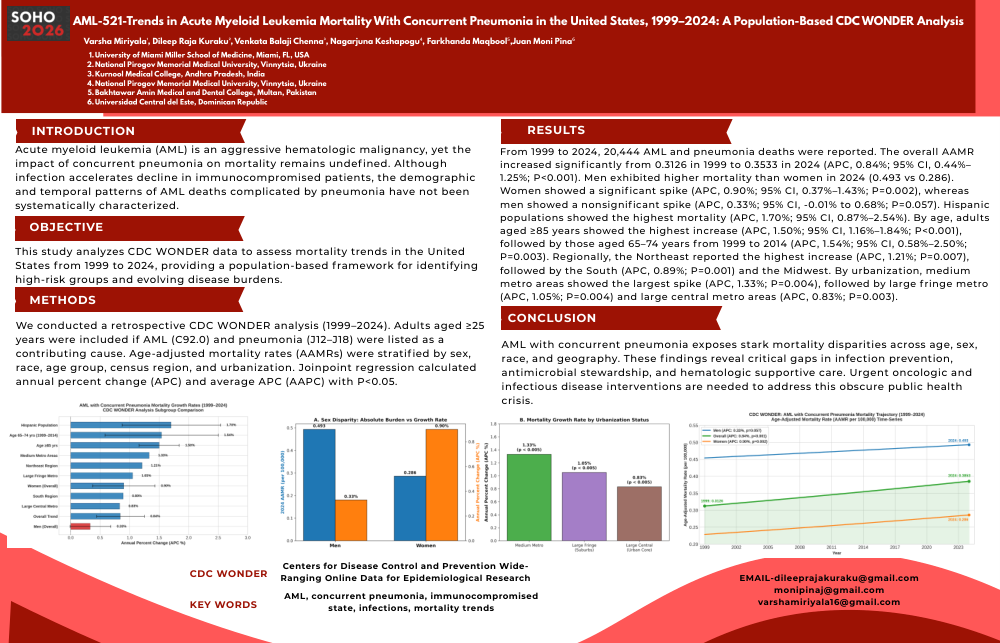
From 1999 to 2024, 20444 AML and pneumonia deaths were reported. The overall AAMR increased significantly from 0.3126 in 1999 to 0.3533 in 2024 (APC, 0.84%; 95% CI, 0.44%–1.25%; P <0.001). Men exhibited higher mortality than women in 2024 (0.493 vs 0.286). Women showed a significant spike (APC, 0.90%; 95% CI, 0.37%–1.43%; P =0.002), whereas men showed a nonsignificant spike (APC, 0.33%; 95% CI, –0.01% to 0.68%; P =0.057). Hispanic populations showed the highest mortality (APC, 1.70%; 95% CI, 0.87%–2.54%). By age, adults aged ≥85 years showed the highest increase (APC, 1.50%; 95% CI, 1.16%–1.84%; P <0.001), followed by those aged 65–74 years from 1999 to 2014 (APC, 1.54%; 95% CI, 0.58%–2.50%; P =0.003). Regionally, the Northeast reported the highest increase (APC, 1.21%; P =0.007), followed by the South (APC, 0.89%; P =0.001) and the Midwest. By urbanization, medium metro areas showed the largest spike (APC, 1.33%; P =0.004), followed by large fringe metro (APC, 1.05%; P =0.004) and large central metro areas (APC, 0.83%; P =0.003).
Conclusion
AML with concurrent pneumonia exposes stark mortality disparities across age, sex, race, and geography. These findings reveal critical gaps in infection prevention, antimicrobial stewardship, and hematologic supportive care. Urgent oncologic and infectious disease interventions are needed to address this obscure public health crisis. CDC WONDER: Centers for Disease Control and Prevention Wide-Ranging Online Data for Epidemiological Research Keywords AML, concurrent pneumonia, immunocompromised state, infections, mortality trend