1,267 posters, 47 videos, 13 topics, 4 sessions, 853 authors
ePostersLive by SciGen Technologies S.A. All rights reserved.
SOHO 2026 Annual Meeting
September 9 - 12, 2026 | George R. Brown Convention Center, Houston, Texas

ALL - 514
Identifying Drivers of Patient-Reported Treatment Burden to Inform Symptom Management in Newly Diagnosed Ph+ ALL: Results from the Phase 3 PhALLCON Study
Poster Presenter
Authors
Part of Topic
Acute Lymphoblastic Leukemia (ALL)
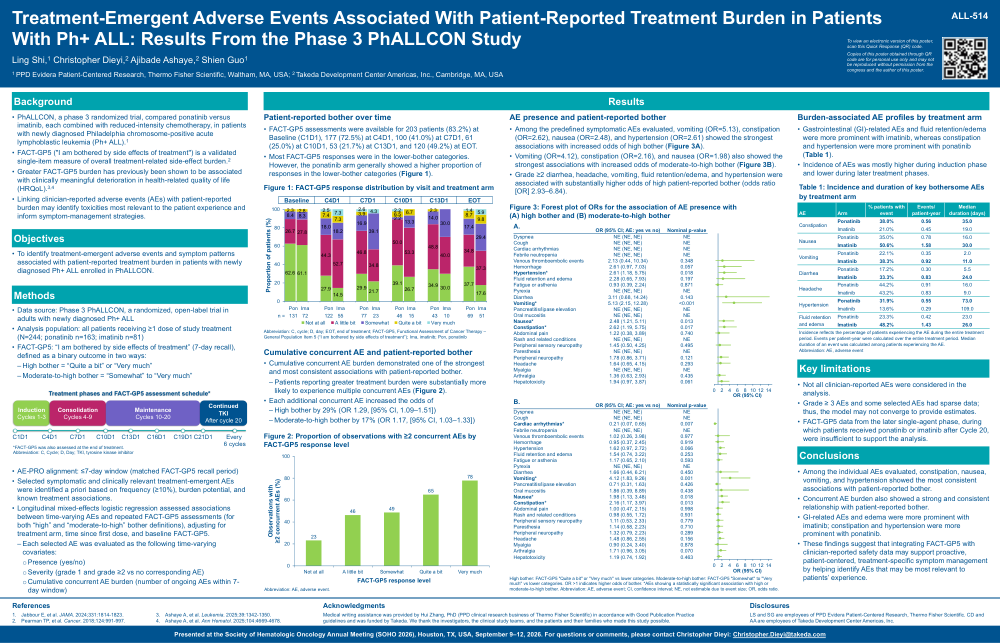
Treatment-Emergent Adverse Events Associated With Patient-Reported Treatment Burden in Patients With Ph+ ALL: Results From the Phase 3 PhALLCON Study
Background
•PhALLCON, a phase 3 randomized trial, compared ponatinib versus imatinib, each combined with reduced-intensity chemotherapy, in patients with newly diagnosed Philadelphia chromosome-positive acute lymphoblastic leukemia (Ph+ ALL).1
•FACT-GP5 ("I am bothered by side effects of treatment") is a validated single-item measure of overall treatment-related side-effect burden.2
•Greater FACT-GP5 burden has previously been shown to be associated with clinically meaningful deterioration in health-related quality of life (HRQoL).3,4
•Linking clinician-reported adverse events (AEs) with patient-reported burden may identify toxicities most relevant to the patient experience and inform symptom-management strategies.
Objectives
To identify treatment-emergent adverse events and symptom patterns associated with patient-reported treatment burden in patients with newly diagnosed Ph+ ALL enrolled in PhALLCON.
Methods
Data source: Phase 3 PhALLCON, a randomized, open-label trial in adults with newly diagnosed Ph+ ALL
Analysis population: all patients receiving ≥1 dose of study treatment (N=244; ponatinib n=163; imatinib n=81)
FACT-GP5: “I am bothered by side effects of treatment” (7-day recall), defined as a binary outcome in two ways:
High bother = “Quite a bit” or “Very much”
Moderate-to-high bother = “Somewhat” to “Very much”
AE-PRO alignment: ≤7-day window (matched FACT-GP5 recall period)
Selected symptomatic and clinically relevant treatment-emergent AEs were identified a priori based on frequency (≥10%), burden potential, and known treatment associations.
Longitudinal mixed-effects logistic regression assessed associations between time-varying AEs and repeated FACT-GP5 assessments (for both “high” and “moderate-to-high” bother definitions), adjusting for treatment arm, time since first dose, and baseline FACT-GP5.
Each selected AE was evaluated as the following time-varying covariates:
oPresence (yes/no)
oSeverity (grade 1 and grade ≥2 vs no corresponding AE)
oCumulative concurrent AE burden (number of ongoing AEs within 7-day window)
Results
Patient-reported bother over time
•FACT-GP5 assessments were available for 203 patients (83.2%) at Baseline (C1D1), 177 (72.5%) at C4D1, 100 (41.0%) at C7D1, 61 (25.0%) at C10D1, 53 (21.7%) at C13D1, and 120 (49.2%) at EOT.
Most FACT-GP5 responses were in the lower-bother categories. However, the ponatinib arm generally showed a higher proportion of responses in the lower-bother categories
Cumulative concurrent AE and patient-reported bother
Cumulative concurrent AE burden demonstrated one of the strongest and most consistent associations with patient-reported bother.
–Patients reporting greater treatment burden were substantially more likely to experience multiple concurrent AEs.
•Each additional concurrent AE increased the odds of
High bother by 29% (OR 1.29, [95% CI, 1.09–1.51])
Moderate-to-high bother by 17% (OR 1.17, [95% CI, 1.03–1.33])
AE presence and patient-reported bother
Among the predefined symptomatic AEs evaluated, vomiting (OR=5.13), constipation (OR=2.62), nausea (OR=2.48), and hypertension (OR=2.61) showed the strongest associations with increased odds of high bother.
Vomiting (OR=4.12), constipation (OR=2.16), and nausea (OR=1.98) also showed the strongest associations with increased odds of moderate-to-high bother.
Grade ≥2 diarrhea, headache, vomiting, fluid retention/edema, and hypertension were associated with substantially higher odds of high patient-reported bother (odds ratio [OR] 2.93–6.84).
Burden-associated AE profiles by treatment arm
Gastrointestinal (GI)-related AEs and fluid retention/edema were more prominent with imatinib, whereas constipation and hypertension were more prominent with ponatinib.
Incidence of AEs was mostly higher during induction phase and lower during later treatment phases.
Key Limitations
Not all clinician-reported AEs were considered in the analysis.
Grade ≥ 3 AEs and some selected AEs had sparse data; thus, the model may not converge to provide estimates.
FACT-GP5 data from the later single-agent phase, during which patients received ponatinib or imatinib after Cycle 20, were insufficient to support the analysis.
Conclusions
Among the individual AEs evaluated, constipation, nausea, vomiting, and hypertension showed the most consistent associations with patient-reported bother.
Concurrent AE burden also showed a strong and consistent relationship with patient-reported bother.
GI-related AEs and edema were more prominent with imatinib; constipation and hypertension were more prominent with ponatinib.
These findings suggest that integrating FACT-GP5 with clinician-reported safety data may support proactive, patient-centered, treatment-specific symptom management by helping identify AEs that may be most relevant to patients’ experience.