1,267 posters, 47 videos, 13 topics, 4 sessions, 853 authors
ePostersLive by SciGen Technologies S.A. All rights reserved.
SOHO 2026 Annual Meeting
September 9 - 12, 2026 | George R. Brown Convention Center, Houston, Texas

CLL - 476
Real-World Comparative Analysis of Treatment Discontinuation (TD) with Covalent Bruton Tyrosine Kinase Inhibitors (cBTKis) in First-Line (1L) Chronic Lymphocytic Leukemia (CLL)
Poster Presenter
Authors
Part of Topic
Chronic Lymphocytic Leukemia (CLL)
Video
Real-World Comparative Analysis of Treatment Discontinuation with Covalent Bruton Tyrosine Kinase Inhibitors in First-Line Chronic Lymphocytic Leukemia (CLL)
Nakhle Saba,1 Erin Mulvey,2 Mei Xue,3 Keri Yang,3 Qianhong Fu,3 Dong Yuan,3 Derrick van Beuge,3 Sikander Ailawadhi4
1Our Lady of the Lake Cancer Institute, Baton Rouge, LA, USA; 2Weill Cornell Medicine, New York, NY, USA; 3BeOne Medicines Ltd, San Carlos, CA, USA; 4Mayo Clinic, Jacksonville, FL, USA
Presented at the Society of Hematologic Oncology (SOHO) Annual Meeting 2026; September 9-12, Houston, TX, USA
Data originally presented at the European Hematology Association (EHA) Congress 2026; June 11-14, Stockholm, Sweden
CORRESPONDENCE: Nakhle Saba, nsaba1@lsuhsc.edu
CONCLUSIONS
• In this real-world study, zanubrutinib demonstrated significantly lower risk of treatment discontinuation and greater treatment persistence than acalabrutinib or ibrutinib in 1L treatment for CLL, especially in patients aged ≥65 years
• While this study provides comparative insights into real‑world treatment discontinuation, additional studies with longer follow-up are needed to better understand the reasons for and consequences of treatment discontinuation in 1L CLL
INTRODUCTION
• Covalent Bruton tyrosine kinase inhibitors (cBTKis) are commonly used first-line (1L) therapies approved in the EU and USA for chronic lymphocytic leukemia (CLL)1,2
• A previous real-world study using the US Flatiron Health database showed that the risk of death in patients with 1L CLL who received zanubrutinib was significantly lower than in those who received ibrutinib and numerically lower than in those who received acalabrutinib3
• Elderly patients (≥65 years) represent nearly 70% of those diagnosed with CLL, but often experience lower treatment rates and poorer outcomes4,5
– Real-world data on treatment patterns with cBTKis remain limited, including in elderly patients
Aim
• This retrospective observational study aimed to evaluate real-world treatment persistence and treatment discontinuation associated with 1L cBTKi use in CLL
METHODS
Data Source and Study Population
• The US IQVIA PharMetrics® closed claims database was used to identify adult patients with ≥2 entries of International Classification of Diseases (ICD) codes for CLL/small lymphocytic leukemia diagnoses (ICD-9-CM, 204.1x, 200.8x; ICD-10-CM, C91.1x, C83.0x) who initiated 1L cBTKi monotherapy (ibrutinib, acalabrutinib, or zanubrutinib) from January 1, 2022, to February 28, 2025
– The index date was the date of initiation of 1L treatment
• Eligible patients had continuous enrollment in health insurance for ≥3 months before the start of each cBTKi treatment and were followed until the end of the study period or loss to follow-up, whichever occurred first
• Patients who participated in clinical trials (ICD Z00.6) during the study period were excluded
Study Design and Statistical Analysis
• Baseline patient characteristics and outcomes were examined by each cBTKi group
• Outcomes included: treatment discontinuation, defined as the time from index date to regimen end date if there was a subsequent therapy, or a gap of ≥120 days between regimen end date and last activity/enrollment date; and treatment persistence, defined as the probability that a patient continues on treatment
• Real-world time to treatment discontinuation (rwTTD) was analyzed using Kaplan-Meier (KM) estimates
• A multivariable Cox proportional hazards model that adjusted for age, sex, race, ethnicity, payer type, geographic region, and Charlson Comorbidity Index (CCI) was used to estimate the hazard ratio (HR) of treatment discontinuation between zanubrutinib and acalabrutinib or ibrutinib
• A subgroup analysis for these outcomes was conducted in elderly patients aged ≥65 years
RESULTS
Patient Demographics and Baseline Characteristics
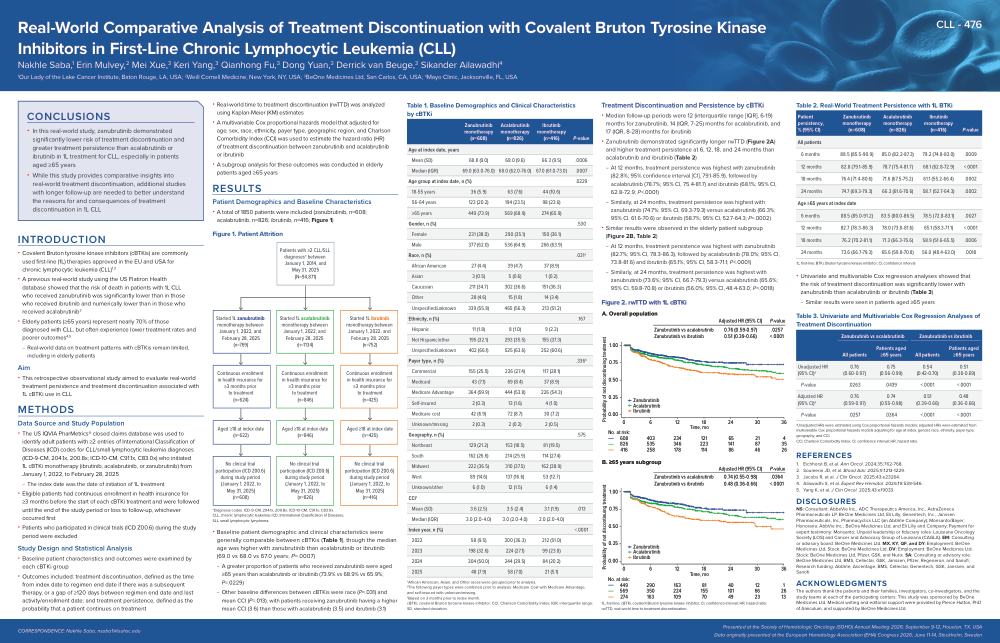
• A total of 1850 patients were included (zanubrutinib, n=608; acalabrutinib, n=826; ibrutinib, n=416; Figure 1)
[Figure 1]
• Baseline patient demographic and clinical characteristics were generally comparable between cBTKis (Table 1), though the median age was higher with zanubrutinib than acalabrutinib or ibrutinib (69.0 vs 68.0 vs 67.0 years; P=.0007)
– A greater proportion of patients who received zanubrutinib were aged ≥65 years than acalabrutinib or ibrutinib (73.9% vs 68.9% vs 65.9%; P=.0229)
– Other baseline differences between cBTKis were race (P=.031) and mean CCI (P=.013), with patients receiving zanubrutinib having a higher mean CCI (3.6) than those with acalabrutinib (3.5) and ibrutinib (3.1)
[Table 1]
Treatment Discontinuation and Persistence by cBTKi
• Median follow-up periods were 12 (interquartile range [IQR], 6-19) months for zanubrutinib, 14 (IQR, 7-25) months for acalabrutinib, and 17 (IQR, 8-28) months for ibrutinib
• Zanubrutinib demonstrated significantly longer rwTTD (Figure 2A) and higher treatment persistence at 6, 12, 18, and 24 months than acalabrutinib and ibrutinib (Table 2)
– At 12 months, treatment persistence was highest with zanubrutinib (82.8%; 95% confidence interval [CI], 79.1-85.9), followed by acalabrutinib (78.7%; 95% CI, 75.4-81.7) and ibrutinib (68.1%; 95% CI, 62.8-72.9; P<.0001)
– Similarly, at 24 months, treatment persistence was highest with zanubrutinib (74.7%; 95% CI, 69.3-79.3) versus acalabrutinib (66.3%; 95% CI, 61.6-70.6) or ibrutinib (58.7%; 95% CI, 52.7-64.3; P=.0002)
• Similar results were observed in the elderly patient subgroup (Figure 2B, Table 2)
– At 12 months, treatment persistence was highest with zanubrutinib (82.7%; 95% CI, 78.3-86.3), followed by acalabrutinib (78.0%; 95% CI, 73.8-81.6) and ibrutinib (65.1%; 95% CI, 58.3-71.1; P<.0001)
– Similarly, at 24 months, treatment persistence was highest with zanubrutinib (73.6%; 95% CI, 66.7-79.3) versus acalabrutinib (65.6%; 95% CI, 59.8-70.8) or ibrutinib (56.0%; 95% CI, 48.4-63.0; P=.0018)
[Figure 2]
[Table 2]
• Univariate and multivariable Cox regression analyses showed that the risk of treatment discontinuation was significantly lower with zanubrutinib than acalabrutinib or ibrutinib (Table 3)
– Similar results were seen in patients aged ≥65 years
[Table 3]
REFERENCES
1. Eichhorst B, et al. Ann Oncol. 2024;35:762-768.
2. Soumerai JD, et al. Blood Adv. 2025;9:1213-1229.
3. Jacobs R, et al. J Clin Oncol. 2025;43:e23264.
4. Ailawadhi S, et al. Expert Rev Hematol. 2026;19:539-546.
5. Yang K, et al. J Clin Oncol. 2025;43:e19033.
DISCLOSURES
NS: Consultant: AbbeVie Inc., ADC Therapeutics America, Inc., AstraZeneca Pharmaceuticals LP, BeOne Medicines Ltd, Eli Lilly, Genentech, Inc., Janssen
Pharmaceuticals, Inc, Pharmacyclics LLC (an AbbVie Company), Monsanto/Bayer; Honoraria: AbbVie Inc., BeOne Medicines Ltd, and Eli Lilly and Company; Payment for expert testimony: Monsanto; Unpaid leadership or fiduciary roles: Louisiana Oncology Society (LOS) and Cancer and Advocacy Group of Louisiana (CAGLA). EM: Consulting or advisory board: BeOne Medicines Ltd. MX, KY, QF, and DY: Employment: BeOne Medicines Ltd; Stock: BeOne Medicines Ltd. DV: Employment: BeOne Medicines Ltd; Stock: BeOne Medicines Ltd, Pfizer, GSK, and Nurix. SA: Consulting or advisory role: BeOne Medicines Ltd, BMS, Cellectar, GSK, Janssen, Pfizer, Regeneron, and Sanofi; Research funding: AbbVie, Ascentage, BMS, Cellectar, Genentech, GSK, Janssen, and Sanofi.
ACKNOWLEDGMENTS
The authors thank the patients and their families, investigators, co-investigators, and the study teams at each of the participating centers. This study was sponsored by BeOne Medicines Ltd. Medical writing and editorial support were provided by Pierce Hutton, PhD of Amiculum, and supported by BeOne Medicines Ltd.