1,267 posters, 47 videos, 13 topics, 4 sessions, 853 authors
ePostersLive by SciGen Technologies S.A. All rights reserved.
SOHO 2026 Annual Meeting
September 9 - 12, 2026 | George R. Brown Convention Center, Houston, Texas

ABCL - 438
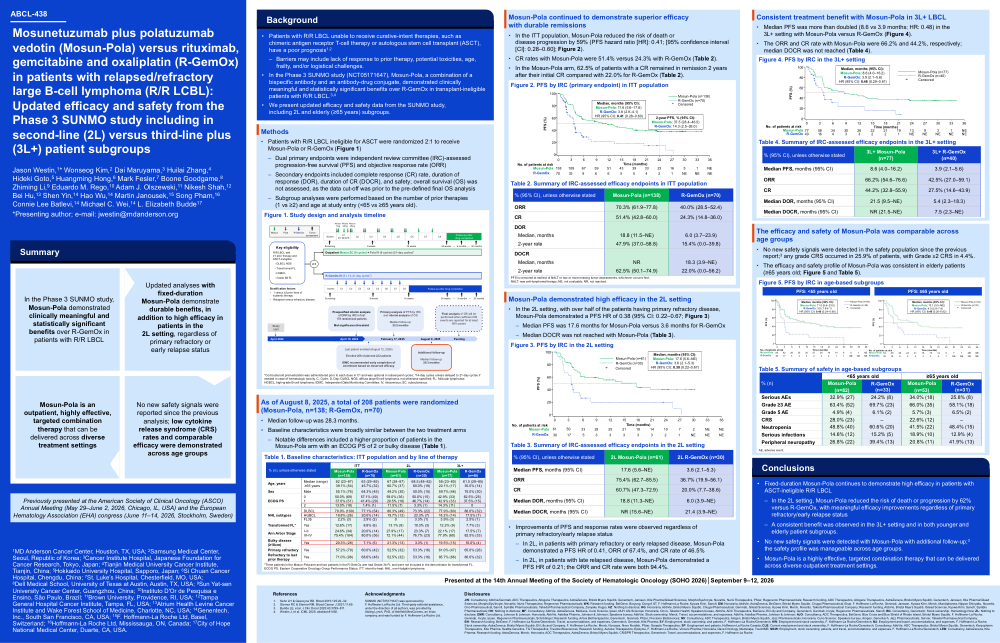
Mosunetuzumab Plus Polatuzumab Vedotin (Mosun-Pola) vs Rituximab, Gemcitabine and Oxaliplatin (R-GemOx) in Patients With Relapsed/Refractory Large B-Cell Lymphoma (R/R LBCL): Updated Efficacy and Safety From the Phase 3 SUNMO Study Including Second-Line (2L) vs Third-Line Plus (3L+) Patient Subgroups
Poster Presenter
Authors
Part of Topic
Aggressive B-Cell Lymphoma (ABCL)
Context: Mosun-Pola demonstrated superior efficacy versus R-GemOx, with infrequent cytokine release syndrome (CRS) events and manageable safety in patients with R/R LBCL in the Phase 3 SUNMO trial (NCT05171647; Budde et al. JCO 2025).
Objective: To report updated efficacy and safety, including in the 2L setting.
Methods: Patients with autologous stem-cell transplant (ASCT)-ineligible R/R LBCL were randomized 2:1 to Mosun (subcutaneous)-Pola or R-GemOx. Dual primary endpoints: IRC-assessed progression-free survival (PFS) and objective response rate (ORR); secondary endpoints: complete response (CR) rate, duration of response (DOR), duration of CR (DOCR), safety. Overall survival (OS) was not assessed as the data cut-off was prior to the pre-defined final OS analysis.
Results: As of August 8, 2025, 138 and 70 patients were assigned to Mosun-Pola or R-GemOx, respectively. Ninety-one patients had 1 prior line of therapy (LOT; 2L; Mosun-Pola, n=61; R-GemOx, n=30) and 117 had ≥2 prior LOT (3L+; Mosun-Pola, n=77; R-GemOx, n=40). With a median follow-up of 28.3 months, Mosun-Pola continued to demonstrate superior PFS benefits over R-GemOx (11.6 versus 3.8 months; HR, 0.41; 95% CI: 0.28–0.60). ORRs with Mosun-Pola were 70.3% versus 40.0% with R-GemOx; CR rates were 51.4% versus 24.3%, respectively. The observed PFS benefit of Mosun-Pola over R-GemOx was similar in 2L (17.6 versus 3.6 months; HR, 0.38; 95% CI: 0.22–0.67) and 3L+ (8.6 versus 3.9 months; HR, 0.48; 95% CI: 0.29–0.81) subgroups. With Mosun-Pola versus R-GemOx in 2L, the 2-year PFS rates were 40.3% versus 20.1%; the 2-year DOCR estimates were 60.8% versus 37.5%, respectively. Median DOCR was not reached with Mosun-Pola in the 2L and 3L+ subgroups. ORRs with Mosun-Pola versus R-GemOx were 75.4% versus 36.7% in 2L patients, and 66.2% versus 42.5% in 3L+ patients, respectively. The safety profile was unchanged since the primary analysis. Grade ≥2 CRS occurred in 4% of Mosun-Pola-treated patients and no ICANS events occurred. The safety profile was consistent in 2L patients: Grade 2 CRS occurred in 3% of Mosun-Pola-treated patients, with no Grade ≥3 CRS events.
Conclusions: Mosun-Pola continues to show notable efficacy with manageable safety in patients with ASCT-ineligible R/R LBCL, particularly in the 2L setting.