1,267 posters, 47 videos, 13 topics, 4 sessions, 853 authors
ePostersLive by SciGen Technologies S.A. All rights reserved.
SOHO 2026 Annual Meeting
September 9 - 12, 2026 | George R. Brown Convention Center, Houston, Texas

MPN - 425
Baseline Predictors of Survival and Spleen Response in Ruxolitinib-Treated Myelofibrosis: Development of the Ruxolitinib Prognostic Scoring System in a Real-World Cohort
Poster Presenter
Authors
Part of Topic
Myeloproliferative Neoplasms (MPN)
Baseline Predictors of Survival and Spleen Response in Ruxolitinib-Treated Myelofibrosis: Development of the Ruxolitinib Prognostic Scoring System in a Real-World Cohort
A. LAGANÀ¹, E. SCALZULLI¹, M.L. BISEGNA¹, I. CARMOSINO¹, D. KASMI¹, M. GHERARDINI¹, A.L. FACCINI¹, C. ANDRIOLA¹, M. MARTELLI¹ and M. BRECCIA¹
1. Department of Translational and Precision Medicine, Hematology, Policlinico Umberto I–Sapienza University, Rome, Italy
INTRODUCTION: In Myelofibrosis (MF), conventional prognostic scores are primarily designed for risk stratification at diagnosis and are not designed for patients undergoing ruxolitinib (RUX) therapy. Currently, there is a lack of baseline tools specifically tailored to predict outcomes upon JAK-inhibitor (JAKi) initiation, as the RR6 score provides post-6-month-treatment guidance.
AIMS: To evaluate the rate of IWG-MRT defined-spleen response (SR) and overall survival (OS) in a real-life RUX-treated MF cohort. To identify baseline clinical predictors of OS. To develop an easily and broadly applicable clinical prognostic model at RUX initiation.
METHODS: We analyzed a single-center cohort of 235 JAKi naïve RUX-treated MF patients. Eligibility to RUX treatment was based on national guidelines and reimbursement policies: diagnosis of PMF or SMF; DIPSS ≥int-1; palpable spleen ≥5 cm below LCM; PLTs count ≥50×109/L. SR was assessed by physical examination as per clinical practice. For survival analysis patients undergoing allo-HSCT were censored at transplant date. Multivariate Cox proportional hazard was used to identify independent predictors. Model performance was assessed using C-index, AIC, and reclassification metrics (NRI/IDI).
RESULTS: Median age at RUX-start was 65.9 years (IQR, 56.3–73.6), with 124 males (52.8%). PMF accounted for 109 (46.4%) cases, SMF for 126 (53.6%), with 37 (15.7%) cases of early-MF. After a median follow-up of 66.5 months, the overall SR rate was 49.8%, with 93 deaths (39.6%) and an estimated median OS of 82.5 months of the whole cohort.
Multivariate analysis, identified the following baseline factors as independent predictors of shortened OS:
•Age ≥68 years - HR 2.94 (95%CI, 1.76–4.91)
•BM Fibrosis Grade III - HR 2.41 (95%CI, 1.48–3.94)
•Gender-Adjusted Anemia (M<11 g/dL, F<10 g/dL) - HR 2.41 (95%CI, 1.46–3.96)
•PLTs < 150×109/L - HR 2.27 (95%CI, 1.39–3.73)
•PB Blasts: 1–2% - HR 2.23 (95%CI, 1.35–3.69) & ≥3% - HR 4.05 (95%CI, 2.17–7.58)
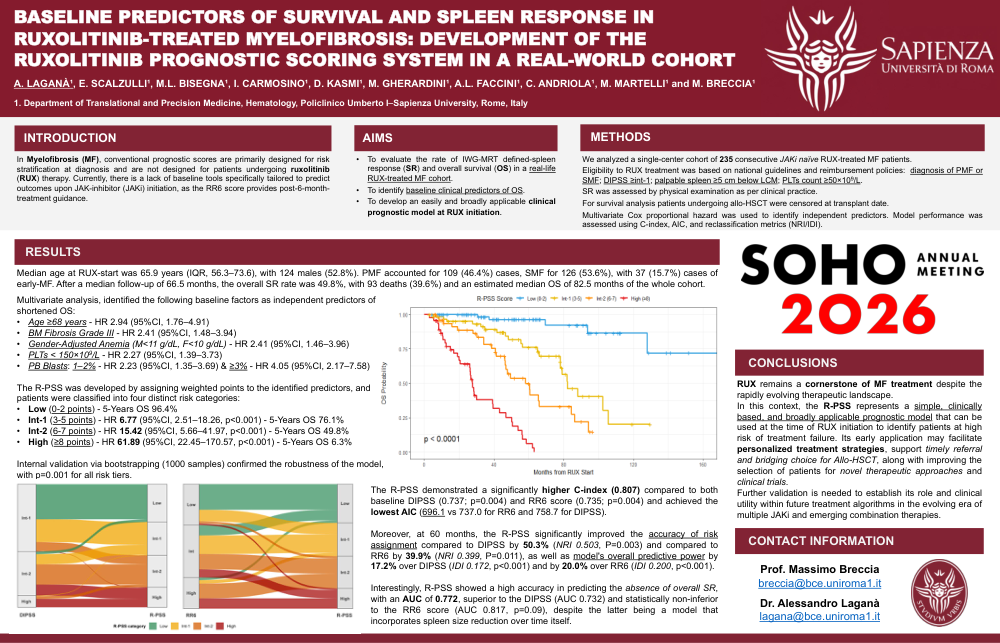
The R-PSS was developed by assigning weighted points to the identified predictors, and patients were classified into four distinct risk categories:
•Low (0-2 points) - 5-Years OS 96.4%
•Int-1 (3-5 points) - HR 6.77 (95%CI, 2.51–18.26, p<0.001) - 5-Years OS 76.1%
•Int-2 (6-7 points) - HR 15.42 (95%CI, 5.66–41.97, p<0.001) - 5-Years OS 49.8%
•High (≥8 points) - HR 61.89 (95%CI, 22.45–170.57, p<0.001) - 5-Years OS 6.3%
Internal validation via bootstrapping (1000 samples) confirmed the robustness of the model, with p=0.001 for all risk tiers.
The R-PSS demonstrated a significantly higher C-index (0.807) compared to both baseline DIPSS (0.737; p=0.004) and RR6 score (0.735; p=0.004) and achieved the lowest AIC (696.1 vs 737.0 for RR6 and 758.7 for DIPSS). Moreover, at 60 months, the R-PSS significantly improved the accuracy of risk assignment compared to DIPSS by 50.3% (NRI 0.503, P=0.003) and compared to RR6 by 39.9% (NRI 0.399, P=0.011), as well as model's overall predictive power by 17.2% over DIPSS (IDI 0.172, p<0.001) and by 20.0% over RR6 (IDI 0.200, p<0.001). Interestingly, R-PSS showed a high accuracy in predicting the absence of overall SR, with an AUC of 0.772, superior to the DIPSS (AUC 0.732) and statistically non-inferior to the RR6 score (AUC 0.817, p=0.09), despite the latter being a model that incorporates spleen size reduction over time itself.
CONCLUSIONS: RUX remains a cornerstone of MF treatment despite the rapidly evolving therapeutic landscape. In this context, the R-PSS represents a simple, clinically based, and broadly applicable prognostic model that can be used at the time of RUX initiation to identify patients at high risk of treatment failure. Its early application may facilitate personalized treatment strategies, support timely referral and bridging choice for Allo-HSCT, along with improving the selection of patients for novel therapeutic approaches and clinical trials. Further validation is needed to establish its role and clinical utility within future treatment algorithms in the evolving era of multiple JAKi and emerging combination therapies.