1,267 posters, 47 videos, 13 topics, 4 sessions, 853 authors
ePostersLive by SciGen Technologies S.A. All rights reserved.
SOHO 2026 Annual Meeting
September 9 - 12, 2026 | George R. Brown Convention Center, Houston, Texas

MCL - 332
Trends in Non-Hodgkin Lymphoma Mortality With Concurrent Septicemia in the United States, 1999-2025: A Population-Based CDC WONDER Analysis
Poster Presenter
Authors
Part of Topic
Mantle Cell Lymphoma (MCL)
MCL-332 · Publication and Poster presentation Trends in Non-Hodgkin Lymphoma Mortality With Concurrent Septicemia in the United States, 1999–2025: A Population-Based CDC WONDER Analysis
Introduction
Non-Hodgkin lymphoma (NHL) is a leading cause of hematologic malignancy death, yet the impact of concur rent septicemia on mortality remains undefined. Although sepsis accelerates decline in immunocompromised patients, the demographic and temporal patterns of NHL deaths complicated by septicemia have not been systematically characterized.
Objective
This study analyzed CDC WONDER data to assess mortality trends in the United States from 1999 to 2025, providing a population-based framework to identify high-risk groups and evolving disease burdens.
Methods
We conducted a retrospective CDC WONDER analysis (1999–2025). Adults aged ≥25 years were included if NHL (G82–G83) and septicemia (A40–A41) were listed as contributing causes. Adults aged 25 years were included if age-adjusted mortality rates (AAMR) were stratified by sex, race, census region, and urbanization. Joinpoint regression calculated annual percent change (APC) and average annual percent change (AAPC) with P <0.05.
Results
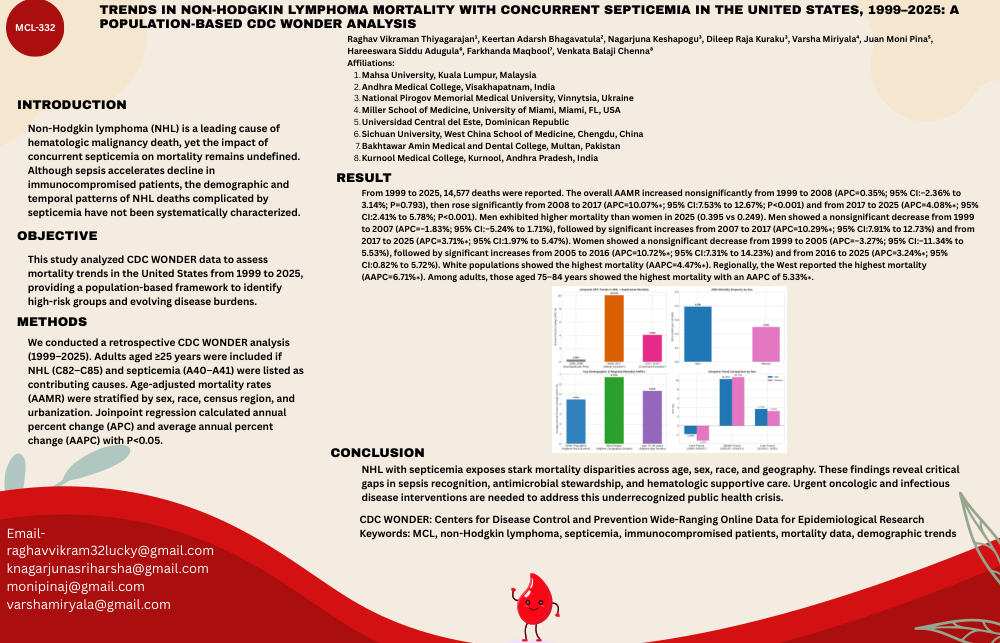
From 1999 to 2025, 14577 deaths were reported. The overall AAMR increased nonsignificantly from 1999 to 2008 (APC, 0.35; 95% CI, −2.36 to 3.14; P =0.793), then rose significantly from 2008 to 2017 (APC, 10.07*; 95% CI, 7.53–12.67; P <0.001) and from 2017 to 2025 (APC, 4.08*; 95% CI, 2.41–5.78; P <0.001). Men exhibited higher mortality than women in 2025 (0.395 vs 0.249). Men showed a nonsignificant decrease from 1999 to 2007 (APC, −1.83; 95% CI, −5.24 to 1.71), followed by significant increases from 2007 to 2017 (APC, 10.29*; 95% CI, 7.91 12.73) and from 2017 to 2025 (APC, 3.71*; 95% CI, 1.97–5.47). Women showed a nonsignificant decrease from 1999 to 2005 (APC, −3.27; 95% CI, −11.34 to 5.53), followed by significant increases from 2005 to 2016 (APC, 10.72*; 95% CI, 7.31–14.23) and from 2016 to 2025 (APC, 3.24*; 95% CI, 0.82–5.72). White populations showed the highest mortality (AAPC, 4.47*). Regionally, the West reported the highest mortality (AAPC, 6.71*). Among adults, those aged 75–84 years showed the highest mortality with an AAPC of 5.33*.
Conclusion NHL with septicemia exposes stark mortality disparities across age, sex, race, and geography. These findings reveal critical gaps in sepsis recognition, antimicrobial stewardship, and hematologic supportive care. Urgent oncologic and infectious disease interventions are needed to address this underrecognized public health crisis. CDC WONDER: Centers for Disease Control and Prevention Wide-Ranging Online Data for Epidemiological Research Keywords MCL, non-Hodgkin lymphoma, septicemia, immunocompromised patients, mortality data, demographic trend