1,267 posters, 47 videos, 13 topics, 4 sessions, 853 authors
ePostersLive by SciGen Technologies S.A. All rights reserved.
SOHO 2026 Annual Meeting
September 9 - 12, 2026 | George R. Brown Convention Center, Houston, Texas

IBCL - 290
Light Chain Amyloidosis in Waldenstrφm Macroglobulinemia/Lymphoplasmacytic Lymphoma: Treatment Strategies and Outcomes of 74 Cases
Poster Presenter
Authors
Part of Topic
Indolent B-Cell Lymphoma (IBCL)
Light Chain Amyloidosis in Waldenstrom Macroglobulinemia/Lymphoplasmacytic Lymphoma: Treatment Strategies and Outcomes of 74 Cases.
INTRODUCTION
Light chain (AL) amyloidosis occurs in only 3-7% of patients with Waldenström macroglobulinemia (WM) and is characterized by severe organ dysfunction and poor prognosis.1
Given its rarity, large cohorts descriptions and front-line treatments comparisons are limited.
AIMS
• To characterize baseline LPL-related amyloidosis features and assess their prognostic significance
• To evaluate the efficacy of frontline treatment strategies in terms of serum IgM, sFLC, and organ • responses •
• To describe the impact of Major sFCL/ IgM response on PFS and OS outcomes
METHODS
• Cases of AL/AHL LPL-related referred to DFCI between 2003-2025 were identified and features described at baseline
• AL/AHL diagnosis was made using Congo-red positivity and then confirmed by typing.
• The impact of features on PFS/OS was established with Cox-regression UVA and MVA
• Frontline regimens were grouped into CI (chemoimmunotherapy-based), PI (proteasome inhibitor-based), CI+PI (combined)
• A 6-month landmark analysis from frontline therapy was performed to evalute the impact of Major sFLC/IgM on PFS and OS
RESULTS
WM cases (n=72) and non-IgM LPL (n=2) with concurrent AL/AHL amyloidosis were included.
The majority (78%) presented with Mayo 2012 stage I, II disease and only 20% received ASCT consolidation after frontline. Other baseline features are described on Table 1.
Cardiac involvement was an independent predictor of both inferior PFS (HR 3.91) and OS (HR 3.28) while elevated creatinine serum level predicted inferior OS (HR. 2.19).
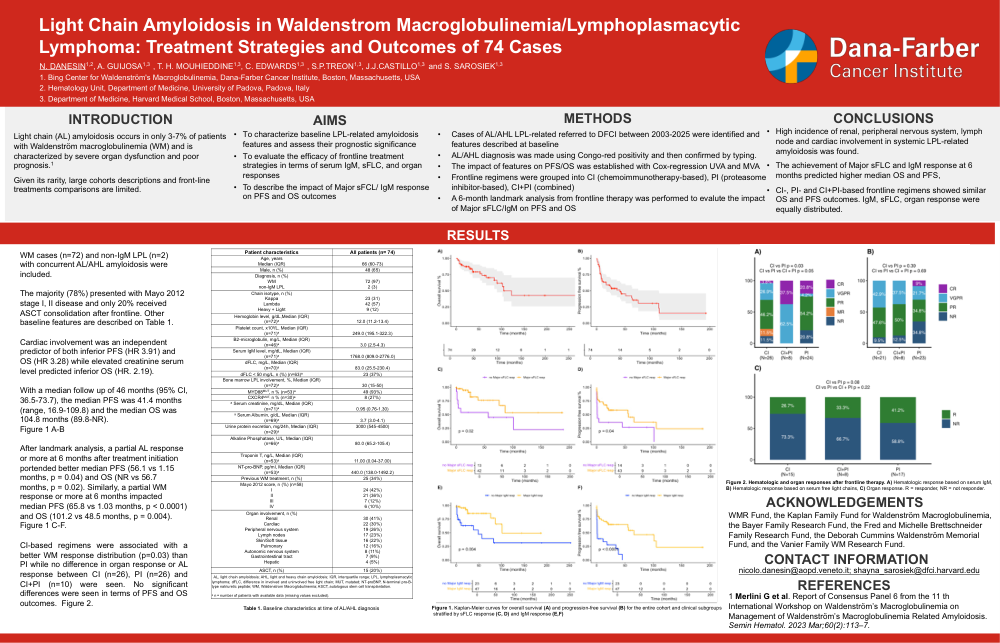
With a median follow up of 46 months (95% CI, 36.5-73.7), the median PFS was 41.4 months (range, 16.9-109.8) and the median OS was 104.8 months (89.8-NR).
Figure 1 A-B
After landmark analysis, a partial AL response or more at 6 months after treatment initiation
portended better median PFS (56.1 vs 1.15 months, p = 0.04) and OS (NR vs 56.7 months, p = 0.02). Similarly, a partial WM response or more at 6 months impacted median PFS (65.8 vs 1.03 months, p < 0.0001) and OS (101.2 vs 48.5 months, p = 0.004). Figure 1 C-F.
CI-based regimens were associated with a better WM response distribution (p=0.03) than
PI while no difference in organ response or AL response between CI (n=26), PI (n=26) and CI+PI (n=10) were seen. No significant differences were seen in terms of PFS and OS outcomes. Figure 2
CONCLUSIONS
• High incidence of renal, peripheral nervous system, lymph node and cardiac involvement in systemic LPL-related amyloidosis was found.
• The achievement of Major sFLC and IgM response at 6 months predicted higher median OS and PFS,
• CI-, PI- and CI+PI-based frontline regimens showed similar OS and PFS outcomes. IgM, sFLC, organ response were equally distributed.