1,267 posters, 47 videos, 13 topics, 4 sessions, 853 authors
ePostersLive by SciGen Technologies S.A. All rights reserved.
SOHO 2026 Annual Meeting
September 9 - 12, 2026 | George R. Brown Convention Center, Houston, Texas

ABCL - 286
Real-World Outcomes of Diffuse Large B-Cell Lymphoma: A 7-Year Retrospective Cohort Study from a Tertiary Care Center in a Low- and Middle-Income Country
Poster Presenter
Authors
Part of Topic
Aggressive B-Cell Lymphoma (ABCL)
Title: Real-World Outcomes of Diffuse Large B-Cell Lymphoma: A 7-Year Retrospective Cohort Study from a Tertiary Care Center in a Low- and Middle-Income Country
Authors: Shahzeb Ahmed¹, Zaratul Ain¹, Faisal Qayum¹, Beenish Aqib¹, Abdul Moeez¹, Sohana Shamim¹, Andleeb Atif¹, Hannan Aslam¹, Bushra Ahsan¹, Usman Ahmad¹, Syed Waqas Bokhari¹
Affiliations: ¹Dept. of Medical Oncology, Shaukat Khanum Memorial Cancer Hospital and Research Centre, Lahore, Pakistan
Introduction: DLBCL is the most common non-Hodgkin lymphoma (NHL) subtype, comprising 30–40% of all NHL cases worldwide(2,3). In Pakistan, NHL ranks as the 7th most common malignancy, accounting for 3.9% of new cancer diagnoses(1); a Pakistani cross-sectional study similarly reported DLBCL comprising 69% of NHL cases(27). DLBCL carries a reported 5-year survival of 60–70%(5). Diagnosing and managing DLBCL in a resource-limited setting like Pakistan poses unique challenges that may adversely affect outcomes in this potentially curable disease(10).
Aim: To report the presentation, treatment patterns, and outcomes of adult DLBCL patients treated over a 7-year period at a single tertiary cancer center in a low- and middle-income country.
Methods: Retrospective cohort study at SKMCH&RC, Lahore. Adults (≥18y) with confirmed DLBCL, January 2015–December 2021. Response assessed per Lugano classification(26). First-line therapy: CHOP-based chemotherapy ± rituximab; DA-EPOCH-R for double-hit lymphoma. Salvage: ICE or GDP ± rituximab, followed by ASCT if eligible. PFS/OS estimated by Kaplan–Meier method; multivariable Cox regression for independent prognostic factors.
At a Glance: 964 patients. Median age 34 years. Overall CR rate 68.5%. 5-year OS 76.4%. 5-year PFS 67.2%. Overall mortality 22.4%.
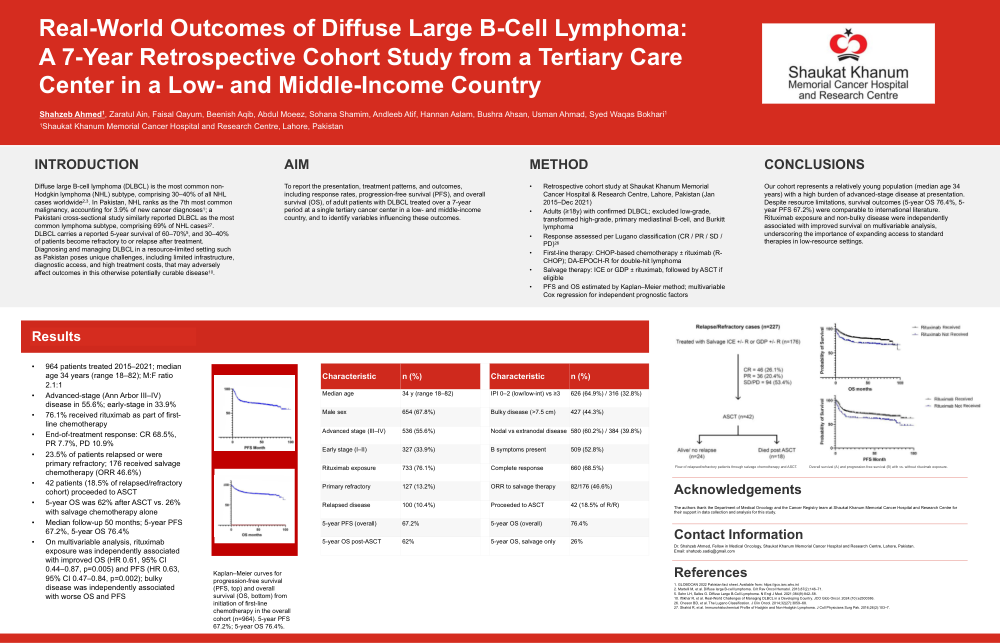
Results — Patient Characteristics: Median age 34 years (range 18–82). M:F ratio 2.1:1. Advanced-stage (III–IV) disease in 55.6%; early-stage in 33.9%; stage not recorded in 10.5%. Low/low-intermediate-risk IPI (0–2) in 64.9%. Bulky disease (>7.5cm) in 44.3%. B symptoms present in 52.8%. Nodal 60.2% / extranodal 39.8%.
Results — Treatment & Response: Rituximab received as part of first-line chemotherapy in 76.1%. CHOP-based chemotherapy ± rituximab in 90.5%. End-of-treatment response: CR 68.5%, PR 7.7%, SD 0.5%, PD 10.9%, not assessed 12.4%.
Results — Relapse, Salvage & ASCT: 23.5% relapsed or were primary refractory (127 primary refractory, 100 relapsed). 176 received salvage chemotherapy (ORR 46.6%). 42 patients (18.5% of relapsed/refractory cohort) proceeded to ASCT. 5-year OS: 62% post-ASCT vs. 26% with salvage chemotherapy alone.
Results — Mortality & Survival: 216 deaths (22.4%); 75% attributable to disease progression. Median follow-up 50 months. 5-year PFS 67.2%; 5-year OS 76.4%.
Results — Multivariable Predictors: Rituximab exposure independently associated with improved OS (HR 0.61, 95% CI 0.44–0.87, p=0.005) and PFS (HR 0.63, 95% CI 0.47–0.84, p=0.002). Bulky disease independently associated with worse OS and PFS.
Conclusion: Our cohort represents a relatively young population with a high burden of advanced-stage disease at presentation. Despite resource limitations, survival outcomes were comparable to international literature. Rituximab exposure and non-bulky disease were independently associated with improved survival, underscoring the importance of expanding access to standard therapies in low-resource settings.
Acknowledgements: We thank the Department of Medical Oncology and the Cancer Registry team at Shaukat Khanum Memorial Cancer Hospital and Research Centre for their support in data collection and analysis for this study.
Contact: Dr. Shahzeb Ahmed, Fellow in Medical Oncology, Shaukat Khanum Memorial Cancer Hospital and Research Centre, Lahore, Pakistan. Email: shahzeb.sadiq@gmail.com
References:
- GLOBOCAN 2022 Pakistan fact sheet. Available from: https://gco.iarc.who.int
- Martelli M, et al. Diffuse large B-cell lymphoma. Crit Rev Oncol Hematol. 2013;87(2):146–71.
- Global Burden of Disease 2019 Cancer Collaboration. Cancer Incidence, Mortality, Years of Life Lost, Years Lived With Disability, and Disability-Adjusted Life Years for 29 Cancer Groups From 2010 to 2019. JAMA Oncol. 2022;8(3):420–44.
- Sehn LH, Salles G. Diffuse Large B-Cell Lymphoma. N Engl J Med. 2021;384(9):842–58.
- Iftikhar R, et al. Real-World Challenges of Managing DLBCL in a Developing Country. JCO Glob Oncol. 2024;(10):e2300386.
- Cheson BD, et al. The Lugano Classification. J Clin Oncol. 2014;32(27):3059–68.
- Shahid R, et al. Immunohistochemical Profile of Hodgkin and Non-Hodgkin Lymphoma. J Coll Physicians Surg Pak. 2016;26(2):103–7.