1,267 posters, 47 videos, 13 topics, 4 sessions, 853 authors
ePostersLive by SciGen Technologies S.A. All rights reserved.
SOHO 2026 Annual Meeting
September 9 - 12, 2026 | George R. Brown Convention Center, Houston, Texas

TCL - 255
Characteristics of Mycosis Fungoides: A Cohort Analysis From a Real-World Single Oncology Center
Poster Presenter
Authors
Part of Topic
T-Cell Lymphoma (TCL)
Characteristics of Mycosis Fungoides: A Cohort Analysis from a Real-world Single Oncology Center
A. Ibrahim1, M. Atef2 , E. Jamal3, Y. Shaaban3
1. Clinical Pathology and Blood transfusion Specialist, Mansoura University Student Hospital, Faculty of Medicine, Mansoura University, Mansoura, Egypt
2. Clinical Hematology and Bone Marrow Transplant Specialist, Air Force specialized Hospital, Cairo, Egypt
3. Clinical Hematology, Oncology Center, Mansoura University (OCMU), Faculty of Medicine, Mansoura, Egypt.
INTRODUCTION
Mycosis fungoides and Sézary syndrome are the most common cutaneous T-cell lymphomas. Diagnosis is complex and depends on clinicopathological correlation and skin biopsy. Management is usually stage-adapted. The subtlety of the initial clinical appearance of MF can result in diagnostic delays.
AIM
This is a retrospective, single‑center study analyzing MF patients that aims to describe clinical characteristics and outcomes of MF cohort.
METHOD
In this cohort of 40 MF patients, 31 (77.5%) patients were referred from Dermatology Department in Mansoura University to Oncology Center Mansoura University, Mansoura, Egypt. This represents real-world multidisciplinary care.
Given the retrospective nature of the study, no intervention was performed.
RESULTS
DEMOGEAPHIC DATA
- The median age was 48.2 years (range, 20–78), with a male predominance (52.5%), ECOG performance status clustered around ≥2 (80%), reflecting moderate functional impairment.
- Skin manifestations were first discovered between 1996–2024, with diagnoses confirmed between 2006–2023 and estimated median time to diagnosis of 14.17 months; follow-up extended to February 2025. At the end of study, 38 patients were alive.
CLINICAL AND LABORATORY PROFILE
- Hematologic parameters were collected, showing that lymphocytosis (>4 ×10⁹/L) occurred in 15%, and anemia (<12 g/dL) in 17.5%.
- LDH was elevated in several patients, with one extreme outlier (1600 IU/L).
- All patients had diverse skin involvement.
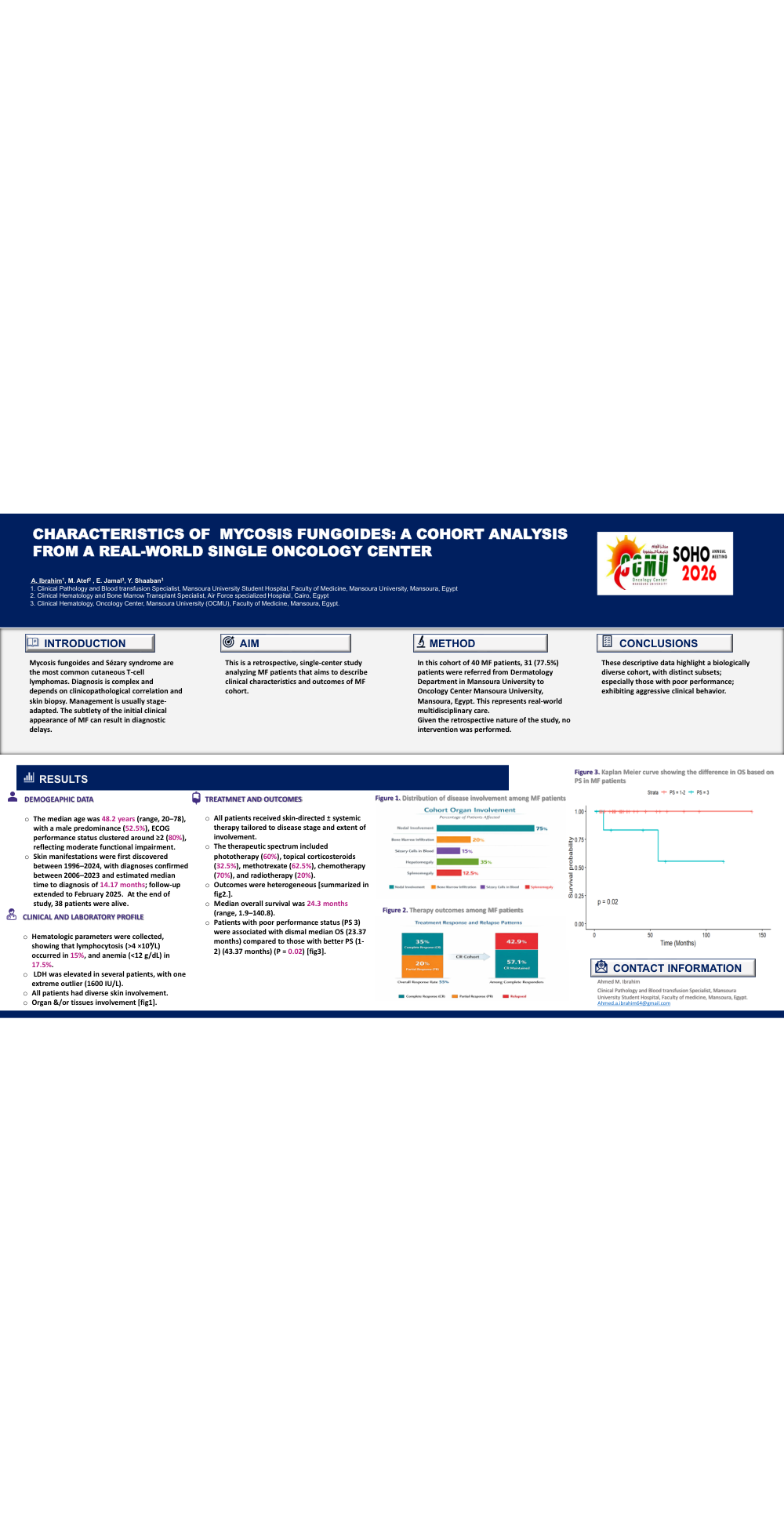
- Organs &/or tissue involvement are illustrated in fig1.
TREATMNET AND OUTCOMES
- All patients received skin‑directed ± systemic therapy tailored to disease stage and extent of involvement.
- The therapeutic spectrum included phototherapy (60%), topical corticosteroids (32.5%), methotrexate (62.5%), chemotherapy (70%), and radiotherapy (20%).
- Outcomes were heterogeneous [summarized in fig2.].
- Median overall survival was 24.3 months (range, 1.9–140.8).
- Patients with poor performance status (PS 3) were associated with dismal median OS (23.37 months) compared to those with better PS (1-2) (43.37 months) (P = 0.02) [fig3].
CONCLUSION
These descriptive data highlight a biologically diverse cohort, with distinct subsets; especially those with poor performance; exhibiting aggressive clinical behavior.