1,267 posters, 47 videos, 13 topics, 4 sessions, 853 authors
ePostersLive by SciGen Technologies S.A. All rights reserved.
SOHO 2026 Annual Meeting
September 9 - 12, 2026 | George R. Brown Convention Center, Houston, Texas

MPN - 237
Selinexor Alone and in Combination With JAK Inhibitors Suppresses Pro-Inflammatory Cytokine Secretion From Primary Myelofibrosis Cells Ex Vivo
Poster Presenter
Authors
Part of Topic
Myeloproliferative Neoplasms (MPN)
Selinexor alone and in combination with JAK inhibitors suppresses pro-inflammatory cytokine secretion from primary myelofibrosis cells ex vivo
INTRODUCTION: Selinexor is an oral selective inhibitor of the nuclear export protein exportin 1 (XPO1)1
• In combination with ruxolitinib, selinexor has shown rapid and sustained spleen and symptom responses, including potential of disease modification through reduction in driver gene variant allele frequency, and proinflammatory cytokine levels2
• MF is characterized by elevated levels of proinflammatory cytokines, which correlate with disease severity3,4
– Many of these cytokines, including IL-6 and TNFα, are transcriptionally regulated by NF-κB5 and activate the JAK/STAT signaling pathway
• Selinexor inhibits NF-κB activity by preventing nuclear export of its inhibitor IκBα6
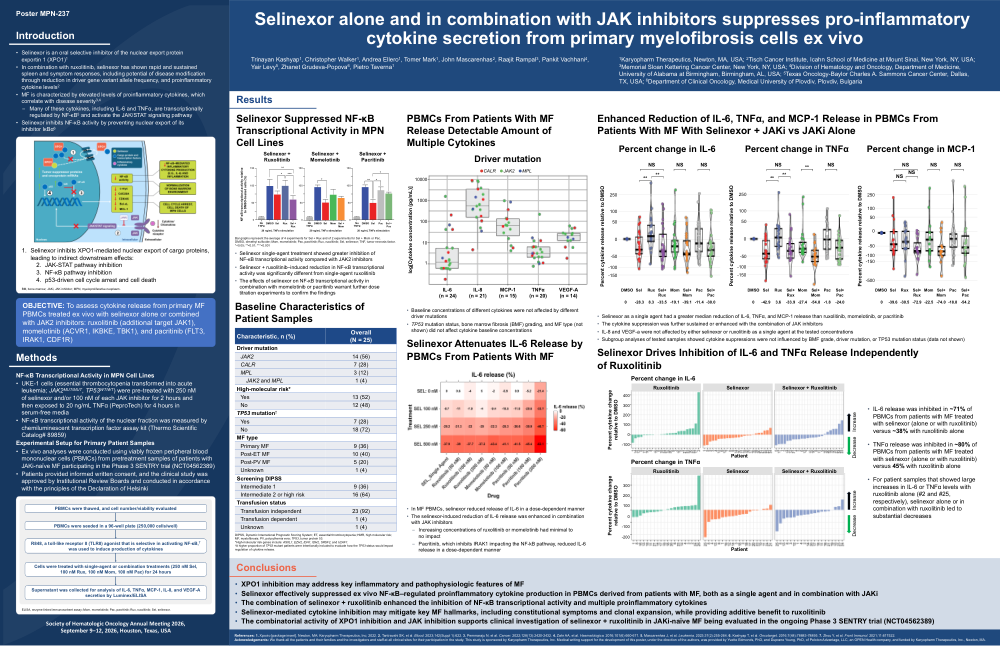
OBJECTIVE: To assess cytokine release from primary MF PBMCs treated ex vivo with selinexor alone or combined with JAK2 inhibitors: ruxolitinib (additional target JAK1), momelotinib (ACVR1, IKBKE, TBK1), and pacritinib (FLT3, IRAK1, CDF1R).
METHODS: NF-κB Transcriptional Activity in MPN Cell Lines
• UKE-1 cells (essential thrombocytopenia transformed into acute leukemia; JAK2MUT/MUT, TP53WT/WT) were pre-treated with 250 nM of selinexor and/or 100 nM of each JAK inhibitor for 2 hours and then exposed to 20 ng/mL TNFα (PeproTech) for 4 hours in serum-free media
• NF-κB transcriptional activity of the nuclear fraction was measured by chemiluminescent transcription factor assay kit (Thermo Scientific Catalog# 89859)
Experimental Setup for Primary Patient Samples
• Ex vivo analyses were conducted using viably frozen peripheral blood mononuclear cells (PBMCs) from pretreatment samples of patients with JAKi-naïve MF participating in the Phase 3 SENTRY trial (NCT04562389)
• Patients provided informed written consent, and the clinical study was approved by Institutional Review Boards and conducted in accordance with the principles of the Declaration of Helsinki
RESULTS: Selinexor single-agent treatment showed greater inhibition of NF-κB transcriptional activity compared with JAK2 inhibitors
• Selinexor + ruxolitinib–induced reduction in NF-κB transcriptional activity was significantly different from single-agent ruxolitinib
• The effects of selinexor on NF-κB transcriptional activity incombination with momelotinib or pacritinib warrant further dose titration experiments to confirm the findings
Baseline concentrations of different cytokines were not affected by different driver mutations
• TP53 mutation status, bone marrow fibrosis (BMF) grading, and MF type (not shown) did not affect cytokine baseline concentrations
• In MF PBMCs, selinexor reduced release of IL-6 in a dose-dependent manner
• The selinexor-induced reduction of IL-6 release was enhanced in combination
with JAK inhibitors– Increasing concentrations of ruxolitinib or momelotinib had minimal to no impact
– Pacritinib, which inhibits IRAK1 impacting the NF-kB pathway, reduced IL-6 release in a dose-dependent manner
• Selinexor as a single agent had a greater median reduction of IL-6, TNFα, and MCP-1 release than ruxolitinib, momelotinib, or pacritinib
• The cytokine suppression was further sustained or enhanced with the combination of JAK inhibitors
• IL-8 and VEGF-a were not affected by either selinexor or ruxolitinib as a single agent at the tested concentrations
• Subgroup analyses of tested samples showed cytokine suppressions were not influenced by BMF grade, driver mutation, or TP53 mutation status (data not shown)
• IL-6 release was inhibited in ~71% of PBMCs from patients with MF treated with selinexor (alone or with ruxolitinib) versus ~38% with ruxolitinib alone
• TNFα release was inhibited in ~80% of PBMCs from patients with MF treated with selinexor (alone or with ruxolitinib) versus 45% with ruxolitinib alone
• For patient samples that showed large increases in IL-6 or TNFα levels with ruxolitinib alone (#2 and #25, respectively), selinexor alone or in combination with ruxolitinib led to substantial decreases
CONCLUSIONS: XPO1 inhibition may address key inflammatory and pathophysiologic features of MF
• Selinexor effectively suppressed ex vivo NF-κB–regulated proinflammatory cytokine production in PBMCs derived from patients with MF, both as a single agent and in combination with JAKi
• The combination of selinexor + ruxolitinib enhanced the inhibition of NF-κB transcriptional activity and multiple proinflammatory cytokines
• Selinexor-mediated cytokine inhibition may mitigate key MF hallmarks, including constitutional symptoms and clonal expansion, while providing additive benefit to ruxolitinib
• The combinatorial activity of XPO1 inhibition and JAK inhibition supports clinical investigation of selinexor + ruxolitinib in JAKi-naïve MF being evaluated in the ongoing Phase 3 SENTRY trial (NCT04562389)