1,267 posters, 47 videos, 13 topics, 4 sessions, 853 authors
ePostersLive by SciGen Technologies S.A. All rights reserved.
SOHO 2026 Annual Meeting
September 9 - 12, 2026 | George R. Brown Convention Center, Houston, Texas

TCL - 186
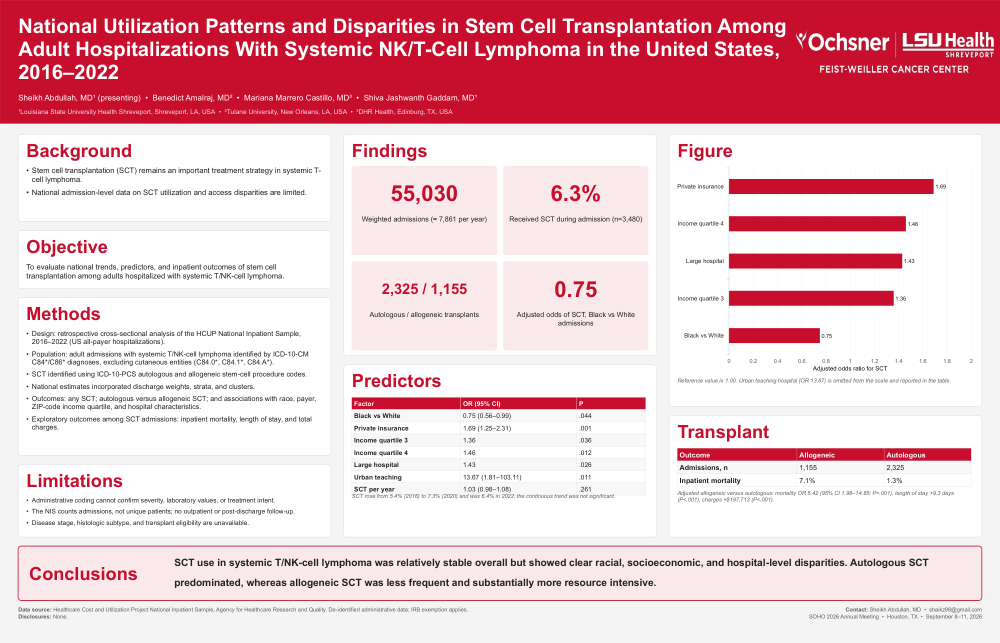
National Utilization Patterns and Disparities in Stem Cell Transplantation Among Adult Hospitalizations With Systemic NK/T-Cell Lymphoma in the United States, 2016-2022
Poster Presenter
Authors
Part of Topic
T-Cell Lymphoma (TCL)
Background
- Stem cell transplantation (SCT) remains an important treatment strategy in systemic T-cell lymphoma.
- National admission-level data on SCT utilization and access disparities are limited.
Objective
To evaluate national trends, predictors, and inpatient outcomes of stem cell transplantation among adults hospitalized with systemic T/NK-cell lymphoma.
Methods
- Design: retrospective cross-sectional analysis of the HCUP National Inpatient Sample, 2016-2022 (US all-payer hospitalizations).
- Population: adult admissions with systemic T/NK-cell lymphoma identified by ICD-10-CM C84*/C86* diagnoses, excluding cutaneous entities (C84.0*, C84.1*, C84.A*).
- SCT identified using ICD-10-PCS autologous and allogeneic stem-cell procedure codes.
- National estimates incorporated discharge weights, strata, and clusters.
- Outcomes: any SCT; autologous versus allogeneic SCT; and associations with race, payer, ZIP-code income quartile, and hospital characteristics.
- Exploratory outcomes among SCT admissions: inpatient mortality, length of stay, and total charges.
Limitations
- Administrative coding cannot confirm severity, laboratory values, or treatment intent.
- The NIS counts admissions, not unique patients; no outpatient or post-discharge follow-up.
- Disease stage, histologic subtype, and transplant eligibility are unavailable.
Findings
- 55,030 | Weighted admissions (approximately 7,861 per year)
- 6.3% | Received SCT during admission (n=3,480)
- 2,325 / 1,155 | Autologous / allogeneic transplants
- 0.75 | Adjusted odds of SCT, Black vs White admissions
Predictors (table: Factor / OR, 95% CI / P)
Black vs White 0.75 (0.56-0.99), .044 · Private insurance 1.69 (1.25-2.31), .001 · Income quartile 3 1.36, .036 · Income quartile 4 1.46, .012 · Large hospital 1.43, .026 · Urban teaching 13.67 (1.81-103.11), .011 · SCT per year 1.03 (0.98-1.08), .261
SCT rose from 5.4% (2016) to 7.3% (2020) and was 6.4% in 2022; the continuous trend was not significant.
Transplant (table: Outcome / Allogeneic / Autologous)
Admissions, n 1,155 vs 2,325 · Inpatient mortality 7.1% vs 1.3%
Adjusted allogeneic versus autologous: mortality OR 5.42 (95% CI 1.98-14.85; P=.001), length of stay +9.3 days (P<.001), charges +$197,713 (P<.001).
Figure caption
Reference value is 1.00. Urban teaching hospital (OR 13.67) is omitted from the scale and reported in the table.
Conclusions
SCT use in systemic T/NK-cell lymphoma was relatively stable overall but showed clear racial, socioeconomic, and hospital-level disparities. Autologous SCT predominated, whereas allogeneic SCT was less frequent and substantially more resource intensive.