1,267 posters, 47 videos, 13 topics, 4 sessions, 853 authors
ePostersLive by SciGen Technologies S.A. All rights reserved.
SOHO 2026 Annual Meeting
September 9 - 12, 2026 | George R. Brown Convention Center, Houston, Texas

ABCL - 146
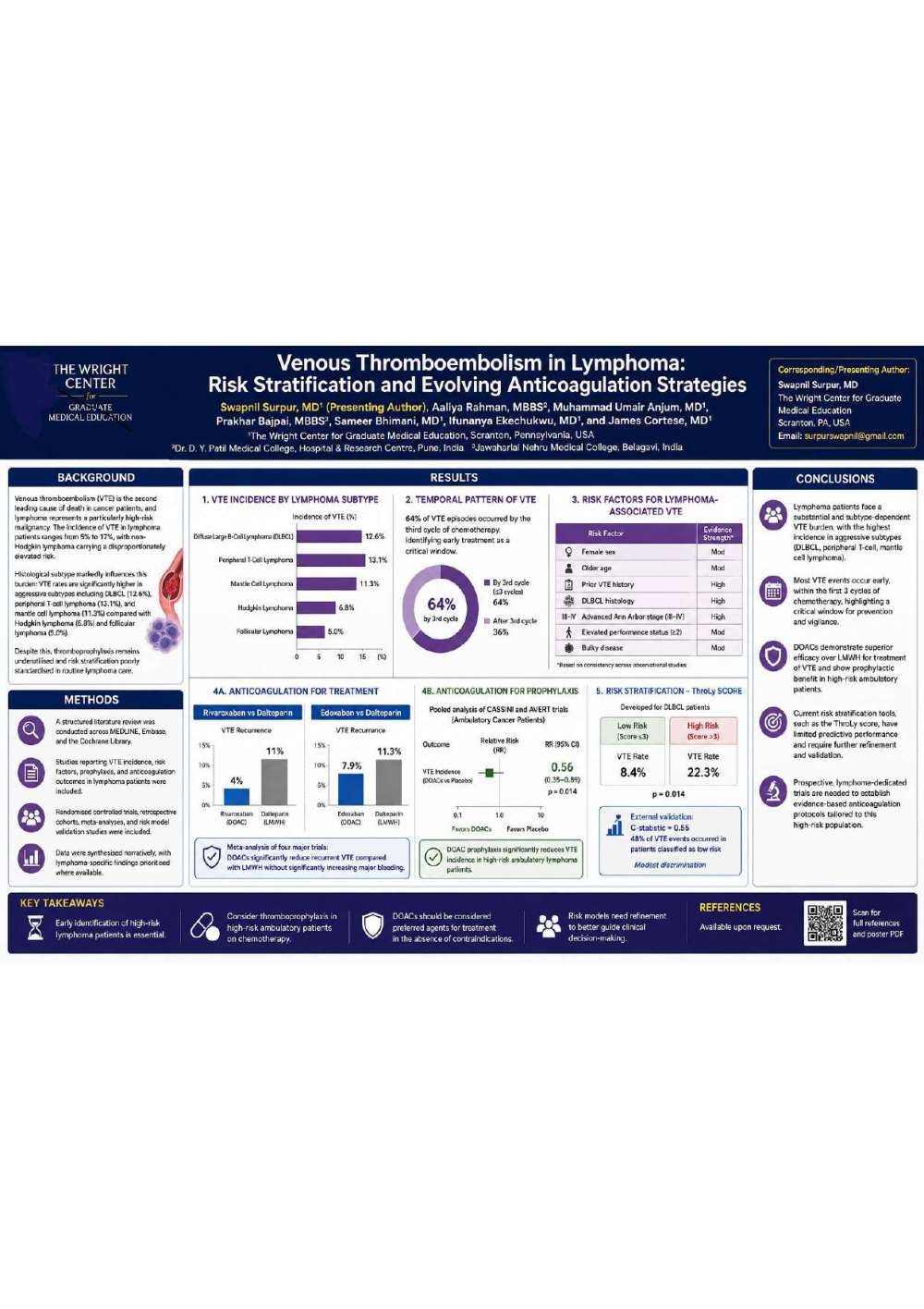
Venous Thromboembolism in Lymphoma: Risk Stratification and Evolving Anticoagulation Strategies
Poster Presenter
Authors
Part of Topic
Aggressive B-Cell Lymphoma (ABCL)
Thromboembolism in Lymphoma: Risk Stratification and Evolving Anticoagulation Strategies
Background
Venous thromboembolism (VTE) is the second leading cause of death in cancer patients, and
lymphoma represents a particularly high-risk malignancy. The incidence of VTE in lymphoma
patients ranges from 5% to 17%, with non-Hodgkin lymphoma carrying a disproportionately
elevated risk. Histological subtype markedly influences this burden: VTE rates are significantly
higher in aggressive subtypes including diffuse large B-cell lymphoma (DLBCL) at 12.6%,
peripheral T-cell lymphoma at 13.1%, and mantle cell lymphoma at 11.3% compared with
Hodgkin lymphoma (6.8%) and follicular lymphoma (5.0%). Despite this, thromboprophylaxis
remains underutilised and risk stratification poorly standardised in routine lymphoma care.
Methods
A structured literature review was conducted across MEDLINE, Embase, and the Cochrane
Library to identify studies reporting VTE incidence, risk factors, prophylaxis, and anticoagulation
outcomes in lymphoma patients. Randomised controlled trials, retrospective cohorts, meta-
analyses, and risk model validation studies were included. Data were synthesised narratively,
with lymphoma-specific findings prioritised where available.
Results
Independent risk factors for lymphoma-associated VTE include female sex, older age, prior VTE
history, DLBCL histology, advanced Ann Arbor stage (III–IV), elevated performance status, and
bulky disease. Temporally, 64% of VTE episodes occurred by the third cycle of chemotherapy,
identifying early treatment as a critical window. In the treatment setting, rivaroxaban reduced
VTE recurrence to 4% versus 11% with dalteparin, while edoxaban demonstrated a 7.9%
versus 11.3% recurrence rate, and a meta-analysis of four major trials confirmed DOACs
significantly reduce recurrent thrombosis compared with LMWH without significantly increasing
major bleeding. For prophylaxis, pooled estimates from the CASSINI and AVERT trials
demonstrated a significant reduction in VTE incidence with DOACs versus placebo (RR 0.56;
95% CI, 0.35–0.89). Regarding risk stratification, the ThroLy score identified high-risk DLBCL
patients (score >3) with a VTE rate of 22.3% versus 8.4% in low-risk patients (p=0.014);
however, external validation revealed modest discrimination, with a C-statistic of 0.55 and 48%
of events occurring in patients classified as low risk.
Conclusions
Lymphoma patients face a substantial and subtype-dependent VTE burden, concentrated in the
early chemotherapy period. DOACs demonstrate superior efficacy over LMWH for treatment
and show prophylactic benefit in high-risk ambulatory patients, though lymphoma-specific trial
representation remains limited. Prospective lymphoma-dedicated trials are needed to establish
evidence-based anticoagulation protocols.