1,267 posters, 47 videos, 13 topics, 4 sessions, 853 authors
ePostersLive by SciGen Technologies S.A. All rights reserved.
SOHO 2026 Annual Meeting
September 9 - 12, 2026 | George R. Brown Convention Center, Houston, Texas

MPN - 129
Efficacy and Safety of Ropeginterferon in Myeloproliferative Neoplasms: A Systematic Review and Meta-Analysis
Poster Presenter
Authors
Part of Topic
Myeloproliferative Neoplasms (MPN)
Efficacy And Safety Of Ropeginterferon In Myeloproliferative Neoplasms: A Systematic Review And Meta-analysis
Aadhila Abbas Manthiri¹, Leen Haj Saleh², Marrita Rabadi², Ayman Dalol², Rowan Mesilhy³, Usra Elshaikh⁴, Abdulrahman F. Al-Mashdali⁵, Mohammed Abdulgayoom⁵, Mahmood Aldapt⁶, Shehab F Mohamed⁵
¹College of Pharmacy, Qatar University, Doha, Qatar; ²College of Medicine, Qatar University, Doha, Qatar; ³Department of Internal Medicine, Hamad Medical Corporation, Doha, Qatar; ⁴Department of Public Health, College of Health Sciences, QU Health, Qatar University, Doha, Qatar; ⁵Department of Hematology, National Center for Cancer Care and Research, Hamad Medical Corporation, Doha, Qatar; ⁶Division of Hematology and Medical Oncology, Mayo Clinic, Jacksonville, Florida, USA
INTRODUCTION
Philadelphia chromosome-negative myeloproliferative neoplasms (MPNs) (polycythemia vera [PV], essential thrombocythemia [ET], primary myelofibrosis [MF]) are clonal disorders driven by JAK2, CALR, or MPL mutations, with risk of thrombohemorrhagic complications and transformation to MF/Acute myeloid leukemia (AML).
Hydroxyurea is the standard cytoreductive agent but lacks disease-modifying capacity and is limited by intolerance or resistance.
Interferon-α preferentially targets the malignant clone and reduces driver mutation allele burden.
Ropeginterferon alfa-2b (BESREMi®) is a mono-pegylated proline-IFN-α2b with an extended half-life, approved by the EMA (Feb 2019) and FDA (Nov 2021) - the first interferon approved specifically for PV.
PROUD-PV/CONTINUATION-PV and SURPASS-ET trials showed higher hematologic/molecular response and event-free survival versus hydroxyurea or anagrelide.
Real-world data are still needed to characterize dosing, adherence, discontinuation, and effectiveness outside controlled trial settings.
AIM
To evaluate the efficacy and safety of ropeginterferon alfa-2b across clinical and real-world studies in patients with myeloproliferative neoplasms (PV, ET, and MF).
METHOD
PRISMA-guided systematic review and meta-analysis; registered in PROSPERO (CRD420261337306). Systematic search of PubMed, Embase, and Web of Science (to 17 Oct 2025), plus an updated PubMed search (17 Oct 2025-11 Mar 2026). Eligible: primary studies (RCTs, prospective/retrospective cohorts, single-arm trials) reporting ropeginterferon (P1101/BESREMi®) outcomes in PV/ET/MF patients; English language, 2020-2026. Independent dual screening (title/abstract, then full-text) in Rayyan; dual data extraction with discrepancies resolved by a third reviewer. Risk of bias: RoB 2 (RCTs), ROBINS-I (non-randomized interventional), Newcastle-Ottawa Scale (observational), NIH tool (database studies). Proportional meta-analysis (R, meta package): generalized linear mixed model with logit transformation, random-effects; pooled proportions with 95% CI; I² for heterogeneity.
RESULTS
Study selection:
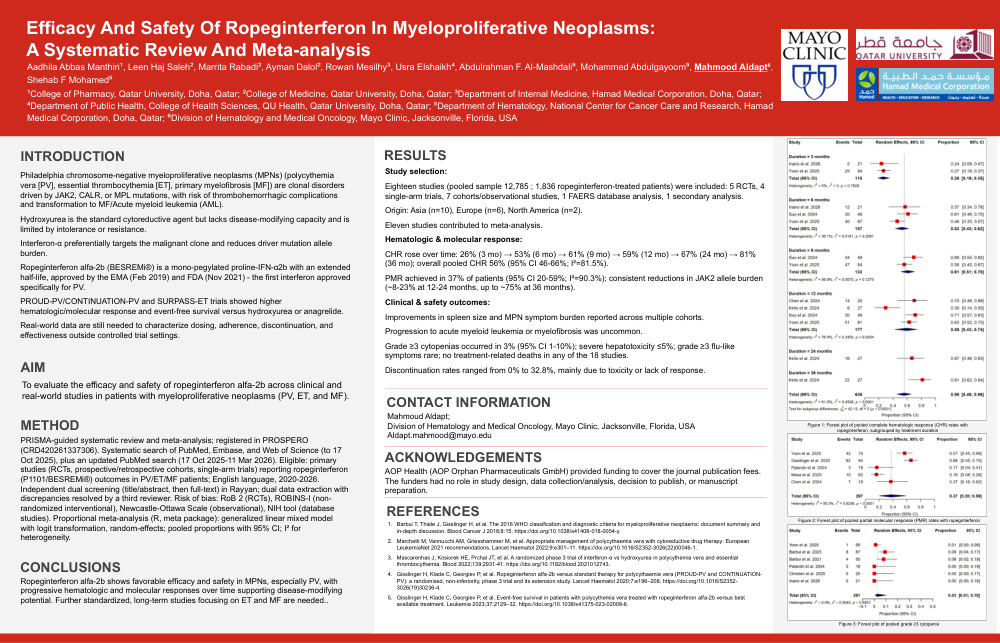
Eighteen studies (pooled sample 12,785 ; 1,836 ropeginterferon-treated patients) were included: 5 RCTs, 4 single-arm trials, 7 cohorts/observational studies, 1 FAERS database analysis, 1 secondary analysis.
Origin: Asia (n=10), Europe (n=6), North America (n=2).
Eleven studies contributed to meta-analysis.
Hematologic & molecular response:
CHR rose over time: 26% (3 mo) → 53% (6 mo) → 61% (9 mo) → 59% (12 mo) → 67% (24 mo) → 81% (36 mo); overall pooled CHR 56% (95% CI 46-66%; I²=81.5%).
PMR achieved in 37% of patients (95% CI 20-59%; I²=90.3%); consistent reductions in JAK2 allele burden (~8-23% at 12-24 months, up to ~75% at 36 months).
Clinical & safety outcomes:
Improvements in spleen size and MPN symptom burden reported across multiple cohorts.
Progression to acute myeloid leukemia or myelofibrosis was uncommon.
Grade ≥3 cytopenias occurred in 3% (95% CI 1-10%); severe hepatotoxicity ≤5%; grade ≥3 flu-like symptoms rare; no treatment-related deaths in any of the 18 studies.
Discontinuation rates ranged from 0% to 32.8%, mainly due to toxicity or lack of response.
CONCLUSIONS
Ropeginterferon alfa-2b shows favorable efficacy and safety in MPNs, especially PV, with progressive hematologic and molecular responses over time supporting disease-modifying potential. Further standardized, long-term studies focusing on ET and MF are needed..