1,267 posters, 47 videos, 13 topics, 4 sessions, 853 authors
ePostersLive by SciGen Technologies S.A. All rights reserved.
SOHO 2026 Annual Meeting
September 9 - 12, 2026 | George R. Brown Convention Center, Houston, Texas

MDS - 113
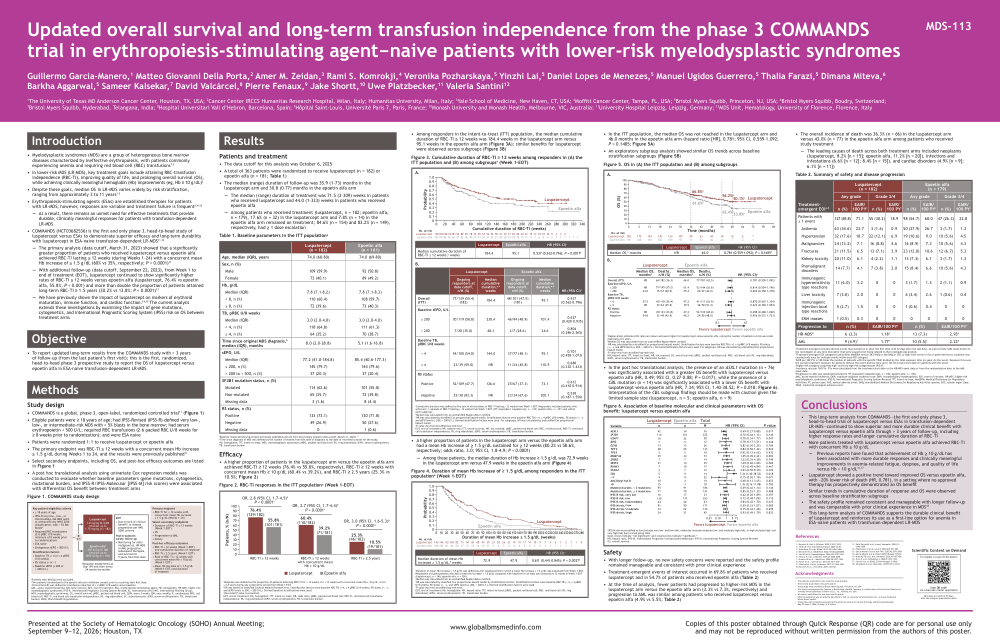
Updated Overall Survival (OS) and Long-Term Transfusion Independence (TI) From the Phase 3 COMMANDS Trial in Erythropoiesis-Stimulating Agent (ESA)-Naive Patients With Lower-Risk Myelodysplastic Syndromes (LR-MDS)
Poster Presenter
Authors
Part of Topic
Myelodysplastic Syndromes (MDS)
Updated overall survival and long-term transfusion independence from the phase 3 COMMANDS trial in erythropoiesis-stimulating agent−naive patients with lower-risk myelodysplastic syndromes
Introduction:
• Myelodysplastic syndromes (MDS) are a group of heterogeneous bone marrow diseases characterized by ineffective erythropoiesis, with patients commonly experiencing anemia and requiring red blood cell (RBC) transfusions1,2 • In lower-risk MDS (LR-MDS), key treatment goals include attaining RBC-transfusion independence (RBC-TI), improving quality of life, and prolonging overall survival (OS), while achieving clinically meaningful hemoglobin (Hb) improvements (eg, Hb ≥ 10 g/dL)2 • Despite these goals, median OS in LR-MDS varies widely by risk stratification, ranging from approximately 3 to 11 years3–5 • Erythropoiesis-stimulating agents (ESAs) are established therapies for patients with LR-MDS; however, responses are variable and treatment failure is frequent2,6–10 — As a result, there remains an unmet need for effective treatments that provide durable, clinically meaningful responses for patients with transfusion-dependent LR-MDS • COMMANDS (NCT03682536) is the first and only phase 3, head-to-head study of luspatercept versus ESAs to demonstrate superior efficacy and long-term durability with luspatercept in ESA-naive transfusion-dependent LR-MDS11,12 — The primary analysis (data cutoff, March 31, 2023) showed that a significantly greater proportion of patients who received luspatercept versus epoetin alfa achieved RBC-TI lasting ≥ 12 weeks (during Weeks 1–24) with a concurrent mean Hb increase of ≥ 1.5 g/dL (60% vs 35%, respectively; P < 0.0001)11 — With additional follow-up (data cutoff, September 22, 2023), from Week 1 to end of treatment (EOT), luspatercept continued to show significantly higher rates of RBC-TI ≥ 12 weeks versus epoetin alfa (luspatercept, 76.4% vs epoetin alfa, 55.8%; P < 0.001) and more than double the proportion of patients attained long-term RBC-TI ≥ 1.5 years (30.2% vs 13.8%; P < 0.0001)13 — We have previously shown the impact of luspatercept on markers of erythroid maturation, immune function, and cardiac function.14,15 The current analysis extends these investigations by examining the impact of gene mutations, cytogenetics, and International Prognostic Scoring System (IPSS) risk on OS between treatment arms
Objective:
To report updated long-term results from the COMMANDS study with > 3 years of follow-up (from the last patient’s first visit); this is the first, randomized, head-to-head phase 3 prospective study to report the OS of lusp
Methods:
Study design • COMMANDS is a global, phase 3, open-label, randomized controlled trial11 (Figure 1) • Eligible patients were ≥ 18 years of age; had IPSS-Revised (IPSS-R)–defined very low-, low-, or intermediate-risk MDS with < 5% blasts in the bone marrow; had serum erythropoietin < 500 U/L; required RBC transfusions (2–6 packed RBC U/8 weeks for ≥ 8 weeks prior to randomization); and were ESA naive • Patients were randomized 1:1 to receive luspatercept or epoetin alfa • The primary endpoint was RBC-TI ≥ 12 weeks with a concurrent mean Hb increase ≥ 1.5 g/dL during Weeks 1 to 24, and the results were previously published11 • Select secondary endpoints, including OS, and post-hoc efficacy outcomes are listed in Figure 1 • A post hoc translational analysis using univariate Cox regression models was conducted to evaluate whether baseline parameters (gene mutations, cytogenetics, mutational burden, and IPSS-R/IPSS-Molecular [IPSS-M] risk scores) were associated with differential OS benefit between treatment arms
Results:
Study design • COMMANDS is a global, phase 3, open-label, randomized controlled trial11 (Figure 1) • Eligible patients were ≥ 18 years of age; had IPSS-Revised (IPSS-R)–defined very low-, low-, or intermediate-risk MDS with < 5% blasts in the bone marrow; had serum erythropoietin < 500 U/L; required RBC transfusions (2–6 packed RBC U/8 weeks for ≥ 8 weeks prior to randomization); and were ESA naive • Patients were randomized 1:1 to receive luspatercept or epoetin alfa • The primary endpoint was RBC-TI ≥ 12 weeks with a concurrent mean Hb increase ≥ 1.5 g/dL during Weeks 1 to 24, and the results were previously published11 • Select secondary endpoints, including OS, and post-hoc efficacy outcomes are listed in Figure 1 • A post hoc translational analysis using univariate Cox regression models was conducted to evaluate whether baseline parameters (gene mutations, cytogenetics, mutational burden, and IPSS-R/IPSS-Molecular [IPSS-M] risk scores) were associated with differential OS benefit between treatment arms
Efficacy • A higher proportion of patients in the luspatercept arm versus the epoetin alfa arm achieved RBC-TI ≥ 12 weeks (76.4% vs 55.8%, respectively), RBC-TI ≥ 12 weeks with concurrent mean Hb ≥ 10 g/dL (60.4% vs 39.2%), and RBC-TI ≥ 2.5 years (25.3% vs 10.5%; Figure 2). Among responders in the intent-to-treat (ITT) population, the median cumulative duration of RBC-TI ≥ 12 weeks was 184.4 weeks in the luspatercept arm versus 95.1 weeks in the epoetin alfa arm (Figure 3A); simila A higher proportion of patients in the luspatercept arm versus the epoetin alfa arm had a mean Hb increase of ≥ 1.5 g/dL sustained for ≥ 12 weeks (80.2% vs 58.6%, respectively; odds ratio, 3.0; 95% CI, 1.8-4.9; P < 0.0001) — Among these patients, the median duration of Hb increase ≥ 1.5 g/dL was 72.9
Conclusions:
This long-term analysis from COMMANDS—the first and only phase 3, head-to-head trial of luspatercept versus ESAs in transfusion-dependent LR-MDS—continued to show superior and more durable clinical benefit with luspatercept versus epoetin alfa through > 3 years of follow-up, including higher response rates and longer cumulative duration of RBC-TI • More patients treated with luspatercept versus epoetin alfa achieved RBC-TI with concurrent Hb ≥ 10 g/dL – Previous reports have found that achievement of Hb ≥ 10 g/dL has been associated with more durable responses and clinically meaningful improvements in anemia-related fatigue, dyspnea, and quality of life versus Hb < 10 g/dL16,17 • Luspatercept showed a positive trend toward improved OS versus epoetin alfa, with ~20% lower risk of death (HR, 0.781), in a setting where no approved therapy has prospectively demonstrated an OS benefit • Similar trends in cumulative duration of response and OS were observed across baseline stratification subgroups • The safety profile remained consistent and manageable with longer follow-up and was comparable with prior clinical experience in MDS18 • This long-term analysis of COMMANDS supports the durable clinical benefit of luspatercept and reinforces its use as a first-line option for anemia in ESA-naive patients with transfusion-dependent LR-MD