1,267 posters, 47 videos, 13 topics, 4 sessions, 853 authors
ePostersLive by SciGen Technologies S.A. All rights reserved.
SOHO 2026 Annual Meeting
September 9 - 12, 2026 | George R. Brown Convention Center, Houston, Texas

AML - 109
CRHBP Activates NF-?B Signaling Through TNIP1 Inhibition in Leukemic Stem Cells: A Novel CRH-Independent Mechanism of Treatment Resistance
Poster Presenter
Authors
Part of Topic
Acute Myeloid Leukemia (AML)
CRHBP ACTIVATES NF-ΚB SIGNALING THROUGH TNIP1 INHIBITION IN LEUKEMIC STEM CELLS: A NOVEL CRH-INDEPENDENT MECHANISM OF TREATMENT RESISTANCE
INTRODUCTION
Leukemia stem cells (LSCs) that persist after treatment are a major driver of AML relapse.
However, the mechanisms that enable LSC persistence remain poorly understood.
AIM
We aimed to identify the mechanisms that promote LSC persistence after treatment.
METHOD
Longitudinal single-cell transcriptomics
・Phenotypic LSCs (CD34⁺CD38⁻TIM-3⁺) were isolated from bone marrow samples collected at diagnosis, remission, and relapse from two patients with AML and subjected to 384-well plate-based single-cell RNA sequencing.
Identification of CRHBP-interacting proteins
・AML cell lines expressing 3×FLAG-tagged CRHBP were analyzed by anti-FLAG immunoprecipitation coupled with mass spectrometry. The CRHBP–TNIP1 interaction was evaluated by co-immunoprecipitation and immunoblotting.
Functional analysis of the CRHBP–TNIP1 axis
・CRHBP-overexpressing and TNIP1-knockout cells were generated using THP-1 cell.
・Following IL-1β stimulation, NF-κB activation was assessed by p-p65 immunoblotting.
・Transcriptomic changes were further characterized by bulk RNA sequencing and pathway enrichment analysis.
RESULTS
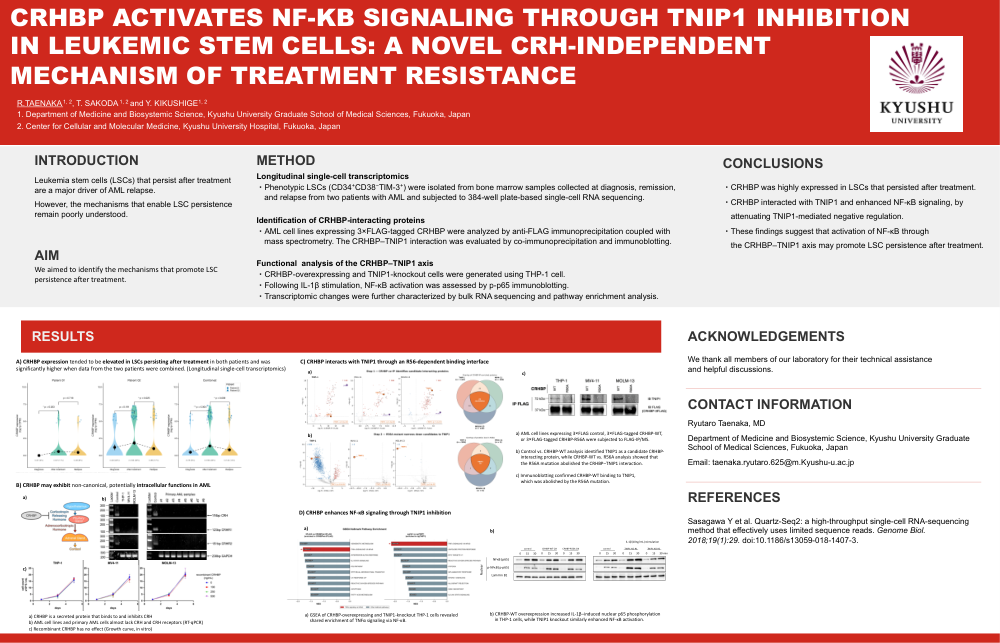
A) CRHBP expression tended to be elevated in LSCs persisting after treatment in both patients and was significantly higher when data from the two patients were combined. (Longitudinal single-cell transcriptomics)
B) CRHBP may exhibit non-canonical, potentially intracellular functions in AML
a) CRHBP is a secreted protein that binds to and inhibits CRH
b) AML cell lines and primary AML cells almost lack CRH and CRH receptors (RT-qPCR)
c) Recombinant CRHBP has no effect (Growth curve, in vitro)
C) CRHBP interacts with TNIP1 through an R56-dependent binding interface
a) AML cell lines expressing 3×FLAG control, 3×FLAG-tagged CRHBP-WT, or 3×FLAG-tagged CRHBP-R56A were subjected to FLAG-IP/MS.
b) Control vs. CRHBP-WT analysis identified TNIP1 as a candidate CRHBP-interacting protein, while CRHBP-WT vs. R56A analysis showed that the R56A mutation abolished the CRHBP–TNIP1 interaction.
c) Immunoblotting confirmed CRHBP-WT binding to TNIP1, which was abolished by the R56A mutation.
D) CRHBP enhances NF-κB signaling through TNIP1 inhibition
a) GSEA of CRHBP-overexpressing and TNIP1-knockout THP-1 cells revealed shared enrichment of TNFα signaling via NF-κB.
b) CRHBP-WT overexpression increased IL-1β–induced nuclear p65 phosphorylation in THP-1 cells, while TNIP1 knockout similarly enhanced NF-κB activation.
CONCLUSIONS
・CRHBP was highly expressed in LSCs that persisted after treatment.
・CRHBP interacted with TNIP1 and enhanced NF-κB signaling, by attenuating TNIP1-mediated negative regulation.
・These findings suggest that activation of NF-κB through the CRHBP–TNIP1 axis may promote LSC persistence after treatment.