1,267 posters, 47 videos, 13 topics, 4 sessions, 853 authors
ePostersLive by SciGen Technologies S.A. All rights reserved.
SOHO 2026 Annual Meeting
September 9 - 12, 2026 | George R. Brown Convention Center, Houston, Texas

AML - 087
Nationwide Trends in Acute Myeloid Leukemia Mortality Arising From Philadelphia Chromosome-Negative Myeloproliferative Neoplasms in the United States, 1999-2023
Poster Presenter
Authors
Part of Topic
Acute Myeloid Leukemia (AML)
Nationwide Trends in Acute Myeloid Leukemia Mortality Arising from Philadelphia Chromosome–Negative Myeloproliferative Neoplasms in the United States, 1999-2023
Valerin Arno, Aqsa Zoey Sorathia, Basel, Disha, Karan, Esra, Mehandar Kumar
Background
Philadelphia chromosome-negative myeloproliferative neoplasms (MPNs), including polycythemia vera, essential thrombocythemia, and myelofibrosis, carry a recognized risk of leukemic transformation to acute myeloid leukemia (AML), which confers poor prognosis. National mortality trends specifically capturing AML arising from antecedent MPNs remain incompletely characterized.
Methods
We conducted a population-based study using the CDC WONDER Multiple Cause of Death database (1999–2023). Deaths were identified when AML (ICD-10 C92.0) was the underlying cause and an MPN (D45, D47.3, D47.1) was listed as a contributing cause. Crude and age-adjusted mortality rates (AAMRs), standardized to the 2000 U.S. population, were calculated. Temporal trends were assessed using Joinpoint regression with weighted Bayesian Information Criterion, reporting annual percent change (APC) with 95% confidence intervals (CI). Analyses were stratified by sex, age, race, ethnicity, urbanization, state, and place of death.
Results
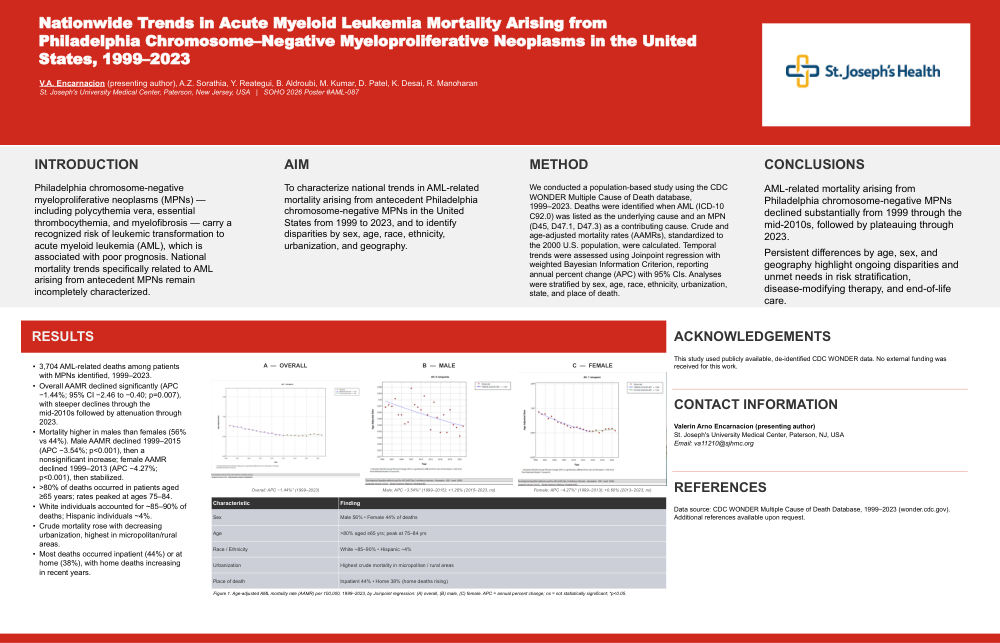
From 1999–2023, 3,704 AML-related deaths among patients with MPNs were identified. Overall AAMRs declined significantly over the study period (APC −1.44%; 95% CI −2.46 to −0.40; p=0.007), with steeper declines through the mid-2010s followed by attenuation through 2023. Mortality was higher among males than females (56% vs 44%). Among males, AAMRs declined from 1999–2015 (APC −3.54%; p<0.001) with a nonsignificant increase thereafter. Among females, AAMRs declined from 1999–2013 (APC −4.27%; p<0.001) and subsequently stabilized. Over 80% of deaths occurred in individuals aged ≥65 years, with rates peaking at ages 75–84. White individuals accounted for ~85–90% of deaths; Hispanic individuals comprised ~4%. Crude mortality rates increased with decreasing urbanization, highest in micropolitan and rural areas. Most deaths occurred in inpatient facilities (44%) or at home (38%), with increasing home deaths in recent years. The highest mortality burden was observed in California, Texas, Florida, and New York.
Conclusions
AML-related mortality arising from Philadelphia chromosome–negative MPNs declined substantially from 1999 through the mid-2010s, with subsequent plateauing through 2023. Persistent age-, sex-, and geography-based differences and a high proportion of deaths outside inpatient settings highlight ongoing disparities and unmet needs in risk stratification, disease-modifying therapy, and end-of-life care.