516 posters, 59 topics, 63 sessions, 1,127 authors, 353 institutions
ePostersLive by SciGen Technologies S.A. All rights reserved.
2026 SOAP Annual Meeting
April 29 - May 3, 2026 | Montreal, Quebec Canada

2335543
My Legs Fell Asleep and They Won't Wake Up! Managing HNPP During Labor and Delivery
Poster Presenter
Authors
Affiliations
Part of Topic
DILEMMAS in LABOR
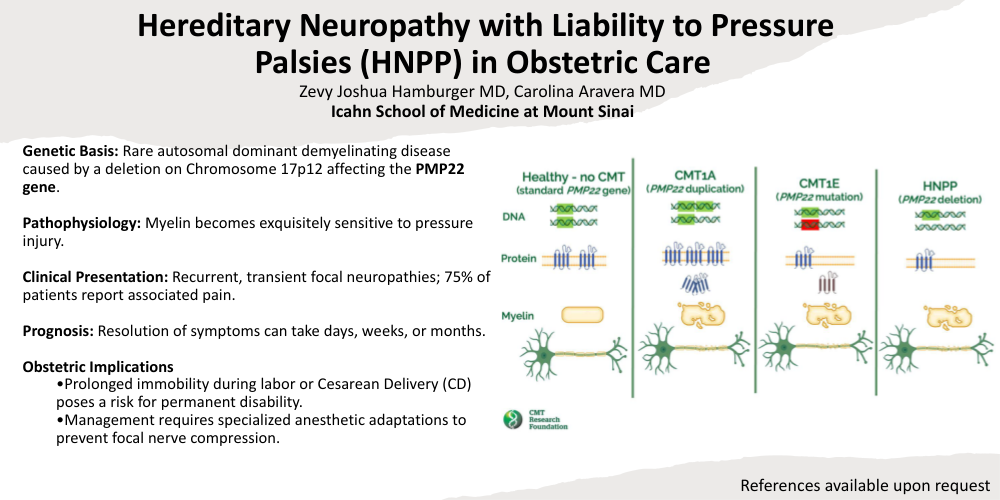
Introduction: Hereditary Neuropathy with Liability to Pressure Palsies (HNPP) is a rare autosomal dominant demyelinating disease in which short duration pressure leads to transient or sometimes permanent somatic and motor neuropathies.1 We present a case in which a parturient with known HNPP presents for delivery and discuss the management strategies and adaptations needed for safe anesthetic care.
Case: KP was a G2P0 with known HNPP without permanent deficits who presented in labor at 40 weeks gestation. An epidural catheter was placed at L4-5 and an PCEA with Bupivacaine 0.625% and fentanyl 2mcg/ml was started. The bed was padded and the patient was asked to move every 15-20 minutes. 14 hours later she proceeded for cesarean delivery (CD) for arrest of dilation with category 2 tracing. Chloroprociane 3% 20ml and fentanyl 100mcg were administered epidurally and the cesarean proceeded. The OR bed was padded, and the patient’s legs were moved q15 minutes. She regained lower extremity strength within 30 minutes of arrival to the PACU and reported no neuropathies.
Discussion: HNPP is caused by a deletion on Chromosome 17p12 affecting the PMP22 gene1, causing myelin to be exquisitely sensitive to pressure injury. HNPP manifests as recurrent transient focal neuropathies. Most patients report the sensation of a limb ’falling asleep’ after leaning on it or after sleep, but 75% report associated pain. Resolution may take days, weeks or even months.2 Prolonged immobility during labor or CD may be dangerous and lead to prolonged or even permanent disability3. Attention must be paid to padding and frequent repositioning. In the case presented, we utilized ultra-low dose epidural analgesia to maintain mobility so the patient may move around on a schedule to prevent injury, recognizing that that the analgesia may reduce her ability to detect a neuropathy. For the CD, Cloroprocaine was selected to minimize immobility time. All surfaces were padded and her legs were moved every 15 minutes to prevent continuous pressure. Reports suggest a preference for neuraxial anesthesia over general anesthesia given complications such as tongue and other oropharyngeal neuropathies from the endotracheal tube.3 While the same author suggested utilizing invasive pressure monitoring to avoid neuropathies from a frequently cycling blood pressure cuff, we opted to use a cuff given that the patient would maintain sensation in her arms.
1.Chance PF. Inherited focal, episodic neuropathies: hereditary neuropathy with liability to pressure palsies and hereditary neuralgic amyotrophy. Neuromolecular Med. 2006;8(1-2):159-174. doi:10.1385/NMM:8:1:159
2.HNPP | The Foundation for Peripheral Neuropathy. Accessed January 22, 2026. https://www.foundationforpn.org/causes/hnpp/
3.Sudhakar VP, etal. Pregnancy and Hereditary Neuropathy With Liability to Pressure Palsies: A Case Report and Narrative Review of the Literature. Cureus. 2024;16(5):e61236. doi:10.7759/CUREUS.61236