516 posters, 59 topics, 63 sessions, 1,127 authors, 353 institutions
ePostersLive by SciGen Technologies S.A. All rights reserved.
2026 SOAP Annual Meeting
April 29 - May 3, 2026 | Montreal, Quebec Canada

2340520
Shortness of Breath… Pleural Effusion… Anterior Mediastinal Mass… Stage IV Lymphoma
Poster Presenter
Authors
Affiliations
Part of Topic
Respiratory challenges
Shortness of Breath... Pleural Effusion... Anterior Mediastinal Mass... Stage IV Lymphoma
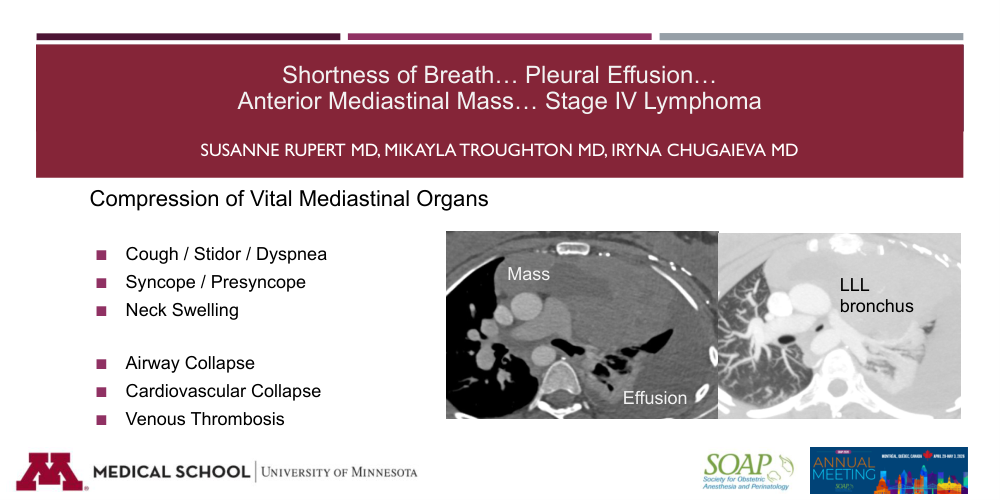
Anterior mediastinal masses can compress vital mediastinal organs. Cough and especially stridor with exertion can be signs of airway compression and tracheo-bronchomalacia. Tracheal collapse can occur with position changes especially under sedation and especially with paralysis. Vascular occlusion can cause syncope, cardiovascular collapse, and venous thrombosis which is a common presenting sign.
G1P0 at 31w6d presented to the emergency room in the setting of acute onset shortness of breath. She reported an intermittent, dry, non-productive cough without dyspnea for around a month that she hadn’t reported to her OB provider. In the week prior, she became increasingly dyspneic and one day prior noticed new swelling on the left side of her neck. Suddenly, she became so dyspneic she was unable to speak in full sentences.
POCUS thoracentesis drained 1L fluid reducing symptoms from her large pleural effusion.
Chest CT revealed a large 14 cm anterior mediastinal mass. The patient’s neck swelling was caused by left internal jugular vein occlusion. Biopsy under CT guidance revealed Hodgkin's lymphoma. She received two cycles of chemotherapy with AVD Adriamycin (Doxorubicin), Vinblastine, Dacarbazine with a reduction in mass size to 12cm x 7.5cm. Steroids for fetal lung maturity can precipitate tumor lysis syndrome and thus were avoided initially in our patient.
Literature on fetal cardiotoxic effects of chemotherapy is relatively sparse. Chemotherapy regimens differ depending on gestational age. Adriamycin and cyclophosphamide have cardiotoxic effects which can cause both immediate and delayed/sub-clinical or progressive cardiac dysfunction. While most fetuses tolerate the administration of these agents in later pregnancy without complications, there are cases of temporally-persuasive likely fetal cardiotoxicity from chemotherapy that results in fetal cardiovascular dysfunction and potentially intra-uterine fetal demise, around 2-6%.
This parturient’s care requires ongoing multidisciplinary planning throughout chemotherapy, pregnancy, and delivery as patient or fetal condition may worsen acutely. Avoidance of positions that are symptomatic for the patient are paramount. Cardiac compression can affect filling and function. Helpful imaging evaluation can involve POCUS, ECHO, MRI, and CT. Rigid bronchoscopy, airway stents, cardiopulmonary bypass, or ECMO may be necessary and life saving in rare cases. The patient is planned for an induction of labor at 38w0d under epidural anesthesia, with large lower extremity access, arterial catheter, and ECMO availability on standby.