875 posters, 25 topics, 3,440 authors, 1,061 institutions
ePostersLive by SciGen Technologies S.A. All rights reserved.
SAGES 2026 Annual Meeting Emerging Technology Session
March 25-28, 2026 | Tampa, FL, USA

P092
Comparative Safety Outcomes in Primary and Incisional Ventral Hernia Repair with the Medtronic Hugo™ Robotic-assisted Surgery System: A Subgroup Analysis
Poster Presenter
Authors
Jacob Greenberg, Ajay Panchal, Jeffrey Berndtson, Steven Hopson, Clayton Petro, Salvatore Docimo, Erik Wilson, Pier Giulianotti, Chris Irwin, Ruben Larue, David Chen, Flavio Malcher
Affiliations
Northwell Health, Duke University, University of Buffalo, Tidewater Physicians Multispecialty Group Hernia Center,
Part of Topic
Abdominal Wall Hernias
Introduction
Ventral hernia repair represents a significant volume of surgical pathology and the use of robotic assisted surgery (RAS) for ventral primary and incisional hernia repair has increased exponentially over the past decade.
Objective: To report the outcomes of 96 patients with primary and incisional ventral hernias treated with the investigational Hugo RAS system in the US through 30 days post-operation (NCT06445504).
Methods
This prospective, multicenter, FDA-monitored, investigational device exemption study of the Hugo RAS system for primary and incisional ventral hernia repair was conducted across seven US sites as part of the Enable Hernia Repair study.
Device safety was assessed based on procedure- and/or device-related surgical-site event (SSE) rates through 30 days, including bleeding requiring transfusion, bowel injury, bowel obstruction, cellulitis, epigastric vessel injury, hematoma or seroma requiring intervention, and surgical-site infection.
Operative times and conversion, 30-day complication (Clavien–Dindo (CD) grade), readmission, reoperation, and recurrence rates were assessed.
“Conversion” was defined as a perioperative change from the use of the Hugo RAS system to traditional laparoscopy, open surgery, or the use of another RAS system.
“Device effectiveness” was defined as no conversion during the procedure.
“Complication” was defined as CD grade ≥ I. “Major complication” was defined as CD grade ≥III.
Continuous variables are summarized using the number of patients (n), mean and standard deviation (SD), or median and interquartile range (IQR). Categorical variables are summarized using frequencies and percentages.
Results
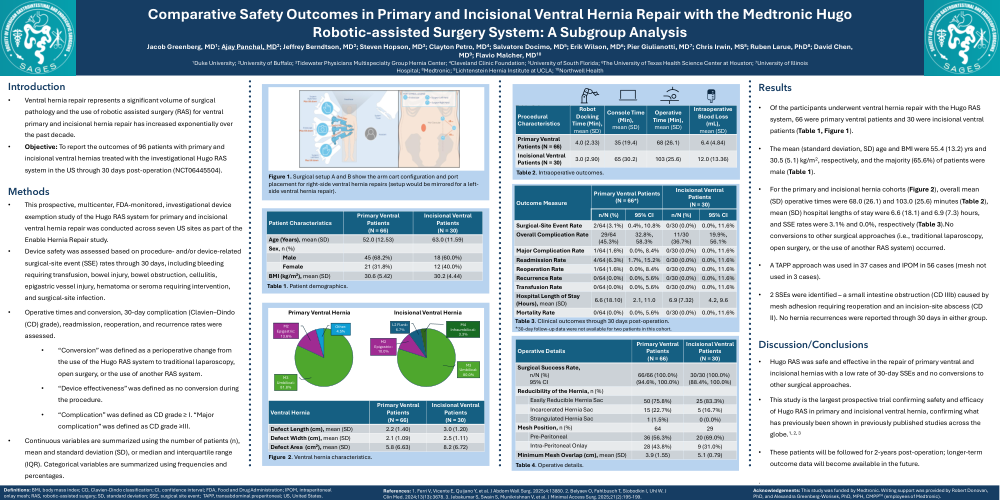
•Of the participants underwent ventral hernia repair with the Hugo RAS system, 66 were primary ventral patients and 30 were incisional ventral patients (Table 1, Figure 1).
•The mean (standard deviation, SD) age and BMI were 55.4 (13.2) yrs and 30.5 (5.1) kg/m2, respectively, and the majority (65.6%) of patients were male (Table 1).
•For the primary and incisional hernia cohorts (Figure 2), overall mean (SD) operative times were 68.0 (26.1) and 103.0 (25.6) minutes (Table 2), mean (SD) hospital lengths of stay were 6.6 (18.1) and 6.9 (7.3) hours, and SSE rates were 3.1% and 0.0%, respectively (Table 3).No conversions to other surgical approaches (i.e., traditional laparoscopy, open surgery, or the use of another RAS system) occurred.
•A TAPP approach was used in 37 cases and IPOM in 56 cases (mesh not used in 3 cases).
•2 SSEs were identified – a small intestine obstruction (CD IIIb) caused by mesh adhesion requiring reoperation and an incision-site abscess (CD II). No hernia recurrences were reported through 30 days in either group.
Discussion/Conclusions
•Hugo RAS was safe and effective in the repair of primary ventral and incisional hernias with a low rate of 30-day SSEs and no conversions to other surgical approaches.
•This study is the largest prospective trial confirming safety and efficacy of Hugo RAS in primary and incisional ventral hernia, confirming what has previously been shown in previously published studies across the globe.1, 2, 3
•These patients will be followed for 2-years post-operation; longer-term outcome data will become available in the future.