875 posters, 25 topics, 3,440 authors, 1,061 institutions
ePostersLive by SciGen Technologies S.A. All rights reserved.
SAGES 2026 Annual Meeting Emerging Technology Session
March 25-28, 2026 | Tampa, FL, USA

P820
ROBOTIC INGUINAL HERNIA REPAIR USING TAPP: EARLY EXPERIENCE FROM A TERTIARY CARE CENTRE
Poster Presenter
Authors
Arpita Mishra, Ankita Bajpai, Sanjeet K Rai, Arun Anand, Omprakash Prajapati, Virinder K Bansal
Affiliations
Part of Topic
Robotics / Advanced Technologies
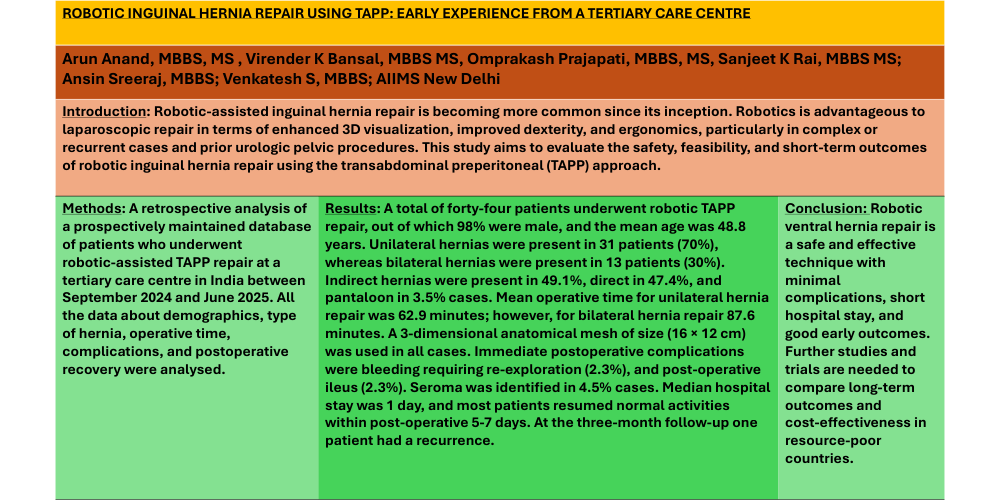
ROBOTIC INGUINAL HERNIA REPAIR USING TAPP: EARLY EXPERIENCE FROM A TERTIARY CARE CENTRE
Arun Anand, MBBS, MS, FCLS, Ankita Bajpai, MBBS, MS; Sanjeet K Rai, MBBS, MS, MCh, FCLS; ; Omprakash Prajapati, MBBS, MS; Virinder K Bansal, MBBS, MS, FACS, FCLS; AIIMS New Delhi
Introduction: Robotic-assisted inguinal hernia repair is becoming more common since its inception. Robotics is advantageous to laparoscopic repair in terms of enhanced 3D visualization, improved dexterity, and ergonomic, particularly in complex or recurrent cases and prior urologic pelvic procedures. This study aims to evaluate the safety, feasibility, and short-term outcomes of robotic inguinal hernia repair using the transabdominal preperitoneal (TAPP) approach.
Methods: A retrospective analysis of a prospectively maintained database of patients who underwent robotic-assisted TAPP repair at a tertiary care centre in India between September 2024 and June 2025. All the data about demographics, type of hernia, operative time, complications, and postoperative recovery were analysed.
Results: A total of forty-four patients underwent robotic TAPP repair, out of which 98% were male, and the mean age was 48.8 years. Unilateral hernias were present in 31 patients (70%), whereas bilateral hernias were present in 13 patients (30%). Indirect hernias were present in 49.1%, direct in 47.4%, and pantaloon in 3.5% cases. Mean operative time for unilateral hernia repair was 62.9 minutes; however, for bilateral hernia repair 87.6 minutes. A 3-dimensional anatomical mesh of size (16x12 cm) was used in all cases. Immediate postoperative complications were bleeding requiring re-exploration (2.3%), and post-operative ileus (2.3%). Seroma was identified in 4.5% cases. Median hospital stay was 1 day, and most patients resumed normal activities within post-operative 5-7 days. At the three-month follow up one patient had a recurrence.
Conclusion: Robotic TAPP inguinal hernia repair is a safe and effective technique with low morbidity, rapid recovery, and promising early outcomes. Robotics has longer operative times. Further trials are required to compare the cost-effectiveness and patient-reported outcomes of robotics and laparoscopic inguinal hernia repair.