875 posters, 25 topics, 3,440 authors, 1,061 institutions
ePostersLive by SciGen Technologies S.A. All rights reserved.
SAGES 2026 Annual Meeting Emerging Technology Session
March 25-28, 2026 | Tampa, FL, USA

P741
Evaluation of the Utility of Intraoperative Nerve Monitoring, Water-Jet dissector, and Fine Bipolar Forceps in Endoscopic Thyroid Surgery
Poster Presenter
Authors
Ryutaro Yasudome, Tadahiro Hirashima, Koji Minami, Yoshiaki Shinden, Akihiro Nakajo
Affiliations
Part of Topic
New Technologies / Techniques
EVALUATION OF THE UTILITY OF INTRAOPERATIVE NERVE MONITORING, WATER-JET DISSECTOR, AND FINE BIPOLAR FORCEPS IN ENDOSCOPIC THYROID SURGERY
Introduction
Recurrent laryngeal nerve (RLN) palsy after thyroid surgery is a serious complication that significantly affects patients’ quality of life. In our department, we have introduced intraoperative nerve monitoring (IONM), a WaterJet dissector, and fine bipolar forceps for RLN dissection. This study aimed to evaluate the efficacy of these techniques.
Patients and Methods
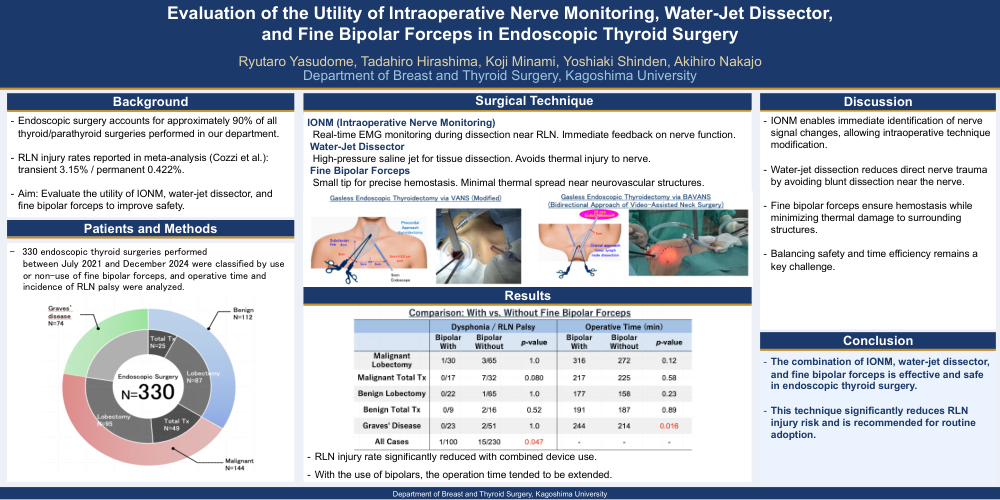
A total of 330 endoscopic thyroid surgeries performed between July 2021 and December 2024 were reviewed. Patients were classified into five groups: benign lobectomy (n=87), benign total thyroidectomy (n=25), malignant lobectomy (n=95), malignant total thyroidectomy (n=49), and Graves’ disease (n=74). Each group was further divided according to whether fine bipolar forceps were used. Operative time and RLN palsy rates were compared among these groups.
Results and Discussion
The incidence of RLN palsy significantly decreased from 6.5% in the first 230 cases (before the introduction) to 1.0% in the subsequent 100 cases (after the introduction). Conversely, operative time tended to be longer after the introduction, with a significant prolongation observed particularly in Graves’ disease cases. This may be attributable not only to the use of fine bipolar forceps but also to the increased application of IONM and the introduction of the WaterJet dissector. Nevertheless, the overall RLN palsy rate improved substantially.
Conclusion
The introduction of IONM, a WaterJet dissector, and fine bipolar forceps was considered useful in reducing the risk of RLN palsy in endoscopic thyroid surgery.