875 posters, 25 topics, 3,440 authors, 1,061 institutions
ePostersLive by SciGen Technologies S.A. All rights reserved.
SAGES 2026 Annual Meeting Emerging Technology Session
March 25-28, 2026 | Tampa, FL, USA

P717
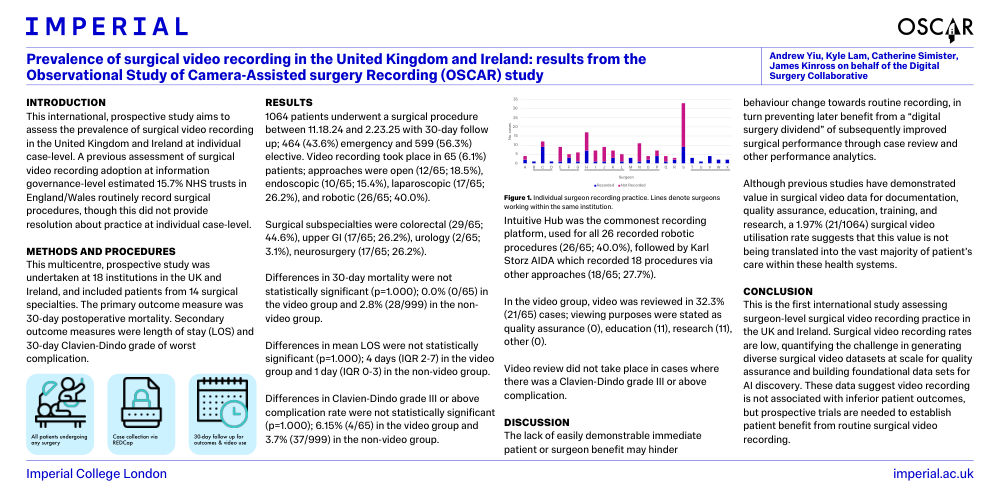
Prevalence of surgical video recording in the United Kingdom and Ireland: results from the Observational Study of Camera-Assisted surgery Recording (OSCAR) study
Poster Presenter
Authors
Andrew Yiu, Kyle Lam, Catherine Simister, James Kinross, Digital Surgery Collaborative
Affiliations
Part of Topic
Miscellaneous / Other
Prevalence of surgical video recording in the United Kingdom and Ireland: results from the
Observational Study of Camera-Assisted surgery Recording (OSCAR) study
INTRODUCTION
This international, prospective study aims to
assess the prevalence of surgical video recording
in the United Kingdom and Ireland at individual
case-level. A previous assessment of surgical
video recording adoption at information
governance-level estimated 15.7% NHS trusts in
England/Wales routinely record surgical
procedures, though this did not provide
resolution about practice at individual case-level.
METHODS AND PROCEDURES
This multicentre, prospective study was
undertaken at 18 institutions in the UK and
Ireland, and included patients from 14 surgical
specialties. The primary outcome measure was
30-day postoperative mortality. Secondary
outcome measures were length of stay (LOS) and
30-day Clavien-Dindo grade of worst
complication.
RESULTS
1064 patients underwent a surgical procedure
between 11.18.24 and 2.23.25 with 30-day follow
up; 464 (43.6%) emergency and 599 (56.3%)
elective. Video recording took place in 65 (6.1%)
patients; approaches were open (12/65; 18.5%),
endoscopic (10/65; 15.4%), laparoscopic (17/65;
26.2%), and robotic (26/65; 40.0%).
Surgical subspecialties were colorectal (29/65;
44.6%), upper GI (17/65; 26.2%), urology (2/65;
3.1%), neurosurgery (17/65; 26.2%).
Differences in 30-day mortality were not
statistically significant (p=1.000); 0.0% (0/65) in
the video group and 2.8% (28/999) in the non-
video group.
Differences in mean LOS were not statistically
significant (p=1.000); 4 days (IQR 2-7) in the video
group and 1 day (IQR 0-3) in the non-video group.
Differences in Clavien-Dindo grade III or above
complication rate were not statistically significant
(p=1.000); 6.15% (4/65) in the video group and
3.7% (37/999) in the non-video group.
Intuitive Hub was the commonest recording
platform, used for all 26 recorded robotic
procedures (26/65; 40.0%), followed by Karl
Storz AIDA which recorded 18 procedures via
other approaches (18/65; 27.7%).
In the video group, video was reviewed in 32.3%
(21/65) cases; viewing purposes were stated as
quality assurance (0), education (11), research (11),
other (0).
Video review did not take place in cases where
there was a Clavien-Dindo grade III or above
complication.
DISCUSSION
The lack of easily demonstrable immediate
patient or surgeon benefit may hinder
behaviour change towards routine recording, in
turn preventing later benefit from a “digital
surgery dividend” of subsequently improved
surgical performance through case review and
other performance analytics.
Although previous studies have demonstrated
value in surgical video data for documentation,
quality assurance, education, training, and
research, a 1.97% (21/1064) surgical video
utilisation rate suggests that this value is not
being translated into the vast majority of patient’s
care within these health systems.
CONCLUSION
This is the first international study assessing
surgeon-level surgical video recording practice in
the UK and Ireland. Surgical video recording rates
are low, quantifying the challenge in generating
diverse surgical video datasets at scale for quality
assurance and building foundational data sets for
AI discovery. These data suggest video recording
is not associated with inferior patient outcomes,
but prospective trials are needed to establish
patient benefit from routine surgical video
recording.
Andrew Yiu, Kyle Lam, Catherine Simister, James Kinross on behalf of the Digital Surgery Collaborative
Imperial College London