875 posters, 25 topics, 3,440 authors, 1,061 institutions
ePostersLive by SciGen Technologies S.A. All rights reserved.
SAGES 2026 Annual Meeting Emerging Technology Session
March 25-28, 2026 | Tampa, FL, USA

P006
Outcomes of enhanced view Totally Extra-peritoneal repair of Ventral wall Hernia from a Tertiary Care Center from India
Poster Presenter
Authors
Utkarsh Kumar, Ankita Bajpai, Omprakash Prajapati, Arun Anand, Sanjeet K Rai, Virinder K Bansal
Affiliations
Part of Topic
Abdominal Wall Hernias
OUTCOMES OF ENHANCED VIEW TOTALLY EXTRA-PERITONEAL REPAIR OF VENTRAL WALL HERNIA FROM A TERTIARY CARE CENTER FROM INDIA
MBBS, MS; Arun Anand; Utkarsh Kumar, MBBS, MS; Ankita Bajpai, MBBS, MS; Omprakash Prajapati, Sanjeet K Rai, MBBS, MS, MCh, FCLS; Virinder K Bansal, MBBS, MS, FACS, FCLS; AIIMS New Delhi
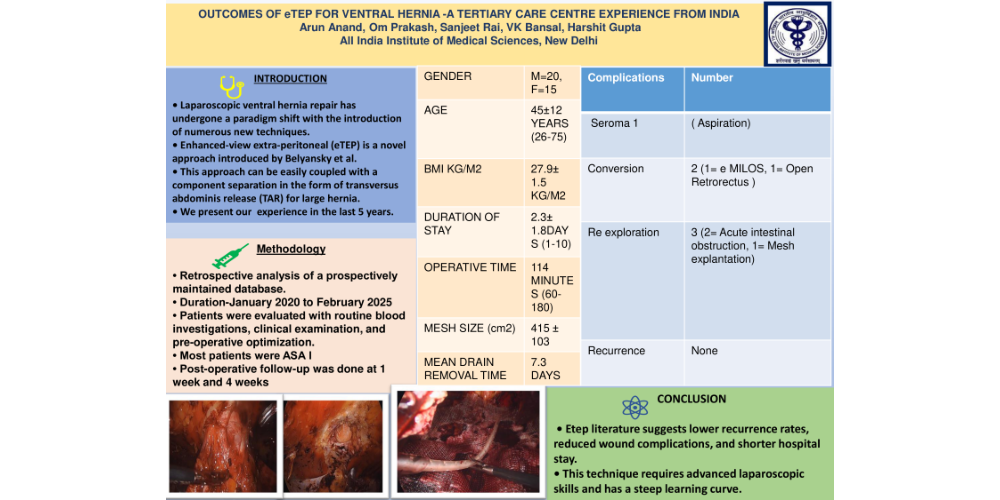
Introduction: The enhanced-view totally extraperitoneal (eTEP) technique has emerged as an alternative to conventional intraperitoneal mesh placement in ventral hernia repair, offering sublay mesh reinforcement without intraperitoneal foreign body contact. We report our experience with eTEP for primary and incisional and inguinal hernias from a tertiary care center in India.
Methods: Data of 66 patients undergoing eTEP between July 2019 and August 2025 were analyzed retrospectively from prospectively maintained database. Demographic profile, operative details, complications, and short-term outcomes were assessed.
Results: The cohort included 34 males and 32 females, with a mean age of 46.9 ± 12.1 years. Of the hernias, 44 (67%) were primary ventral and 22 (33%) incisional. Mean defect size was 8.6 ± 5.2 cm², and mean mesh size was 394 ± 128 cm². Mean operative duration was 1.8 hours (range 1–4 h). Three cases required conversion to IPOM due to dense adhesions. Postoperative complications included 3 re-explorations (2 for bowel obstruction, one for bleeding), one mesh infection necessitating explantation. Two patients developed seroma which was managed conservatively, and one mortality due to septic shock on POD14. Mean hospital stay was 1.1 ± 0.4 days. At a mean follow-up of 10 months, no recurrences were detected. Early postoperative pain and quality-of-life scores were favorable, and overall cost burden was markedly lower than that reported with intraperitoneal mesh repair.
Conclusion: eTEP repair is a versatile and effective approach for ventral hernias, providing durable repair with low early recurrence and acceptable morbidity. While technically demanding with a learning curve, the technique offers advantages in terms of reduced pain, shorter stay, and lower costs compared with traditional intraperitoneal repairs.