875 posters, 25 topics, 3,440 authors, 1,061 institutions
ePostersLive by SciGen Technologies S.A. All rights reserved.
SAGES 2026 Annual Meeting Emerging Technology Session
March 25-28, 2026 | Tampa, FL, USA

P059
A CASE OF SIMULTANEOUS ABDOMINAL WALL RECONSTRUCTION, PANNICULECTOMY, AND ROBOT SLEEVE GASTRECTOMY: EXPANDING THE ROLE OF COMBINED SURGERY
Poster Presenter
Authors
Affiliations
Part of Topic
Abdominal Wall Hernias
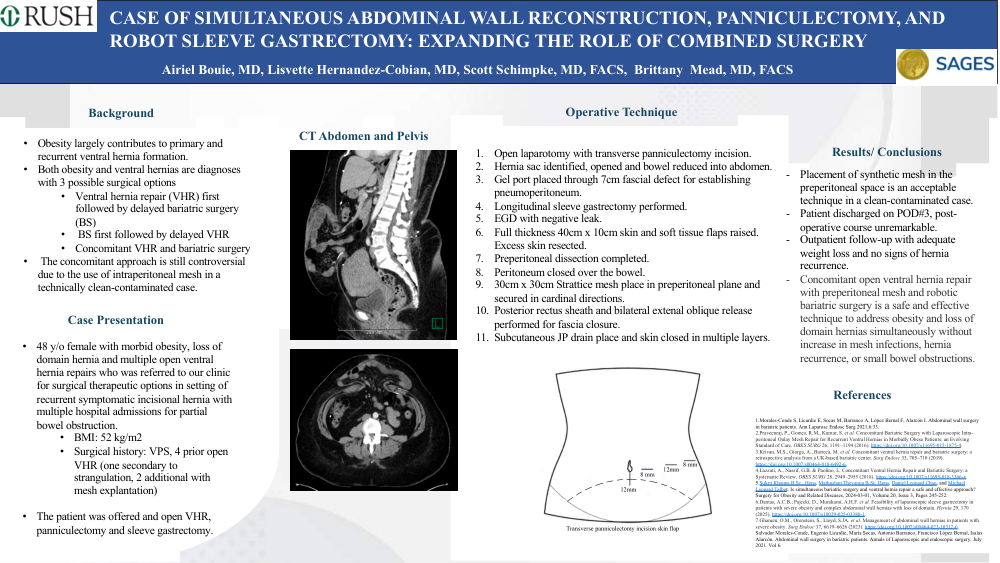
Obesity largely contributes to primary and recurrent ventral hernia formation. • Both obesity and ventral hernias are diagnoses with 3 possible surgical options • Ventral hernia repair (VHR) first followed by delayed bariatric surgery (BS) • BS first followed by delayed VHR • Concomitant VHR and bariatric surgery • The concomitant approach is still controversial due to the use of intraperitoneal mesh in a technically clean-contaminated case. • 48 y/o female with morbid obesity, loss of domain hernia and multiple open ventral hernia repairs who was referred to our clinic for surgical therapeutic options in setting of recurrent symptomatic incisional hernia with multiple hospital admissions for partial bowel obstruction. • BMI: 52 kg/m2 • Surgical history: VPS, 4 prior open VHR (one secondary to strangulation, 2 additional with mesh explantation) • The patient was offered and open VHR, panniculectomy and sleeve gastrectomy. 1. Open laparotomy with transverse panniculectomy incision. 2. Hernia sac identified, opened and bowel reduced into abdomen. 3. Gel port placed through 7cm fascial defect for establishing pneumoperitoneum. 4. Longitudinal sleeve gastrectomy performed. 5. EGD with negative leak. 6. Full thickness 40cm x 10cm skin and soft tissue flaps raised. Excess skin resected. 7. Preperitoneal dissection completed. 8. Peritoneum closed over the bowel. 9. 30cm x 30cm Strattice mesh place in preperitoneal plane and secured in cardinal directions. 10. Posterior rectus sheath and bilateral extenal oblique release performed for fascia closure. 11. Subcutaneous JP drain place and skin closed in multiple layers. Placement of synthetic mesh in the preperitoneal space is an acceptable technique in a clean-contaminated case. - Patient discharged on POD#3, postoperative course unremarkable. - Outpatient follow-up with adequate weight loss and no signs of hernia recurrence. - Concomitant open ventral hernia repair with preperitoneal mesh and robotic bariatric surgery is a safe and effective technique to address obesity and loss of domain hernias simultaneously without increase in mesh infections, hernia recurrence, or small bowel obstructions.