875 posters, 25 topics, 3,440 authors, 1,061 institutions
ePostersLive by SciGen Technologies S.A. All rights reserved.
SAGES 2026 Annual Meeting Emerging Technology Session
March 25-28, 2026 | Tampa, FL, USA

P057
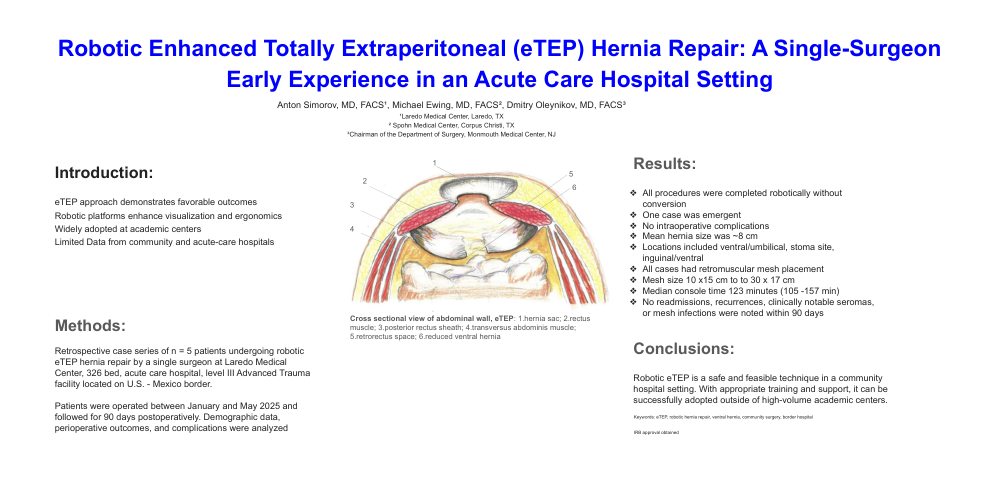
Robotic Enhanced Totally Extraperitoneal (eTEP) Hernia Repair: A Single-Surgeon Early Experience in Acute Care Hospital Setting
Poster Presenter
Authors
Affiliations
Laredo Medical Center, Spohn Medical Center, Monmouth Medical Center
Part of Topic
Abdominal Wall Hernias
ROBOTIC ENHANCED TOTALLY EXTRAPERITONEAL (ETEP) HERNIA REPAIR: A SINGLE-SURGEON EARLY EXPERIENCE IN ACUTE CARE HOSPITAL SETTING
Anton Simorov, MD, FACS1; Michael Ewing, MD, FACS2; Dmitry Oleynikov, MD, FACS3;
1Laredo Medical Center; 2Spohn Medical Center; 3Monmouth Medical Center
Background: The enhanced totally extraperitoneal (eTEP) approach to ventral hernia repair has demonstrated favorable outcomes, particularly when coupled with robotic platforms. Has been described and implemented at larger academic medical centers and university programs. However, its implementation in community hospitals, acute care facilities and border-region hospitals remains underreported.
Methods: We present a retrospective case series of five patients undergoing robotic eTEP hernia repair by a single surgeon at Laredo Medical Center, 326 bed, acute care hospital, level III Advanced Trauma facility located on U.S. - Mexico border. All patients were operated between January and May 2025 and followed for 90 days postoperatively. Demographic data, perioperative outcomes, and complications were analyzed.
Results: All five procedures were completed robotically without conversion. One case was emergent. There were no intraoperative complications. Average intraoperative hernia size was ~8 cm. Locations included ventral/umbilical, stoma site, inguinal/ventral. All cases had retromuscular mesh placement. Mesh dimensions ranged from 10x15 cm up to 30x17 cm, tailored to defect size. Median console time was 123 minutes (105 -157 min). Patients consistently reported peri-incisional pain for approximately 1 day postoperatively, with rapid return to oral intake, ambulation, and daily activities. No readmissions, recurrences, clinically notable seromas, or mesh infections were noted within 90 days. One emergent case was lost to follow-up, but elective cases all had uncomplicated recovery.
Conclusions: Robotic eTEP is a safe and feasible technique in a community hospital setting. With appropriate training and support, it can be successfully adopted outside of high-volume academic centers.