875 posters, 25 topics, 3,440 authors, 1,061 institutions
ePostersLive by SciGen Technologies S.A. All rights reserved.
SAGES 2026 Annual Meeting Emerging Technology Session
March 25-28, 2026 | Tampa, FL, USA

P488
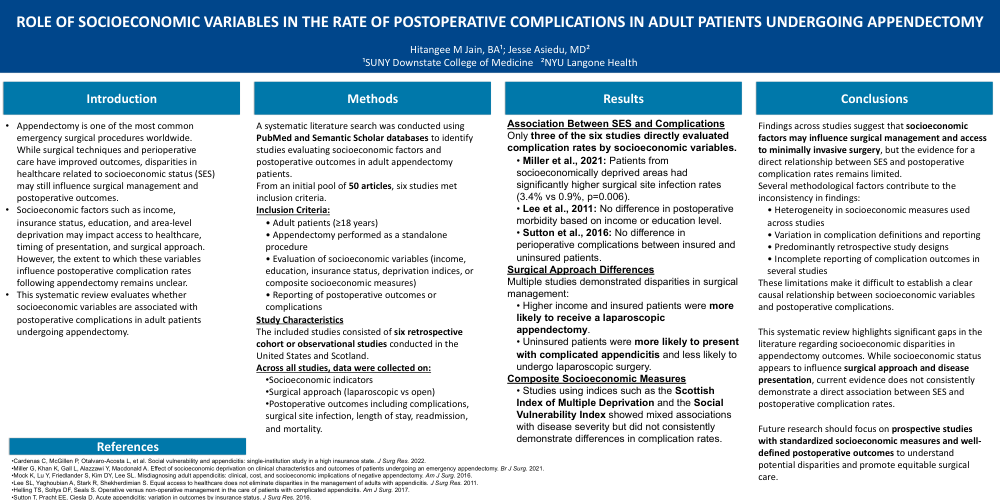
Role of Socioeconomic Variables in the Rate of Postoperative Complications in Adult Patients Undergoing Appendectomy
Poster Presenter
Authors
Affiliations
Part of Topic
Diversity and Inclusion
Introduction
• Appendectomy is one of the most common emergency surgical procedures worldwide. While surgical techniques and perioperative care have improved outcomes, disparities in healthcare related to socioeconomic status (SES) may still influence surgical management and postoperative outcomes.
• Socioeconomic factors such as income, insurance status, education, and area-level deprivation may impact access to healthcare, timing of presentation, and surgical approach. However, the extent to which these variables influence postoperative complication rates following appendectomy remains unclear.
• This systematic review evaluates whether socioeconomic variables are associated with postoperative complications in adult patients undergoing appendectomy.
Methods
A systematic literature search was conducted using PubMed and Semantic Scholar databases to identify studies evaluating socioeconomic factors and postoperative outcomes in adult appendectomy patients.
From an initial pool of 50 articles, six studies met inclusion criteria.
Inclusion Criteria
• Adult patients (≥18 years)
• Appendectomy performed as a standalone procedure
• Evaluation of socioeconomic variables (income, education, insurance status, deprivation indices, or composite socioeconomic measures)
• Reporting of postoperative outcomes or complications
Study Characteristics
The included studies consisted of six retrospective cohort or observational studies conducted in the United States and Scotland.
Across all studies, data were collected on:
• Socioeconomic indicators
• Surgical approach (laparoscopic vs open)
• Postoperative outcomes including complications, surgical site infection, length of stay, readmission, and mortality
Results
Association Between SES and Complications
Only three of the six studies directly evaluated complication rates by socioeconomic variables.
• Miller et al., 2021: Patients from socioeconomically deprived areas had significantly higher surgical site infection rates (3.4% vs 0.9%, p=0.006).
• Lee et al., 2011: No difference in postoperative morbidity based on income or education level.
• Sutton et al., 2016: No difference in perioperative complications between insured and uninsured patients.
Surgical Approach Differences
Multiple studies demonstrated disparities in surgical management:
• Higher income and insured patients were more likely to receive a laparoscopic appendectomy.
• Uninsured patients were more likely to present with complicated appendicitis and less likely to undergo laparoscopic surgery.
Composite Socioeconomic Measures
• Studies using indices such as the Scottish Index of Multiple Deprivation and the Social Vulnerability Index showed mixed associations with disease severity but did not consistently demonstrate differences in complication rates.
Conclusions
Findings across studies suggest that socioeconomic factors may influence surgical management and access to minimally invasive surgery, but the evidence for a direct relationship between SES and postoperative complication rates remains limited.
Several methodological factors contribute to the inconsistency in findings:
• Heterogeneity in socioeconomic measures used across studies
• Variation in complication definitions and reporting
• Predominantly retrospective study designs
• Incomplete reporting of complication outcomes in several studies
These limitations make it difficult to establish a clear causal relationship between socioeconomic variables and postoperative complications.
This systematic review highlights significant gaps in the literature regarding socioeconomic disparities in appendectomy outcomes. While socioeconomic status appears to influence surgical approach and disease presentation, current evidence does not consistently demonstrate a direct association between SES and postoperative complication rates.
Future research should focus on prospective studies with standardized socioeconomic measures and well-defined postoperative outcomes to better understand potential disparities and promote equitable surgical care.
References
Cardenas C, McGillen P, Calvado-Acosta L, et al. Social vulnerability and appendicitis: single-institution study in a high insurance state. J Surg Res. 2022.
Miller G, Khan K, Gall AL, Alazzawi Y, Macdonald A. Effect of socioeconomic deprivation on clinical characteristics and outcomes of patients undergoing an emergency appendectomy. Br J Surg. 2021.
Mock K, Lu Y, Friedlander S, Kim DY, Lee SL. Misdiagnosing acute appendicitis: clinical, cost, and socioeconomic implications of negative appendectomy. Am J Surg. 2016.
Lee SL, Yaghoubian A, Stark R, Shekherdimian S. Equal access to healthcare does not eliminate disparities in the management of adults with appendicitis. J Surg Res. 2011.
Helling TS, Soltys DF, Seals S. Operative versus nonoperative management in the care of patients with complicated appendicitis. Am J Surg. 2017.
Sutton T, Pracht EE, Gessel D. Acute appendicitis: variation in outcomes by insurance status. J Surg Res. 2016.