875 posters, 25 topics, 3,440 authors, 1,061 institutions
ePostersLive by SciGen Technologies S.A. All rights reserved.
SAGES 2026 Annual Meeting Emerging Technology Session
March 25-28, 2026 | Tampa, FL, USA

P460
A Rare Case of Adult Intestinal Malrotation Presenting with Intractable Hiccups
Poster Presenter
Authors
Puja Sengupta, Afia Wilson, Adrian Estrada, Sampath Subramaniam
Affiliations
Part of Topic
Colorectal
-
Intestinal malrotation is a congenital anomaly caused by incomplete rotation of the intestine during embryologic development. Commonly presents in neonates with bilious vomiting or volvulus. Adult presentation is rare, accounting for 0.2-0.5% of cases, and symptoms are nonspecific. Acute midgut volvulus in adults is a surgical emergency due to the risk of bowel ischemia and necrosis. Diagnosis may be particularly challenging in neurologically impaired or non-verbal patients with limited ability to communicate symptoms.
-
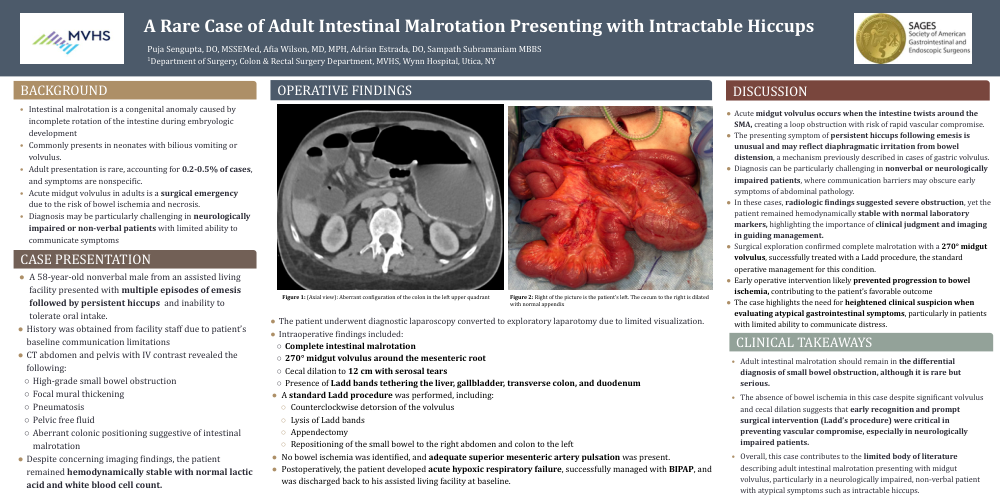
A 58-year-old nonverbal male from an assisted living facility presented with multiple episodes of emesis followed by persistent hiccups and inability to tolerate oral intake. History was obtained from facility staff due to the patient's baseline communication limitations. A CT scan of the abdomen and pelvis with IV contrast revealed the following: High-grade small bowel obstruction, focal mural thickening, pneumatosis, pelvic free fluid, and aberrant colonic positioning suggestive of intestinal malrotation. Despite concerning imaging findings, the patient remained hemodynamically stable with normal lactic acid and white blood cell count.
-
The patient underwent diagnostic laparoscopy converted to exploratory laparotomy. Intraoperative findings included: Complete intestinal malrotation, 270° midgut volvulus around the mesenteric root, cecal dilation to 12 cm with serosal tears, and the presence of Ladd bands tethering the liver, gallbladder, transverse colon, and duodenum. A standard Ladd procedure was performed, including: Counterclockwise detorsion of the volvulus, lysis of Ladd bands, appendectomy, and repositioning of the small bowel to the right abdomen and colon to the left. No bowel ischemia was identified, and adequate superior mesenteric artery pulsation was present. Postoperatively, the patient developed acute hypoxic respiratory failure, successfully managed with BIPAP, and was discharged back to his assisted living facility at baseline.
-
Acute midgut volvulus occurs when the intestine twists around the SMA, creating a loop obstruction with the risk of rapid vascular compromise. The presenting symptom of persistent hiccups following emesis is unusual and may reflect diaphragmatic irritation from bowel distension, a mechanism previously described in cases of gastric volvulus. Diagnosis can be particularly challenging in nonverbal or neurologically impaired patients, where communication barriers may obscure early symptoms of abdominal pathology. In these cases, radiologic findings suggested severe obstruction, yet the patient remained hemodynamically stable with normal laboratory markers, highlighting the importance of clinical judgment and imaging in guiding management. Surgical exploration confirmed complete malrotation with a 270° midgut volvulus, successfully treated with a Ladd procedure, the standard operative management for this condition. Early operative intervention likely prevented progression to bowel ischemia, contributing to the patient’s favorable outcome. The case highlights the need for heightened clinical suspicion when evaluating atypical gastrointestinal symptoms, particularly in patients with limited ability to communicate distress.
-
Adult intestinal malrotation should remain in the differential diagnosis of small bowel obstruction, although it is rare but serious. The absence of bowel ischemia in this case despite significant volvulus and cecal dilation suggests that early recognition and prompt surgical intervention (Ladd’s procedure) were critical in preventing vascular compromise, especially in neurologically impaired patients. Overall, this case contributes to the limited body of literature describing adult intestinal malrotation presenting with midgut volvulus, particularly in a neurologically impaired, non-verbal patient with atypical symptoms such as intractable hiccups.