875 posters, 25 topics, 3,440 authors, 1,061 institutions
ePostersLive by SciGen Technologies S.A. All rights reserved.
SAGES 2026 Annual Meeting Emerging Technology Session
March 25-28, 2026 | Tampa, FL, USA

P451
Adult Hirschsprung Disease presenting as chronic constipation
Poster Presenter
Authors
Affiliations
Part of Topic
Colorectal
Background: Hirschsprung Disease is caused by the absence of ganglion cells in the distal large colon and is most commonly diagnosed in the neonatal period.1 The most common presenting symptoms are constipation, abdominal distension, and vomiting during the first days of life. The condition affects typically 1 in 5000 live births and is more common in males. 2 Adult Hirschprung disease, made for patients 10 years old or older, is a very uncommon diagnosis and is commonly misdiagnosed as functional constipation.3
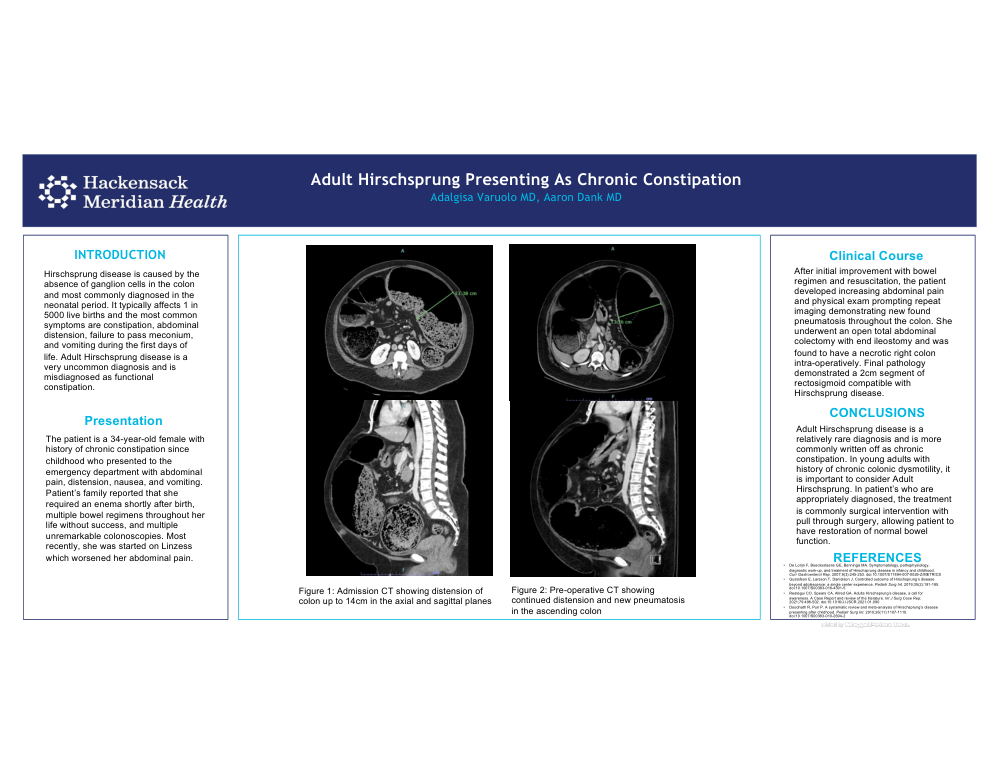
Presentation: The patient is a 34-year-old female with a past history of chronic constipation since childhood who presented to the emergency department due to abdominal pain with associated nausea and vomiting. Patient reported since childhood being on multiple bowel regimens with minimal improvement, undergoing multiple unremarkable colonoscopies, and most recently started on Linzess which she stated worsened her chronic abdominal pain. Patient upon presentation was found to have a soft yet significantly distended abdomen, a mild leukocytosis, and on CT imaging was found to have a significantly distended colon measured up to 14cm at the sigmoid colon with an abrupt caliber change at the rectosigmoid junction. After initial improvement with a bowel regimen and resuscitation, the patient began to develop increased abdominal pain with a worsening correlating physical exam prompting repeat imaging which demonstrated new found pneumatosis throughout the colon. The patient underwent an open total abdominal colectomy with end ileostomy where intraoperatively was found to have a necrotic right colon. The patient’s final pathology demonstrated an aganglionic 2cm segment of rectosigmoid junction compatible with Hirschprung’s disease. The patient’s postoperative course was uncomplicated and the patient was discharged home on postoperative day 6.
Outcomes: This 34 year old female with history of chronic constipation that persisted despite medical intervention, multiple bowel regimens, and unremarkable colonoscopies that was found to have Adult Hirschsprung Disease after undergoing a Total Abdominal Colectomy for colonic ischemia due to worsening distention. Patient post operatively did well and had an uncomplicated hospital course.
Conclusion: Adult Hirschrpung disease is a relatively rare diagnosis and is more commonly written off as chronic constipation. In young adult patients with a history of chronic colonic dysmotility, it is important to possibly consider Adult Hirschsprung on the differential diagnosis. In patients who are appropriately diagnosed, the treatment is commonly surgical intervention with pull through surgery where patients have restoration of normal bowel function.