875 posters, 25 topics, 3,440 authors, 1,061 institutions
ePostersLive by SciGen Technologies S.A. All rights reserved.
SAGES 2026 Annual Meeting Emerging Technology Session
March 25-28, 2026 | Tampa, FL, USA

P409
Impact of Dehydrated Human Amnion/Chorion Membrane on Stricture Formation After Low Anterior Resection in Cancer Patients Without Protective Stoma
Poster Presenter
Authors
Bidhan Das, Dennis Choat, Nezar Jrebi, Taher Sapatwalla, Jealeanet Diez, Matthew Bardin
Affiliations
Southwest Surgical Associates, Piedmont Physicians Colon and Rectal Surgery of Fayetteville, North Texas Surgical Specialists, Henry Ford Warren Hospital, University of Florida College of Pharmacy, STC Clinical, LLC
Part of Topic
Colorectal
Introduction
Anastomotic stricture is a significant long-term complication following low anterior resection (LAR) for colorectal cancer, with reported stricture rates in this population around 2.7-5.9%.1,2 Stricture prevention is important for maintaining quality of life and preventing further complications. Anastomotic stricture arises from multiple factors, including fibrosis, inflammation, leakage, radiotherapy, ischemia, and surgical technique.3
Dehydrated human amnion/chorion membrane (DHACM) allografts preserve cytokines, growth factors, and tissue inhibitors of metalloproteinases that support wound healing and tissue regeneration, while also providing an immune-privileged biologic matrix for cellular ingrowth.4 Animal studies in chemotherapy- and radiation-compromised models indicate amniotic membranes enhance anastomotic healing by strengthening tissue, promoting angiogenesis, stimulating fibroblast activity, supporting collagen deposition, and reducing inflammation and adhesions, thereby limiting fibrosis and stricture formation.5-7
Methods
This chart review evaluated real-world outcomes in consecutive adults undergoing LAR for colorectal cancer, where DHACM was wrapped around the colorectal anastomosis between January 2016 and June 2024. The study excluded patients with a protective stoma and those without follow up (colonoscopy or imaging) to assess anastomotic stricture. The primary endpoint was stricture formation, diagnosed by direct visualization and/or imaging, from at least 6 weeks post-operative to the end of the follow-up period. Secondary endpoints included anastomotic leak and 30-day readmission. An IRB exemption was granted before data collection.
Results
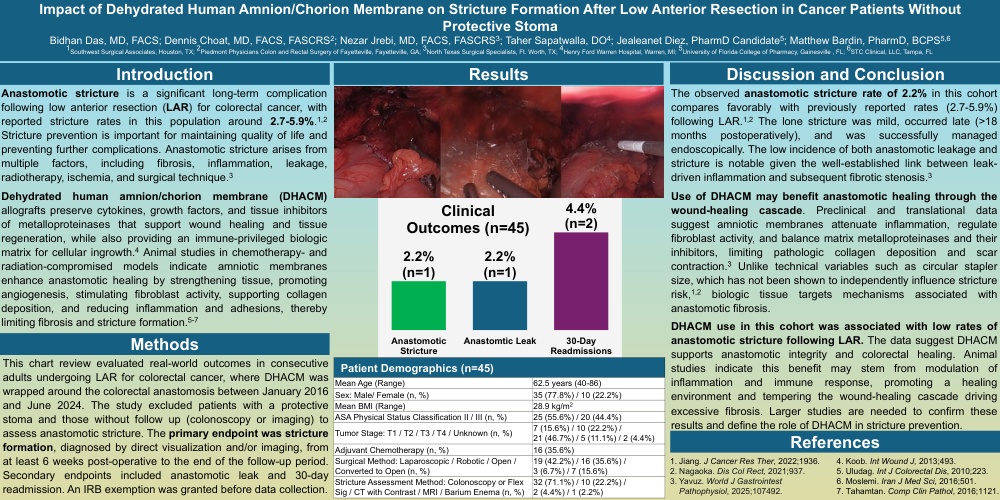
Among 45 patients receiving DHACM (Figure 1), only one (2.2%) developed an AS. The patient was a 68 y/o male with T3 rectal cancer, diagnosed with a mild, AS identified through colonoscopy on post-operative day 548. The stricture was resolved with dilation, follow-up endoscopy confirming resolution with a widely patent anastomosis. Regarding secondary outcomes, there was one (2.2%) anastomotic leak, two patients (4.4%) had unplanned readmissions within 30 days, and no deaths.
|
Figure 1. Patient Demographics and Outcomes |
|
|
Patient Demographics |
|
|
Mean Age (Range) |
62.5 years (40-86) |
|
Sex: Male/ Female (n, %) |
35 (77.8%) / 10 (22.2%) |
|
Mean BMI (Range) |
28.9 kg/m2 (18.8-48.9) |
|
ASA Physical Status Classification II / III (n, %) |
25 (55.6%) / 20 (44.4%) |
|
Tumor Stage: T1 / T2 / T3 / T4 / Unknown (n, %) |
7 (15.6%) / 10 (22.2%) / 21 (46.7%) / 5 (11.1%) / 2 (4.4%) |
|
Adjuvant Chemotherapy (n,%) |
16 (35.6%) |
|
Surgical Method: Laparoscopic / Robotic / Open / Converted to Open (n, %) |
19 (42.2%) / 16 (35.6%) / 3 (6.7%) / 7 (15.6%) |
|
Stricture Assessment Method: Colonoscopy or Flex Sig / CT with Contrast / MRI / Barium Enema (n, %) |
32 (71.1%) / 10 (22.2%) / 2 (4.4%) / 1 (2.2%) |
|
Primary Endpoint |
|
|
Anastomotic Stricture |
2.2% (1 / 45) |
|
Secondary Endpoints |
|
|
Anastomotic Leak |
2.2% (1/45) |
|
30-Day All-Cause Readmissions |
4.4% (2/45) |
|
Follow Up |
|
|
Median Time to First Follow Up (IQR); Mean |
485 days (302-759); 686 days |
|
Median Time to Last Follow Up (IQR); Mean |
758 days (384-1823); 1091 days |
Discussion and Conclusion
The observed anastomotic stricture rate of 2.2% in this cohort compares favorably with previously reported rates (2.7-5.9%) following LAR.1,2 The lone stricture was mild, occurred late (>18 months postoperatively), and was successfully managed endoscopically. The low incidence of both anastomotic leakage and stricture is notable given the well-established link between leak-driven inflammation and subsequent fibrotic stenosis.3
Use of DHACM may benefit anastomotic healing through the wound-healing cascade. Preclinical and translational data suggest amniotic membranes attenuate inflammation, regulate fibroblast activity, and balance matrix metalloproteinases and their inhibitors, limiting pathologic collagen deposition and scar contraction.3 Unlike technical variables such as circular stapler size, which has not been shown to independently influence stricture risk,1,2 biologic tissue targets mechanisms associated with anastomotic fibrosis.
DHACM use in this cohort was associated with low rates of anastomotic stricture following LAR. The data suggest DHACM supports anastomotic integrity and colorectal healing. Animal studies indicate this benefit may stem from modulation of inflammation and immune response, promoting a healing environment and tempering the wound-healing cascade driving excessive fibrosis. Larger studies are needed to confirm these results and define the role of DHACM in stricture prevention.