875 posters, 25 topics, 3,440 authors, 1,061 institutions
ePostersLive by SciGen Technologies S.A. All rights reserved.
SAGES 2026 Annual Meeting Emerging Technology Session
March 25-28, 2026 | Tampa, FL, USA

P399
Palliative Care Utilization in Geriatric Patients Undergoing Surgery for Colorectal Emergencies
Part of Topic
Colorectal
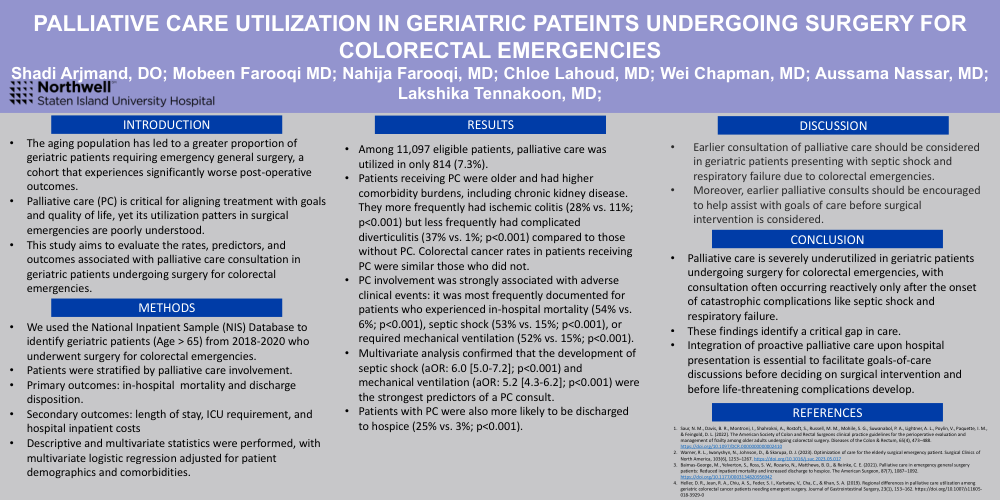
•The aging population has led to a greater proportion of geriatric patients requiring emergency general surgery, a cohort that experiences significantly worse post-operative outcomes.
•Palliative care (PC) is critical for aligning treatment with goals and quality of life, yet its utilization patters in surgical emergencies are poorly understood.
•This study aims to evaluate the rates, predictors, and outcomes associated with palliative care consultation in geriatric patients undergoing surgery for colorectal emergencies.
•We used the National Inpatient Sample (NIS) Database to identify geriatric patients (Age > 65) from 2018-2020 who underwent surgery for colorectal emergencies.
•Patients were stratified by palliative care involvement.
•Primary outcomes: in-hospital mortality and discharge disposition.
•Secondary outcomes: length of stay, ICU requirement, and hospital inpatient costs
•Descriptive and multivariate statistics were performed, with multivariate logistic regression adjusted for patient demographics and comorbidities.
•Among 11,097 eligible patients, palliative care was utilized in only 814 (7.3%).
•Patients receiving PC were older and had higher comorbidity burdens, including chronic kidney disease. They more frequently had ischemic colitis (28% vs. 11%; p<0.001) but less frequently had complicated diverticulitis (37% vs. 1%; p<0.001) compared to those without PC. Colorectal cancer rates in patients receiving PC were similar those who did not.
•PC involvement was strongly associated with adverse clinical events: it was most frequently documented for patients who experienced in-hospital mortality (54% vs. 6%; p<0.001), septic shock (53% vs. 15%; p<0.001), or required mechanical ventilation (52% vs. 15%; p<0.001).
•Multivariate analysis confirmed that the development of septic shock (aOR: 6.0 [5.0-7.2]; p<0.001) and mechanical ventilation (aOR: 5.2 [4.3-6.2]; p<0.001) were the strongest predictors of a PC consult.
•Patients with PC were also more likely to be discharged to hospice (25% vs. 3%; p<0.001).
•Earlier consultation of palliative care should be considered in geriatric patients presenting with septic shock and respiratory failure due to colorectal emergencies.
•Moreover, earlier palliative consults should be encouraged to help assist with goals of care before surgical intervention is considered.
•Palliative care is severely underutilized in geriatric patients undergoing surgery for colorectal emergencies, with consultation often occurring reactively only after the onset of catastrophic complications like septic shock and respiratory failure.
•These findings identify a critical gap in care.
•Integration of proactive palliative care upon hospital presentation is essential to facilitate goals-of-care discussions before deciding on surgical intervention and before life-threatening complications develop.