875 posters, 25 topics, 3,440 authors, 1,061 institutions
ePostersLive by SciGen Technologies S.A. All rights reserved.
SAGES 2026 Annual Meeting Emerging Technology Session
March 25-28, 2026 | Tampa, FL, USA

P302
Efficacy and safety of sleeve gastrectomy in elderly people over 65 years
Poster Presenter
Part of Topic
Bariatric
EFFICACY AND SAFETY OF LAPAROSCOPIC SLEEVE GASTRECTOMY
IN ELDERLY PEOPLE OVER 65 YEARS
General Surgery Department, Faculty of Medicine, Kafrelsheikh University, Egypt
Reda Fawzy Ali, Ragab Seddik, Mohamed Elemawy, Ahmed Gheda, Mohamed Rizk Bishr, Ahmed Sedky Eltaie,
Mohamed Mostafa Omar
Clinical Challenge
• Obesity in elderly patients (≥65 years) represents a major health crisis
with disproportionate comorbidity burden and reduced life
expectancy. Bariatric surgery was historically contraindicated in
patients over 50 due to concerns about morbidity and mortality. Recent
guidelines from IFSO and ASMBS support metabolic and bariatric
surgery in elderly patients, but prospective evidence specifically in the
≥65 age group remains limited.
Study Aim
• To assess the safety and efficacy of laparoscopic sleeve gastrectomy
(LSG) in patients aged 65 years and older, evaluating weight loss
outcomes and comorbidity resolution over 12 months.
Hypothesis
• Laparoscopic sleeve gastrectomy is safe and effective for elderly patients,
achieving significant weight reduction and comorbidity improvement
with acceptable complication rates.
BACKGROUND & AIM
EFFICACY AND SAFETY OF LAPAROSCOPIC SLEEVE GASTRECTOMY
IN ELDERLY PEOPLE OVER 65 YEARS
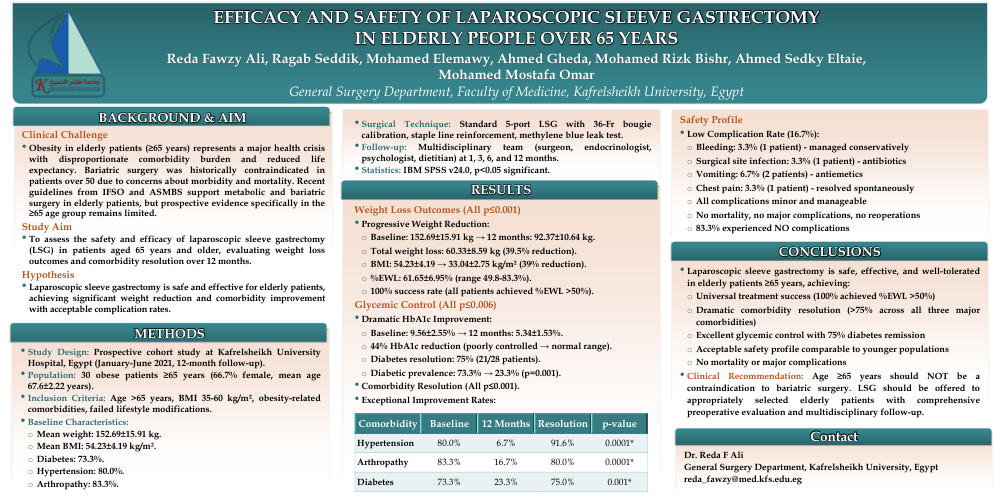
Weight Loss Outcomes (All p≤0.001)
• Progressive Weight Reduction:
o Baseline: 152.69±15.91 kg → 12 months: 92.37±10.64 kg.
o Total weight loss: 60.33±8.59 kg (39.5% reduction).
o BMI: 54.23±4.19 → 33.04±2.75 kg/m² (39% reduction).
o %EWL: 61.65±6.95% (range 49.8-83.3%).
o 100% success rate (all patients achieved %EWL >50%).
Glycemic Control (All p≤0.006)
• Dramatic HbA1c Improvement:
o Baseline: 9.56±2.55% → 12 months: 5.34±1.53%.
o 44% HbA1c reduction (poorly controlled → normal range).
o Diabetes resolution: 75% (21/28 patients).
o Diabetic prevalence: 73.3% → 23.3% (p=0.001).
• Comorbidity Resolution (All p≤0.001).
• Exceptional Improvement Rates:
RESULTS
Safety Profile
• Low Complication Rate (16.7%):
o Bleeding: 3.3% (1 patient) - managed conservatively
o Surgical site infection: 3.3% (1 patient) - antibiotics
o Vomiting: 6.7% (2 patients) - antiemetics
o Chest pain: 3.3% (1 patient) - resolved spontaneously
o All complications minor and manageable
o No mortality, no major complications, no reoperations
o 83.3% experienced NO complications
• Study Design: Prospective cohort study at Kafrelsheikh University
Hospital, Egypt (January-June 2021, 12-month follow-up).
• Population: 30 obese patients ≥65 years (66.7% female, mean age
67.6±2.22 years).
• Inclusion Criteria: Age >65 years, BMI 35-60 kg/m²
, obesity-related
comorbidities, failed lifestyle modifications.
• Baseline Characteristics:
o Mean weight: 152.69±15.91 kg.
o Mean BMI: 54.23±4.19 kg/m²
.
o Diabetes: 73.3%.
o Hypertension: 80.0%.
o Arthropathy: 83.3%.
METHODS
Comorbidity Baseline 12 Months Resolution p-value
Hypertension 80.0% 6.7% 91.6% 0.0001*
Arthropathy 83.3% 16.7% 80.0% 0.0001*
Diabetes 73.3% 23.3% 75.0% 0.001*
• Laparoscopic sleeve gastrectomy is safe, effective, and well-tolerated
in elderly patients ≥65 years, achieving:
o Universal treatment success (100% achieved %EWL >50%)
o Dramatic comorbidity resolution (>75% across all three major
comorbidities)
o Excellent glycemic control with 75% diabetes remission
o Acceptable safety profile comparable to younger populations
o No mortality or major complications
• Clinical Recommendation: Age ≥65 years should NOT be a
contraindication to bariatric surgery. LSG should be offered to
appropriately selected elderly patients with comprehensive
preoperative evaluation and multidisciplinary follow-up.
CONCLUSIONS
Dr. Reda F Ali
General Surgery Department, Kafrelsheikh University, Egypt
reda_fawzy@med.kfs.edu.eg
Contact
• Surgical Technique: Standard 5-port LSG with 36-Fr bougie
calibration, staple line reinforcement, methylene blue leak test.
• Follow-up: Multidisciplinary team (surgeon, endocrinologist,
psychologist, dietitian) at 1, 3, 6, and 12 months.
• Statistics: IBM SPSS v24.0, p<0.05 significant.