875 posters, 25 topics, 3,440 authors, 1,061 institutions
ePostersLive by SciGen Technologies S.A. All rights reserved.
SAGES 2026 Annual Meeting Emerging Technology Session
March 25-28, 2026 | Tampa, FL, USA

P200
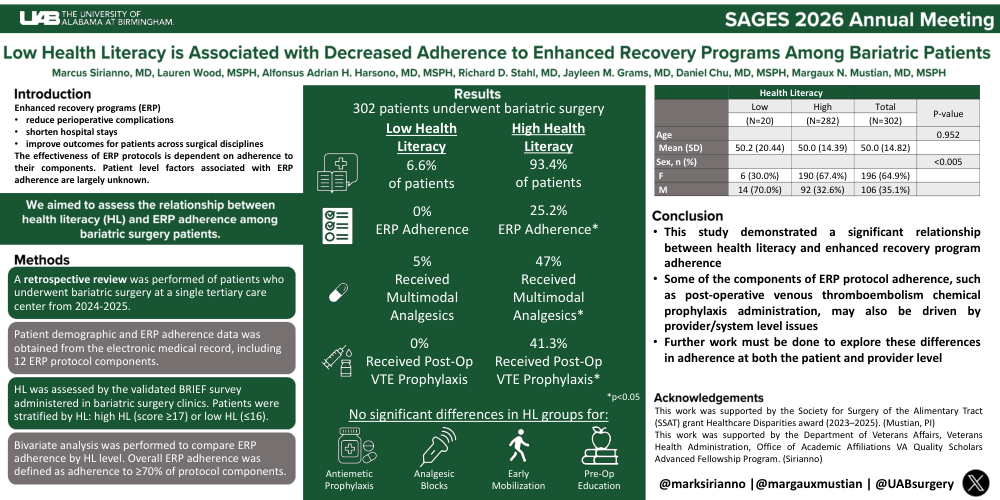
Low Health Literacy is Associated with Decreased Adherence to Enhanced Recovery Programs Among Bariatric Patients
Poster Presenter
Authors
Marcus P Sirianno, Lauren Wood, Alfonsus Adrian H Harsono, Richard D Stahl, Jayleen M Grams, Daniel I Chu, Margaux M Mustian
Affiliations
Department of Surgery, University of Alabama at Birmingham, Birmingham, AL, Department of Surgery. Birmingham Veterans Affairs Medical Center. Birmingham, AL
Part of Topic
Bariatric
Low Health Literacy is Associated with Decreased Adherence to Enhanced Recovery Programs Among Bariatric Patients
Marcus Sirianno, MD, Lauren Wood, MSPH, Alfonsus Adrian H. Harsono, MD, MSPH, Richard D. Stahl, MD, Jayleen M. Grams, MD, Daniel Chu, MD, MSPH, Margaux N. Mustian, MD, MSPH
Introduction:
Enhanced recovery programs (ERP)
•reduce perioperative complications
•shorten hospital stays
•improve outcomes for patients across surgical disciplines
The effectiveness of ERP protocols is dependent on adherence to their components. Patient level factors associated with ERP adherence are largely unknown.
Aim:
We aimed to assess the relationship between health literacy (HL) and ERP adherence among bariatric surgery patients.
Methods:
A retrospective review was performed at a single tertiary care center from 2024-2025. Patient demographic and ERP adherence data was obtained from the electronic medical record, including 12 ERP protocol components. HL was assessed by the validated BRIEF survey administered in bariatric surgery clinics. Patients were then stratified by HL: high HL (score ≥17) and low HL (≤16). Bivariate analysis was then performed to compare ERP adherence by HL level. Overall ERP adherence was defined as adherence to ≥70% of protocol components.
Results:
302 patients underwent bariatric surgery at a single institution from April 2024 through August of 2025 and were included in the study. Of these patients, 6.6% (n=20) had low HL, while 93.4% (n=282) had high HL. Mean age was similar for patients with low and high HL (table). Low HL patients were more likely to be male (70.0%), when compared to high HL patients (32.6%, p <0.005). Overall ERP adherence was achieved in 23.5% of patients, including 25.2% of high HL patients and none of the low HL patients (p=0.01). Only 5.0% of low HL patients received multimodal analgesics per ERP protocol compared to 47.0% of high HL patients (p <0.005). Additionally, low HL patients were significantly less likely to receive post-operative venous thromboembolism chemical prophylaxis within 24 hours, with an adherence rate of 0.0% compared to high HL patients with an adherence rate of 41.3% (p <0.005). Highest adherence was seen with antiemetic prophylaxis, analgesic blocks, early mobilization, and preoperative education, without a statistical difference between HL groups.
Conclusion:
This study demonstrated a significant relationship between health literacy and enhanced recovery program adherence
Some of the components of ERP protocol adherence, such as post-operative venous thromboembolism chemical prophylaxis administration, may also be driven by provider/system level issues
Further work must be done to explore these differences in adherence at both the patient and provider level