875 posters, 25 topics, 3,440 authors, 1,061 institutions
ePostersLive by SciGen Technologies S.A. All rights reserved.
SAGES 2026 Annual Meeting Emerging Technology Session
March 25-28, 2026 | Tampa, FL, USA

P198
Laparoscopic Roux-en-Y Gastric Bypass - 20-Year Weight Loss Outcomes and Beyond
Poster Presenter
Authors
Mark Bourne, Aryel Furman, Krystyna Kabata, Ziyad Nasrawi, Piotr Gorecki
Affiliations
Part of Topic
Bariatric
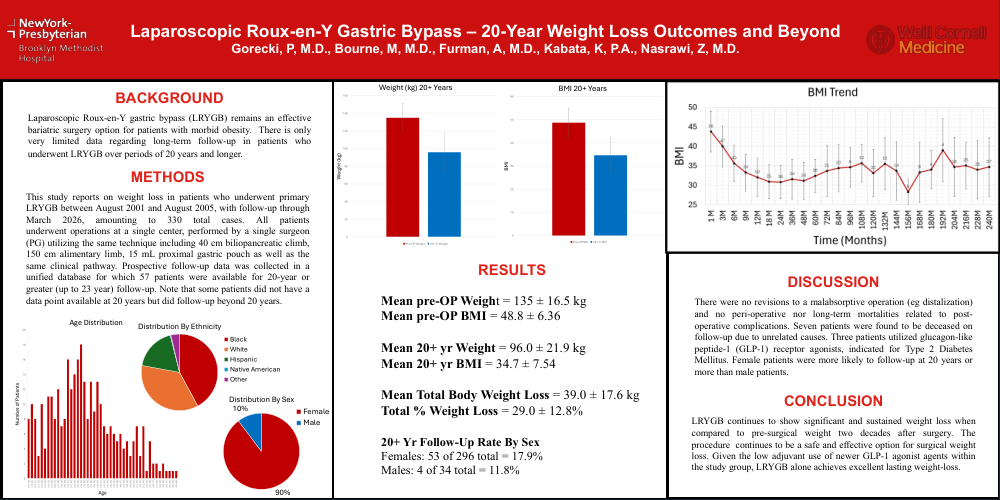
Laparoscopic Roux-en-Y Gastric Bypass – 20-Year Weight Loss Outcomes and Beyond
Gorecki, P, M.D., Bourne, M, M.D., Furman, A, M.D., Kabata, K, P.A., Nasrawi, Z, M.D.
BACKGROUND
Laparoscopic Roux-en-Y gastric bypass (LRYGB) remains an effectivebariatric surgery option for patients with morbid obesity. There is onlyvery limited data regarding long-term follow-up in patients whounderwent LRYGB over periods of 20 years and longer.
METHODS
This study reports on weight loss in patients who underwent primaryLRYGB between August 2001 and August 2005, with follow-up throughMarch 2026, amounting to 330 total cases. All patientsunderwent operations at a single center, performed by a single surgeon(PG) utilizing the same technique including 40 cm biliopancreatic climb,150 cm alimentary limb, 15 mL proximal gastric pouch as well as thesame clinical pathway. Prospective follow-up data was collected in aunified database for which 57 patients were available for 20-year orgreater (up to 23 year) follow-up. Note that some patients did not have adata point available at 20 years but did follow-up beyond 20 years.
RESULTS
Mean pre-OP Weight = 135 ± 16.5 kg
Mean pre-OP BMI = 48.8 ± 6.36
Mean 20+ yr Weight = 96.0 ± 21.9 kg
Mean 20+ yr BMI = 34.7 ± 7.54
Mean Total Body Weight Loss = 39.0 ± 17.6 kg
Total % Weight Loss = 29.0 ± 12.8%
20+ Yr Follow-Up Rate By Sex
Females: 53 of 296 total = 17.9%
Males: 4 of 34 total = 11.8%
DISCUSSION
There were no revisions to a malabsorptive operation (eg distalization)and no peri-operative nor long-term mortalities related to post-operative complications. Seven patients were found to be deceased onfollow-up due to unrelated causes. Three patients utilized glucagon-likepeptide-1 (GLP-1) receptor agonists, indicated for Type 2 DiabetesMellitus. Female patients were more likely to follow-up at 20 years ormore than male patients.
CONCLUSION
LRYGB continues to show significant and sustained weight loss whencompared to pre-surgical weight two decades after surgery. Theprocedure continues to be a safe and effective option for surgical weightloss. Given the low adjuvant use of newer GLP-1 agonist agents withinthe study group, LRYGB alone achieves excellent lasting weight-loss.