875 posters, 25 topics, 3,440 authors, 1,061 institutions
ePostersLive by SciGen Technologies S.A. All rights reserved.
SAGES 2026 Annual Meeting Emerging Technology Session
March 25-28, 2026 | Tampa, FL, USA

P015
Frailty Index As A Predictive Tool For Outcomes After Ventral Hernia Repair - Systematic Review and Meta-Analysis
Poster Presenter
Authors
DIego L Lima, Maria Clara Morais, Denise P Almeida, Guilherme C Caldas, Marina F Pereira, Julia Apocalypse, Louise W Costa Cruz, Raquel Nogueira, Flavio Malcher
Affiliations
Montefiore Medical Center, Lenox Hill Hospital, Northwell, Centro Universitario Cesmac, Universidade de Brasilia, Pontifica Universidade Catolica do Rio Grande do Sul, Pontifícia Universidade Católica do Paraná
Part of Topic
Abdominal Wall Hernias
Frailty Index As A Predictive Tool For Poor Outcomes After Ventral Hernia Repair – Systematic Review and Meta-Analysis
Authors: Maria Clara Morais, MD1, Denise Padilha Abs de Almeida2, Guilherme de Carvalho Caldas, MD3, Marina Fração Pereira4, Julia Apocalypse5, Louise Webster Lima Costa Cruz5, Raquel Nogueira, MD6, Diego Laurentino Lima, MD, MSc6
Affiliations:
- Department of Surgery, Lenox Hill Hospital, New York, NY. Email: drmariamorais@gmail.com
- Centro Universitário Cesmac, Maceió, Brasil. E-mail: denisepadilhaa@hotmail.com
- Universidade de Brasília, Brasília, Distrito Federal, Brasil. E-mail: guilherme.caldas92@gmail.com
- Pontifícia Universidade Católica do Rio Grande do Sul, Porto Alegre, Brazil. Email: marinafracaopereira@gmail.com
- Pontifícia Universidade Católica do Paraná, Curitiba, Brazil. Email: apocalypsejulia@gmail.com louisecostacruz@hotmail.com
- Montefiore Medical Center, Bronx, New York, United States. Email: raquelnogueiramd@gmail.com dlima@montefiore.org
ABSTRACT:
Introduction: Frailty, characterized by reduced physiologic reserve and heightened vulnerability to surgical stress, has emerged as a key predictor of adverse postoperative outcomes. The modified 5-factor frailty index (mFI-5) offers a simplified yet validated framework for quantifying frailty in clinical practice. While its predictive utility is established in multiple surgical specialties, its role in ventral hernia repair (VHR) has not been comprehensively synthesized. This systematic review and meta-analysis evaluated the association between frailty, as measured by mFI-5, and postoperative outcomes in elective VHR.
Methods: Following PRISMA guidelines, the authors searched PubMed, EMBASE, LILACS, and Cochrane databases through April 2025. Adult patients undergoing elective VHR were included if outcomes were stratified by mFI-5 frailty status. Data on demographics, hernia characteristics, complications, readmissions, reoperations, length of stay (LOS), and mortality were extracted. Random-effects meta-analyses assessed pooled risk ratios (RR) for key outcomes. Study quality and risk of bias were evaluated using ROBINS-I.
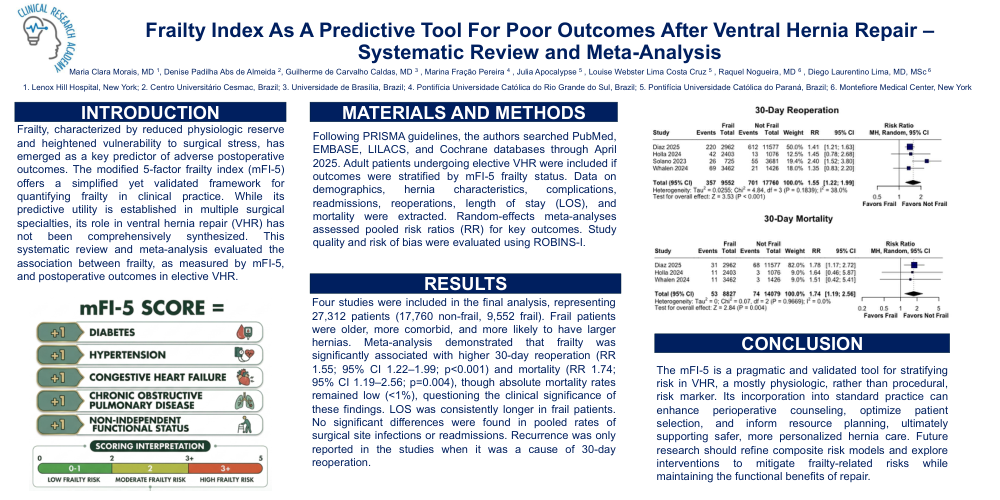
Results: Four studies were included in the final analysis, representing 27,312 patients (17,760 non-frail, 9,552 frail). Frail patients were older, more comorbid, and more likely to have larger hernias. Meta-analysis demonstrated that frailty was significantly associated with higher 30-day reoperation (RR 1.55; 95% CI 1.22–1.99; p<0.001) and mortality (RR 1.74; 95% CI 1.19–2.56; p=0.004), though absolute mortality rates remained low (<1%), questioning the clinical significance of these findings. LOS was consistently longer in frail patients. No significant differences were found in pooled rates of surgical site infections or readmissions. Recurrence was only reported in the studies when it was a cause of 30-day reoperation.
Conclusion: The mFI-5 is a pragmatic and validated tool for stratifying risk in VHR, a mostly physiologic, rather than procedural, risk marker. Its incorporation into standard practice can enhance perioperative counseling, optimize patient selection, and inform resource planning, ultimately supporting safer, more personalized hernia care. Future research should refine composite risk models and explore interventions to mitigate frailty-related risks while maintaining the functional benefits of repair.