119 posters, 6 topics, 524 authors, 243 institutions
ePostersLive by SciGen Technologies S.A. All rights reserved.
RCR Global AI Conference 2026
29-30 June, 2026 | QEII Centre, Westminster

79
<p>ARTIFICIAL INTELLIGENCE IN BREAST IMAGING: A SYSTEMATIC REVIEW OF THE CURRENT SITUATION IN AFRICA</p>
Part of Topic
AI vigilance – Post-implementation monitoring, real world performance evaluation, health economic evaluation
ARTIFICIAL INTELLIGENCE IN BREAST IMAGING: A SYSTEMATIC REVIEW OF THE CURRENT SITUATION IN AFRICA
Babajide Imran Wale-Akinyemi1, Elizabeth AyoOluwa Idowu1, Adenike Temitayo Adeniji-Sofoluwe1,2
1 Department of Radiology, University College Hospital, Ibadan, Nigeria
2 Faculty of Clinical Sciences, College of Medicine, University of Ibadan, Ibadan, Nigeria
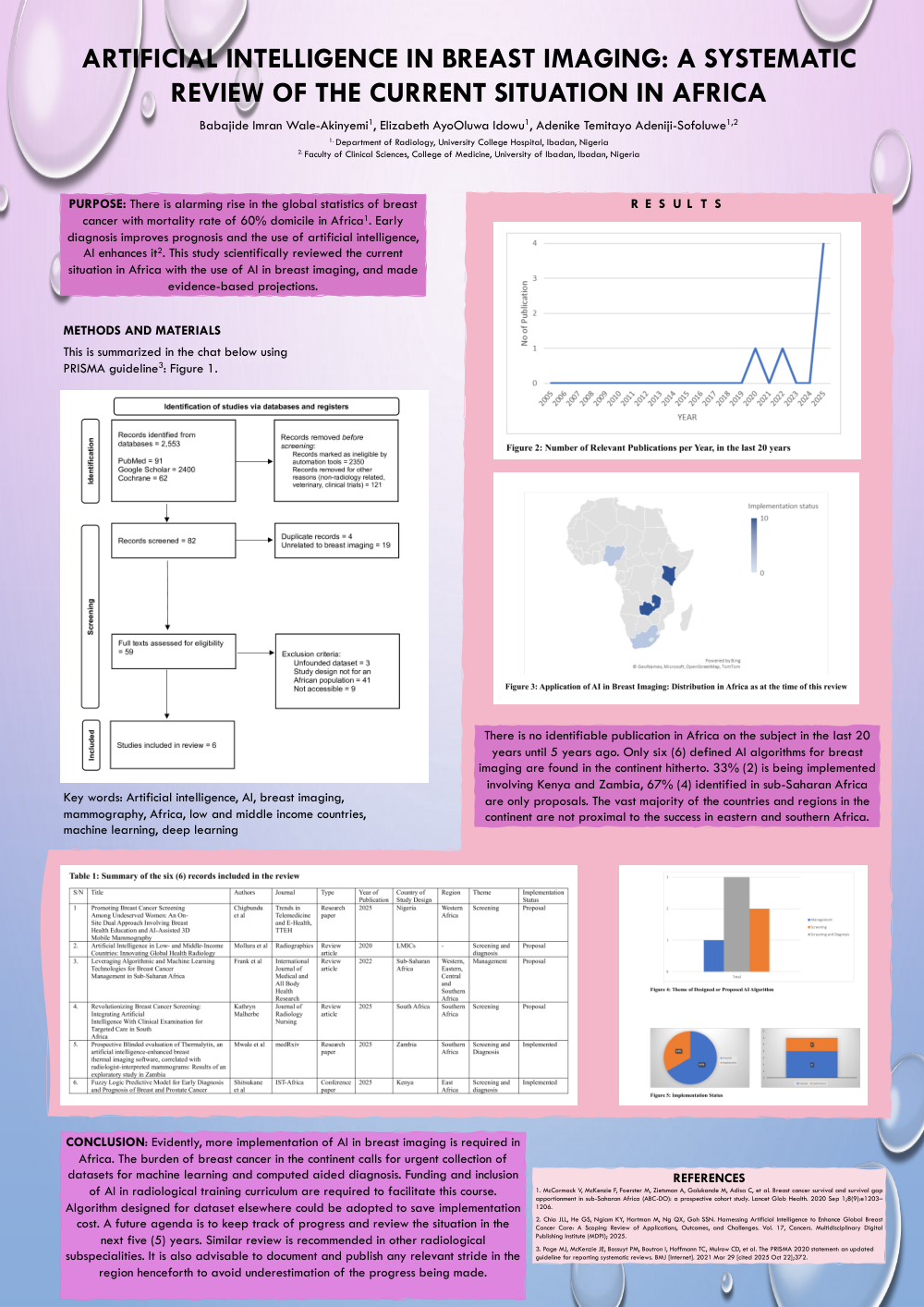
Purpose: There is alarming rise in the global statistics of breast cancer with mortality rate of 60 percent domicile in Africa. Early diagnosis improves prognosis and the use of artificial intelligence, AI enhances it. This study scientifically reviewed the current situation in Africa with the use of AI in breast imaging, and made evidence-based projections.
Methods and materials: Relevant articles were searched on PubMed, Google Scholar and Cochrane spanning 20 years between 2015 to 2025. The key words used were artificial intelligence, AI, breast imaging, mammography, Africa, low- and middle-income countries, machine learning, deep learning and computer aided diagnosis, CAD. 2,553 records were initially obtained. These were screened using the 2020 updated PRISMA guideline, leaving a total of six (6) records. Exclusion criteria were non-English publications, clinical trials, unfounded dataset and study design or breast AI algorithm not for an African dataset. The included records were research, review and conference papers. They were extracted to Microsoft Excel for descriptive analysis with respect to the year and theme of publication, zone of study design and implementation status.
Results: There is no identifiable publication in Africa on the subject in the last 20 years until 5 years ago. Only six (6) defined AI algorithms for breast imaging are found in the continent hitherto. 33% (2) is being implemented involving Kenya and Zambia, 67% (4) identified in sub-Saharan Africa are only proposals. The vast majority of the countries and regions in the continent are not proximal to the success in southern and eastern Africa.
Conclusion: Evidently, more implementation of AI in breast imaging is required in Africa. The burden of breast cancer in the continent calls for urgent collection of datasets for machine learning and computed aided diagnosis. Funding and inclusion of AI in radiological training curriculum are required to facilitate this course. Algorithm designed for dataset elsewhere could be adopted to save implementation cost. A future agenda is to keep track of progress and review the situation in the next five (5) years. Similar review is recommended in other radiological subspecialities. It is also advisable to document and publish any relevant stride in the region henceforth to avoid underestimation of the progress being made.