119 posters, 6 topics, 524 authors, 243 institutions
ePostersLive by SciGen Technologies S.A. All rights reserved.
RCR Global AI Conference 2026
29-30 June, 2026 | QEII Centre, Westminster

208
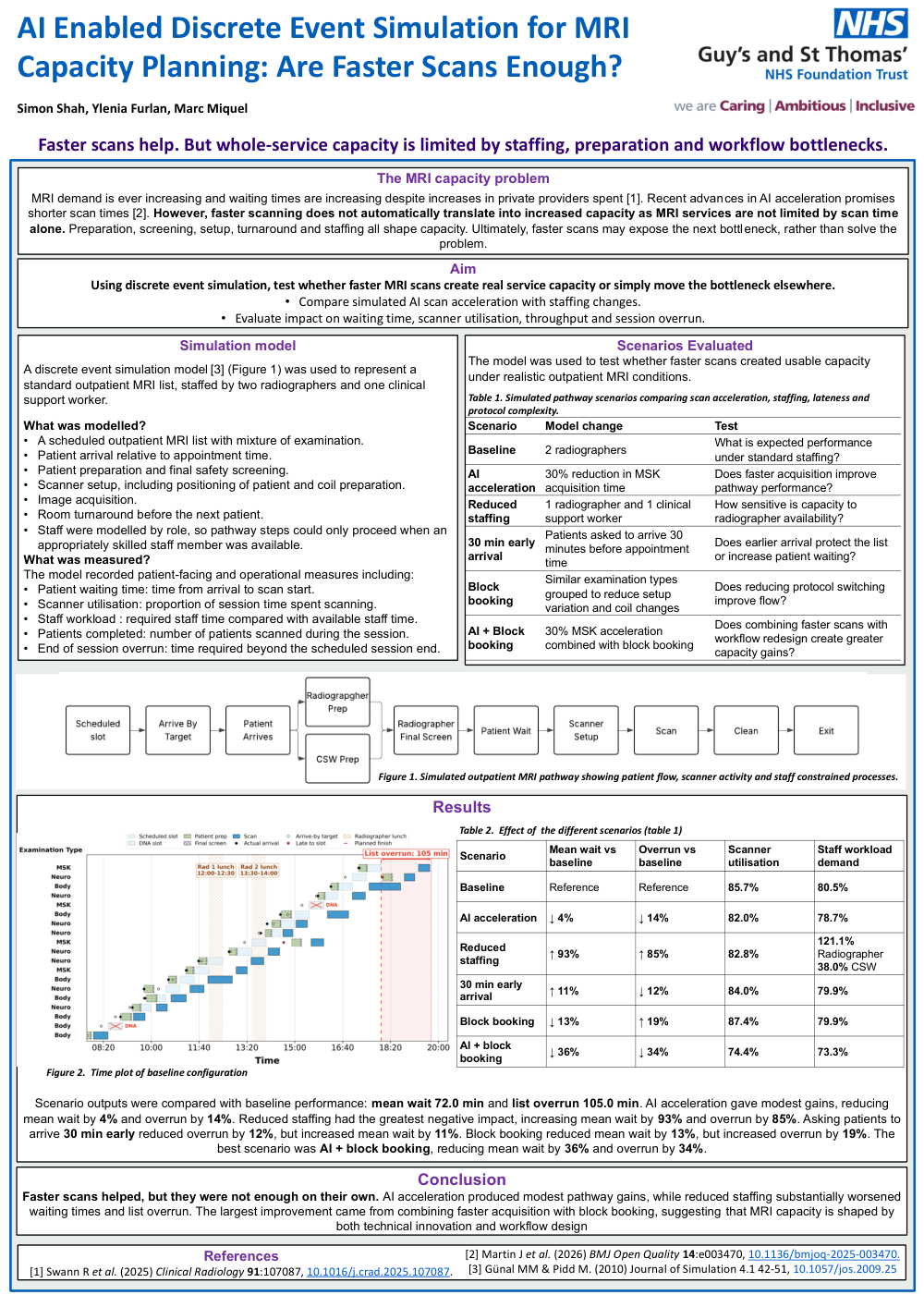
<p>AI Enabled Discrete Event Simulation for MRI Capacity Planning: Are Faster Scans Enough?</p>
Poster Presenter
Authors
Affiliations
Part of Topic
General / other that does not fit into the above
AI Enabled Discrete Event Simulation for MRI Capacity Planning: Are Faster Scans Enough?
The MRI capacity problem
MRI demand is ever increasing and waiting times are increasing despite increases in private providers spent [1]. Recent advances in AI acceleration promises shorter scan times [2]. However, faster scanning does not automatically translate into increased capacity as MRI services are not limited by scan time alone. Preparation, screening, setup, turnaround and staffing all shape capacity. Ultimately, faster scans may expose the next bottleneck, rather than solve the problem.
Aim
Using discrete event simulation, test whether faster MRI scans create real service capacity or simply move the bottleneck elsewhere.
•Compare simulated AI scan acceleration with staffing changes.
•Evaluate impact on waiting time, scanner utilisation, throughput and session overrun.
Simulation model
A discrete event simulation model [3] (Figure 1) was used to represent a standard outpatient MRI list, staffed by two radiographers and one clinical support worker.
What was modelled?
•A scheduled outpatient MRI list with mixture of examination.
•Patient arrival relative to appointment time.
•Patient preparation and final safety screening.
•Scanner setup, including positioning of patient and coil preparation.
•Image acquisition.
•Room turnaround before the next patient.
•Staff were modelled by role, so pathway steps could only proceed when an appropriately skilled staff member was available.
What was measured?
The model recorded patient-facing and operational measures including:
•Patient waiting time: time from arrival to scan start.
•Scanner utilisation: proportion of session time spent scanning.
•Staff workload : required staff time compared with available staff time.
•Patients completed: number of patients scanned during the session.
•End of session overrun: time required beyond the scheduled session end.
Conclusion
Faster scans helped, but they were not enough on their own. AI acceleration produced modest pathway gains, while reduced staffing substantially worsened waiting times and list overrun. The largest improvement came from combining faster acquisition with block booking, suggesting that MRI capacity is shaped by both technical innovation and workflow design