119 posters, 6 topics, 524 authors, 243 institutions
ePostersLive by SciGen Technologies S.A. All rights reserved.
RCR Global AI Conference 2026
29-30 June, 2026 | QEII Centre, Westminster

190
<p>Beyond?�the Black?�Box: A?�Verification-First?�AI Assistant?�for Radiology Education with?�Evidence-Graded Responses</p>
Poster Presenter
Authors
Affiliations
Part of Topic
AI Education and research: examples of proof of concept or AI in development, technical advances, teaching approaches or pre-clinical testing
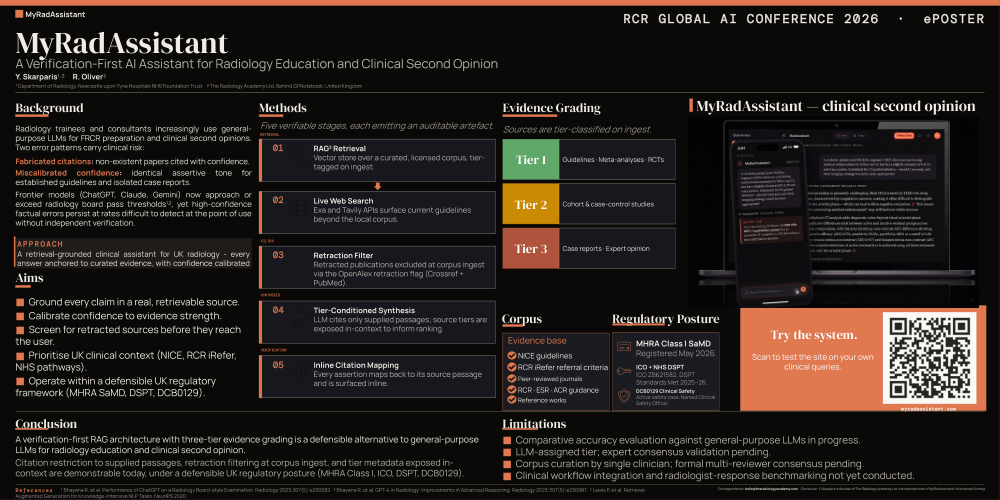
Background. General-purpose LLMs are increasingly used by radiology trainees and consultants for FRCR preparation and clinical second opinions. Two failure modes carry clinical risk: fabricated citations presented with confidence, and miscalibrated confidence in which assertive tone is applied identically to established guidelines and isolated case reports. Frontier models (ChatGPT, Claude, Gemini) now approach or exceed radiology board pass thresholds, yet high-confidence factual errors persist at rates difficult to detect at the point of use without independent verification.
Approach. MyRadAssistant is a retrieval-grounded clinical assistant for UK radiology. Every answer is anchored to a curated evidence base, with confidence calibrated to source quality and retracted sources screened before they reach the user. The system prioritises UK clinical context (NICE, RCR iRefer, NHS pathways) and operates within a defensible UK regulatory framework: MHRA Class I SaMD registered May 2026, DSPT Standards Met 2025–26, ICO ZB621582, with an active DCB0129 clinical safety case under a named Clinical Safety Officer.
Methods. Five verifiable stages, each emitting an auditable artefact: RAG retrieval over a curated tier-tagged corpus; live web search via Exa and Tavily APIs for guidelines beyond the local corpus; retraction filtering at corpus ingest; tier-conditioned synthesis in which the LLM cites only supplied passages with source tiers exposed in context; and inline citation mapping where every assertion maps back to its source passage.
Evidence grading. Sources are tier-classified on ingest. Tier 1: guidelines, meta-analyses, RCTs. Tier 2: cohort and case-control studies. Tier 3: case reports and expert opinion.
Conclusion. A verification-first RAG architecture with three-tier evidence grading is a defensible alternative to general-purpose LLMs for radiology education and clinical second opinion. Citation restriction to supplied passages, retraction filtering at corpus ingest, and tier metadata exposed in context are demonstrable today, under a defensible UK regulatory posture.
Limitations. Comparative accuracy evaluation against general-purpose LLMs in progress. LLM-assigned tier with expert consensus validation pending. Corpus curated by a single clinician with formal multi-reviewer consensus pending. Clinical workflow integration and radiologist-response benchmarking not yet conducted.
Keywords: retrieval-augmented generation, RAG, clinical decision support, radiology, FRCR preparation, FRCR 2A, medical AI safety, hallucination, citation grounding, evidence tiering, MHRA SaMD, DCB0129, DSPT, ICO, UK radiology, NHS, NICE, RCR iRefer, large language models, Chat GPT, Claude, Gemini, clinical safety case, second opinion, retraction filtering, OpenAlex.