119 posters, 6 topics, 524 authors, 243 institutions
ePostersLive by SciGen Technologies S.A. All rights reserved.
RCR Global AI Conference 2026
29-30 June, 2026 | QEII Centre, Westminster

126
<p>Clinician-Led Development of a PACS-Native AI and Reporting Pipeline for Neonatal Cranial Ultrasound in Hypoxic–Ischaemic Encephalopathy to overcome interobserver variability, time and resource constrains.</p>
Part of Topic
AI Education and research: examples of proof of concept or AI in development, technical advances, teaching approaches or pre-clinical testing
Clinician-Led Development of a PACS-Native AI and Reporting Pipeline for Neonatal Cranial Ultrasound in Hypoxic-Ischaemic Encephalopathy to Overcome Interobserver Variability, Time and Resource Constraints
Authors: Robert English (Barts and the London School of Medicine); Rayya Naffa, Shirou Mosoodi, Paige Miller (Basildon University Hospital); Sivakumar Manickam (Mid and South Essex NHS Trust).
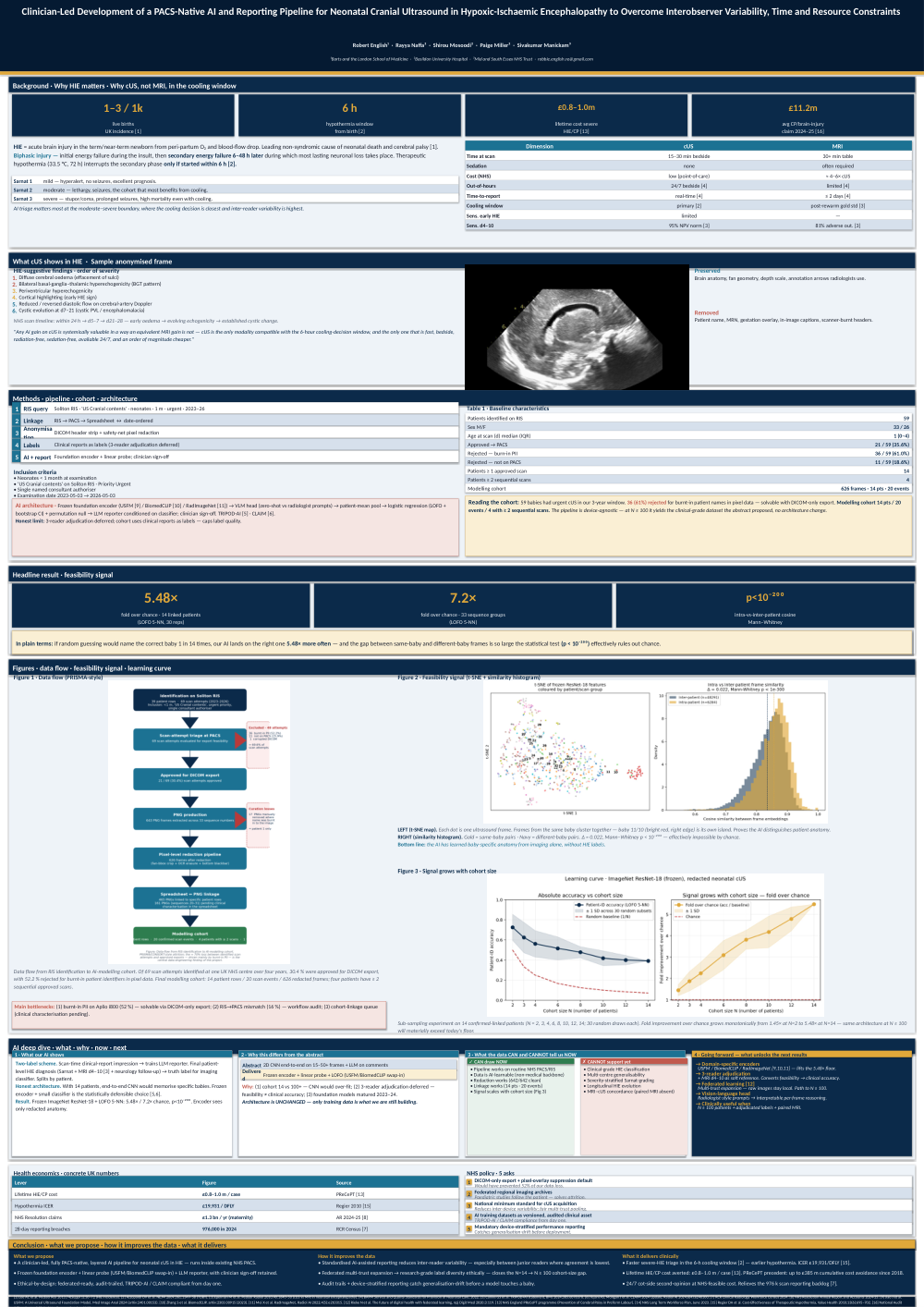
Background. Hypoxic-ischaemic encephalopathy (HIE) is acute brain injury in the term or near-term newborn from peri-partum oxygen and blood-flow drop. It is the leading non-syndromic cause of neonatal death and cerebral palsy, with UK incidence of 1–3 per 1,000 live births. The injury is biphasic: initial energy failure during the insult, then a secondary energy failure 6–48 hours later during which most lasting neuronal loss takes place. Therapeutic hypothermia (33.5 °C for 72 hours) interrupts the secondary phase only if started within 6 hours of birth. Lifetime cost per severe HIE/cerebral palsy case is £0.8–1.0 million; the average CP/brain-injury negligence claim in 2024–25 was £11.2 million (NAO). AI triage matters most at the moderate–severe Sarnat boundary, where the cooling decision is closest and inter-reader variability is highest.
What cUS shows in HIE, in order of severity: diffuse cerebral oedema with sulcal effacement; bilateral basal-ganglia–thalamic hyperechogenicity (BGT pattern); periventricular hyperechogenicity; cortical highlighting; reduced or reversed diastolic flow on cerebral-artery Doppler; cystic evolution at days 7–21 (cystic periventricular leukomalacia / encephalomalacia). NHS standard scan timeline: within 24 h, then days 5–7, then days 21–28.
Why cUS, not MRI, in the cooling window. cUS is the only modality compatible with the 6-hour cooling-decision window: bedside, fast, radiation-free, sedation-free, 24/7 available, and an order of magnitude cheaper. MRI is the post-rewarm gold standard for HIE injury characterisation; cUS retains 95 % NPV in normal d4–10 studies.
Methods. Single-centre retrospective cohort with prospective AI-pipeline development at a UK NHS hospital, 2023–2026. PACS-native 5-step pipeline: RIS query (Soliton; 'US Cranial contents'; neonates < 1 month; urgent priority; single named consultant authoriser); RIS → PACS → spreadsheet linkage with date-ordered scans; DICOM header strip plus safety-net pixel-level redaction (fan-bbox crop, Tesseract OCR-bbox erasure, uniform bottom blackbar at y ≥ 0.83·H); clinical reports as labels (three-reader research-grade adjudication deferred); foundation-encoder + linear-probe modelling with clinician sign-off. Reporting follows TRIPOD-AI and CLAIM 2024.
AI architecture (planned): frozen foundation encoder (USFM / BiomedCLIP / RadImageNet, three-way comparator) → vision-language head zero-shot scored against radiologist-style prompts → patient-mean pooling → logistic regression with leave-one-patient-out cross-validation, bootstrap 95 % CI and 1,000-permutation null → lightweight LLM reporter conditioned on the classifier, with mandatory clinician edit-and-sign-off before PACS storage.
Cohort. 59 babies had an urgent cUS in the three-year window. 36 (61 %) were rejected because the Aplio i800 scanner burnt patient names into the pixel data — solvable by DICOM-only export with pixel-overlay suppression. 11 (19 %) never reached PACS. The modelling cohort is 14 patients across 20 confirmed scan events; 4 patients have ≥ 2 sequential scans, enabling within-baby change tracking.
Headline result — feasibility signal. Without HIE labels, a frozen ImageNet ResNet-18 encoder plus leave-one-frame-out 5-nearest-neighbour patient identification reaches 5.48× chance on 14 linked patients (LOFO 5-NN, 30 repetitions) and 7.2× chance across 33 sequence groups, with intra-vs-inter-patient cosine similarity Mann–Whitney p < 10⁻²⁰⁰. This is a feasibility floor, not clinical accuracy — it proves the redacted data carries patient-specific anatomical signal an AI can learn from. Domain-specific encoders are expected to lift it. Plain reading: if random guessing would name the correct baby 1 in 14 times, the AI lands on the right one 5.48 times more often; the gap between same-baby and different-baby frames is so large that chance is effectively ruled out.
Why the architecture differs from the abstract proposal. The abstract proposed a 2D CNN trained end-to-end on 15–50+ frames per exam plus a lightweight LLM on adjudicator comments. Three changes were forced: (1) the cohort of 14 vs an anticipated 100+ would cause a CNN trained end-to-end to memorise individual babies rather than learn HIE features — a frozen encoder + linear probe is the statistically defensible choice at this N; (2) three-reader research-grade adjudication is deferred, so the cohort uses single-reporter clinical reports as labels, capping label quality; (3) ultrasound and biomedical foundation models (USFM, BiomedCLIP, RadImageNet) matured between abstract submission and now, making swap-in higher-leverage than CNN-from-scratch. The pipeline architecture is unchanged from the proposal — the training data is what we are still building.
What the data CAN tell us now: pipeline works end-to-end on routine NHS PACS/RIS; data is AI-learnable even with a non-medical ImageNet backbone; redaction works (642/642 frames clean below blackbar); spreadsheet–PNG linkage works for 14 patients and 20 events with four sequential cases; signal scales monotonically with cohort size from 1.45× at N=2 to 5.48× at N=14. What the data CANNOT tell us yet: clinical-grade HIE classification; multi-centre generalisability; severity-stratified Sarnat grading; longitudinal HIE evolution; cUS–MRI concordance (paired MRI not yet integrated).
Going forward: domain-specific encoder swap-in; three-reader adjudication with paired MRI day 4–10 as soft reference; federated multi-trust expansion (raw images stay local); vision-language head for interpretable per-frame reasoning and multimodal fusion with gestational age, birth weight, Apgar, EEG. Clinically useful when N ≥ 100 patients with adjudicated labels plus paired MRI.
Health economics (UK). Lifetime HIE/CP cost averted £0.8–1.0 million per case (PReCePT). Therapeutic-hypothermia ICER £19,931 per disability-free life-year gained (Regier 2010, Value in Health). NHS Resolution paid £1.3 bn in maternity claims in 2024–25 (Annual Report). RCR Clinical Radiology Workforce Census 2024 documents 976,000 28-day reporting breaches.
NHS policy asks. (1) DICOM-only export with pixel-overlay suppression as default — would have prevented 52 % of our data loss. (2) Federated regional imaging archives so paediatric studies follow the patient — solves the 16 % RIS→PACS attrition we observed. (3) National minimum standard for cUS acquisition (frames, planes, cine clips). (4) AI training datasets as versioned, audited clinical assets, TRIPOD-AI / CLAIM compliant from day one. (5) Mandatory device-stratified performance reporting before deployment to catch generalisation-drift before it reaches a baby.
Conclusion. We propose a clinician-led, fully PACS-native, layered AI pipeline for neonatal cranial ultrasound in HIE that runs inside existing NHS infrastructure with no parallel systems, frozen foundation encoder plus linear probe plus LLM reporter, ethical-by-design (federated-ready, audit-trailed, TRIPOD-AI / CLAIM compliant). It improves the data by standardising AI-assisted reporting where inter-reader variability is highest, by enabling federated multi-trust expansion to close the N=14 → N ≥ 100 cohort-size gap, and by surfacing generalisation-drift before deployment. It delivers faster severe-HIE triage in the 6-hour cooling window — earlier hypothermia at an ICER of £19,931 / DFLY, lifetime HIE/CP cost averted of £0.8–1.0 m per case, PReCePT precedent of up to £385 m cumulative cost avoidance since 2018, and a 24/7 cot-side second-opinion that relieves the 976,000 scan reporting backlog.
Keywords: hypoxic-ischaemic encephalopathy, neonatal cranial ultrasound, cUS, HIE, therapeutic hypothermia, cooling, neonatology, paediatric radiology, foundation model, BiomedCLIP, USFM, RadImageNet, federated learning, TRIPOD-AI, CLAIM, PACS, DICOM, NHS, Basildon, Mid and South Essex, PReCePT, AI triage, ePoster.