119 posters, 6 topics, 524 authors, 243 institutions
ePostersLive by SciGen Technologies S.A. All rights reserved.
RCR Global AI Conference 2026
29-30 June, 2026 | QEII Centre, Westminster

122
<p>Comparative Assessment of Convolutional Neural Network Architectures for BI-RADS Classification Using a Local Mammography Dataset</p>
Part of Topic
AI Education and research: examples of proof of concept or AI in development, technical advances, teaching approaches or pre-clinical testing
Comparative Assessment of Convolutional Neural Network Architectures for BI-RADS Classification Using a Local Mammography Dataset
Elham Keshavarz, Hamed Ghorani, Navid Zandi, Saghar Rasouli Nahad, Matin Noroozi, Reyhaneh Sadat Mortazavi Presenter: Elham Keshavarz
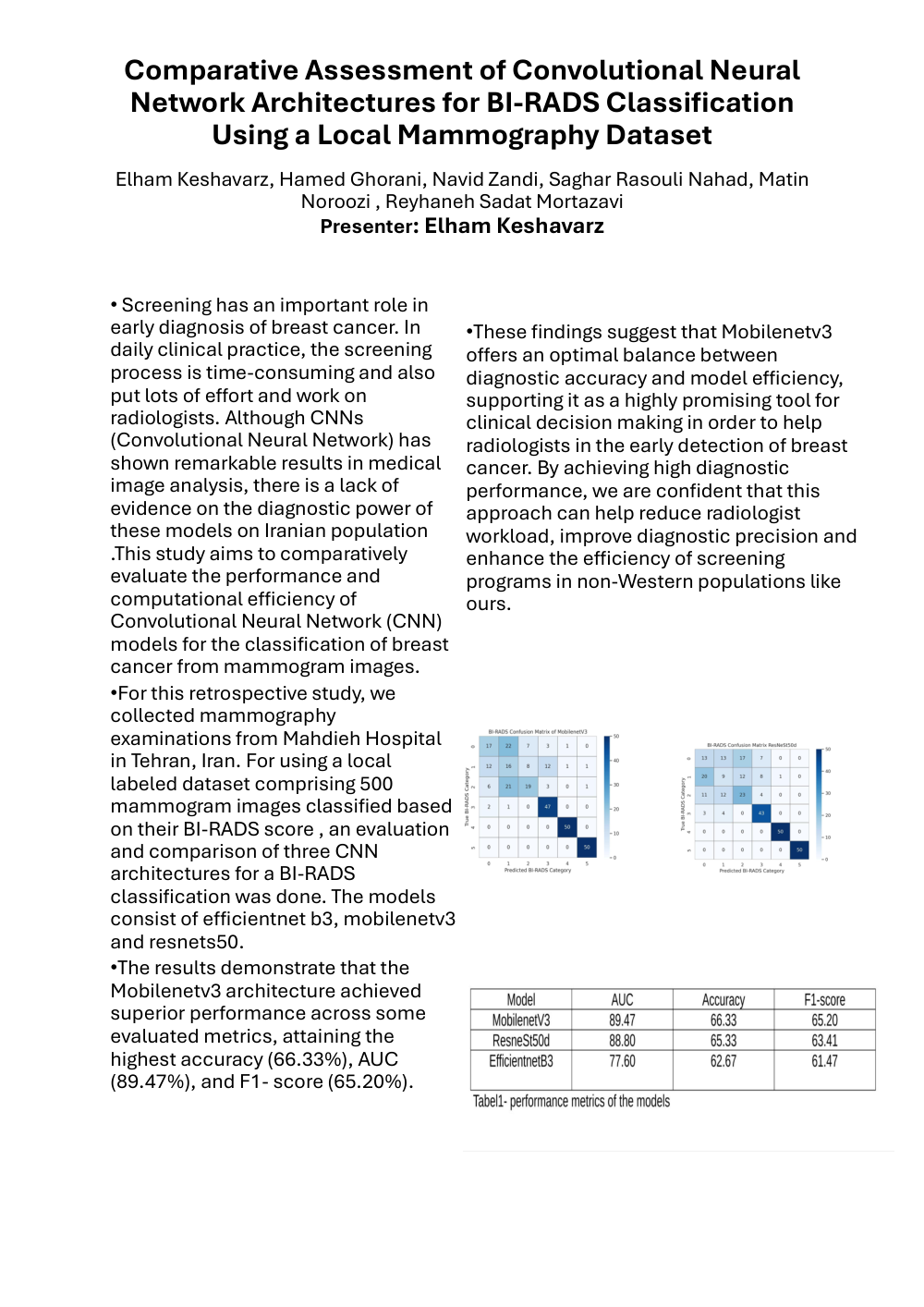
• Screening has an important role in early diagnosis of breast cancer. In daily clinical practice, the screening process is time-consuming and also put lots of effort and work on radiologists. Although CNNs (Convolutional Neural Network) has shown remarkable results in medical image analysis, there is a lack of evidence on the diagnostic power of these models on Iranian population .This study aims to comparatively evaluate the performance and computational efficiency of Convolutional Neural Network (CNN) models for the classification of breast cancer from mammogram images. • For this retrospective study, we collected mammography examinations from Mahdieh Hospital in Tehran, Iran. For using a local labeled dataset comprising 500 mammogram images classified based on their BI-RADS score , an evaluation and comparison of three CNN architectures for a BI-RADS classification was done. The models consist of efficientnet b3, mobilenetv3 and resnets50. • The results demonstrate that the Mobilenetv3 architecture achieved superior performance across some evaluated metrics, attaining the highest accuracy (66.33%), AUC (89.47%), and F1-score (65.20%). • These findings suggest that Mobilenetv3 offers an optimal balance between diagnostic accuracy and model efficiency, supporting it as a highly promising tool for clinical decision making in order to help radiologists in the early detection of breast cancer. By achieving high diagnostic performance, we are confident that this approach can help reduce radiologist workload, improve diagnostic precision and enhance the efficiency of screening programs in non-Western populations like ours