296 posters, 7 videos, 13 audios, 14 topics, 10 sessions, 1,019 authors, 260 institutions
ePostersLive by SciGen Technologies S.A. All rights reserved.
RCOphth Annual Congress 2026
18 - 21 May, 2026 | Manchester Central, Manchester

P074
Large-Scale, Real-World Collection of Refractive Outcomes After Cataract Surgery Through Patient-Mediated Mobile Photography
Poster Presenter
Authors
Aisling Higham, Ernest Lim, Rebecca Turner, Christopher King, Evgenia Anikina, Aris Konstantopoulos, Sarju Athwal, Louisa Stacey, Louis Williams, Joe Tindale, James Godwin, Nick de Pennington, Manju Chandran
Affiliations
Maidstone and Tunbridge Wells NHS Trust, Oxford University Hospitals NHS Foundation Trust, Ufonia Ltd, Oxford, Ufonia Ltd, Oxford,
Part of Topic
Cataract and refractive surgery
Background
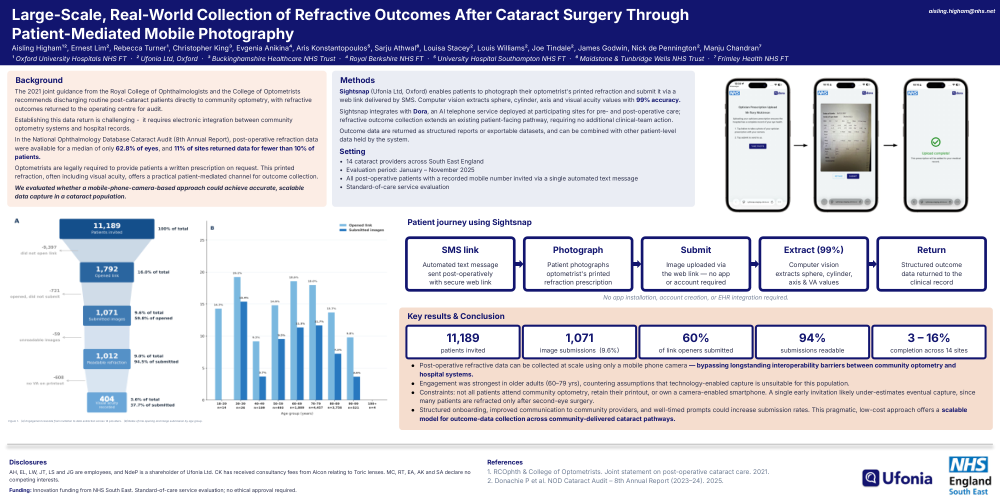
The 2021 joint guidance from the Royal College of Ophthalmologists and the College of Optometrists recommends discharging routine post-cataract patients directly to community optometry, with refractive outcomes returned to the operating centre for audit. Establishing this data return is challenging — it requires electronic integration between community optometry systems and hospital records. In the National Ophthalmology Database Cataract Audit (8th Annual Report), post-operative refraction data were available for a median of only 62.8% of eyes, and 11% of sites returned data for fewer than 10% of patients.
Optometrists are legally required to provide patients a written prescription. This printed refraction, often including visual acuity, offers a practical patient-mediated channel for outcome collection. We evaluated whether a mobile-phone-camera-based approach could achieve accurate, scalable data capture in a cataract population.
Methods
Sightsnap (Ufonia Ltd, Oxford) enables patients to photograph their optometrist's printed refraction and submit it via a web link delivered by SMS. Computer vision extracts sphere, cylinder, axis and visual acuity values with 99% accuracy.
Sightsnap integrates with Dora, an AI telephone service deployed at participating sites for pre- and post-operative care; refractive outcome collection extends an existing patient-facing pathway, requiring no additional clinical-team action. Outcome data are returned as structured reports or exportable datasets, and can be combined with other patient-level data held by the system.
The setting was 14 cataract providers across South East England, with an evaluation period running January to November 2025. All post-operative patients with a recorded mobile number were invited via a single automated text message. The work was carried out as a standard-of-care service evaluation; no ethical approval was required.
What is Sightsnap?
Sightsnap is a patient-mediated tool for collecting post-operative refractive outcomes after cataract surgery — using only what the patient already has. A single text message delivers a secure web link; the patient photographs the optometrist's printed prescription; computer vision extracts sphere, cylinder, axis and visual acuity values at 99% accuracy. There are no apps, dedicated devices, or EHR integrations required. The approach bypasses interoperability barriers between community optometry and hospital systems, and integrates with Dora — an existing AI telephone service for pre- and post-operative care.
Patient journey
What patients see is an NHS-branded web page — no app to install, no account to create. The patient simply taps Take Photo, snaps the printout from their optometrist, and submits. Computer vision then extracts sphere, cylinder, axis and visual acuity values automatically.
Why it works: 99% accuracy of CV extraction across submitted images; bypasses the need for electronic integration between community optometry and hospital systems; and extends an existing patient-facing pathway (Dora), so no extra clinical-team action is required.
Results
Across 14 cataract providers between January and November 2025, 11,189 patients were invited via a single automated SMS. Of these, 1,792 (16.0%) opened the link and 1,071 (9.6% of invited; 59.8% of openers) submitted an image. 1,012 submissions (94.5%) contained readable refractive data; 404 (37.7% of submissions) also included visual acuity, reflecting its inconsistent inclusion on optometrist printouts. Completion rates varied from 3% to 16% across the 14 providers.
Engagement was present across all ages, with the highest submission rates in adults aged 60–79 years, and was comparable between sexes.
Conclusion
Post-operative refractive data can be collected at scale using only a mobile phone camera — bypassing interoperability barriers between community optometry and hospital systems. Engagement was strongest in older adults (60–79 years), countering assumptions that technology-enabled capture is unsuitable for this population. A single early invitation likely under-estimates eventual capture; structured onboarding and well-timed prompts could increase submission rates further. This pragmatic, low-cost approach offers a scalable model for outcome-data collection across community-delivered cataract pathways.