296 posters, 7 videos, 13 audios, 14 topics, 10 sessions, 1,019 authors, 260 institutions
ePostersLive by SciGen Technologies S.A. All rights reserved.
RCOphth Annual Congress 2026
18 - 21 May, 2026 | Manchester Central, Manchester

P276
Artificial Intelligence in the diagnosis and prognosis of uveitis and medical retina conditions: A literature review
Poster Presenter
Authors
Affiliations
Part of Topic
Uveitis
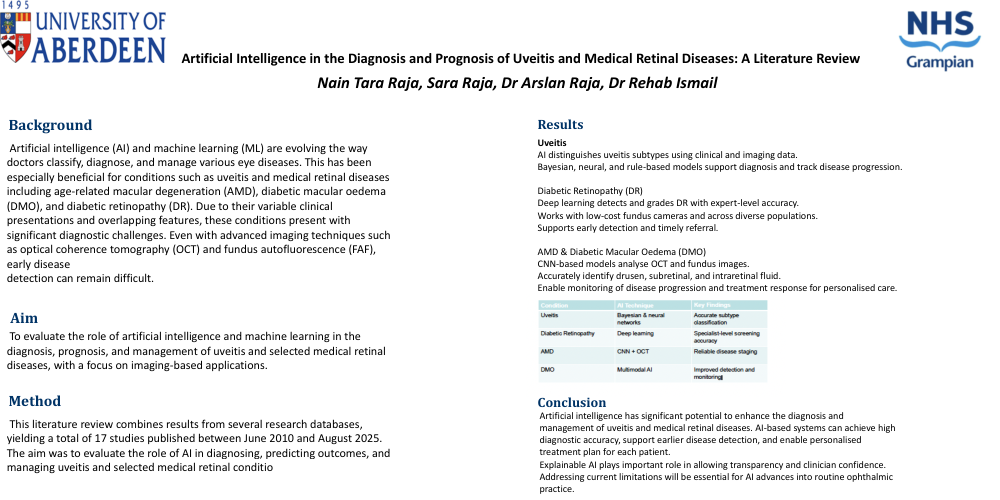
Artificial Intelligence in the Diagnosis and Prognosis of Uveitis and Medical Retinal Diseases: A Literature Review
Backgroung
Artificial intelligence (AI) and machine learning (ML) are evolving the way doctors classify, diagnose, and manage various eye diseases. This has been especially beneficial for conditions such as uveitis and medical retinal diseases including age-related macular degeneration (AMD), diabetic macular oedema (DMO), and diabetic retinopathy (DR). Due to their variable clinical presentations and overlapping features, these conditions present with significant diagnostic challenges. Even with advanced imaging techniques such as optical coherence tomography (OCT) and fundus autofluorescence (FAF), early disease
detection can remain difficult.
Aim
To evaluate the role of artificial intelligence and machine learning in the diagnosis, prognosis, and management of uveitis and selected medical retinal diseases, with a focus on imaging-based applications.
Method
This literature review combines results from several research databases, yielding a total of 17 studies published between June 2010 and August 2025. The aim was to evaluate the role of AI in diagnosing, predicting outcomes, and managing uveitis and selected medical retinal conditio
Results
Uveitis
AI distinguishes uveitis subtypes using clinical and imaging data.
Bayesian, neural, and rule-based models support diagnosis and track disease progression.
Diabetic Retinopathy (DR)
Deep learning detects and grades DR with expert-level accuracy.
Works with low-cost fundus cameras and across diverse populations.
Supports early detection and timely referral.
AMD & Diabetic Macular Oedema (DMO)
CNN-based models analyse OCT and fundus images.
Accurately identify drusen, subretinal, and intraretinal fluid.
Enable monitoring of disease progression and treatment response for personalised care.
Conclusion
ExplainaArtificial intelligence has significant potential to enhance the diagnosis and management of uveitis and medical retinal diseases. AI-based systems can achieve high diagnostic accuracy, support earlier disease detection, and enable personalised treatment plan for each patient.
ble AI plays important role in allowing transparency and clinician confidence. Addressing current limitations will be essential for AI advances into routine ophthalmic practice.