296 posters, 7 videos, 13 audios, 14 topics, 10 sessions, 1,019 authors, 260 institutions
ePostersLive by SciGen Technologies S.A. All rights reserved.
RCOphth Annual Congress 2026
18 - 21 May, 2026 | Manchester Central, Manchester

P271
Cataract surgery and carbon footprint: How does England compare to major centres globally? A comparison on carbon emissions during cataract surgery.
Poster Presenter
Part of Topic
Sustainability
How does England compare globally in Cataract surgery carbon footprint? A comparison on the efficiency of cataract surgery across the globe.
Nicholas Johnson, Subomi Bankole, Opeoluwa Fariyike
Introduction: Healthcare is a major source of greenhouse gases, producing 4-5% of the United Kingdom’s total carbon emissions, and NHS England producing 40% of emissions released by the public sector1. With NHS England aiming to reach a net zero on carbon emissions by 20452, there has a large shift towards sustainable healthcare. In 2021-22, Ophthalmology departments across England saw 7.5 million outpatient appointments alone, and there were over 450,000 cataract procedures done between 2019-203. Increasing sustainability and reducing carbon footprint in Ophthalmology will therefore be crucial in lowering emissions.
Cataract surgery most commonly involves the use of phacoemulsification to fragment the clouded lens, before an artificial intraocular lens (IOL) is inserted to restore vision. Common areas of Carbon dioxide emissions (CO2e, measured as kgCO2e) include factors such as staff and patient travel, consumables (such as needles and syringes), medical gases, energy, waste management and water. Factors such as emergency attendance and follow up appointments are also relevant sources of emissions which must be considered. A single cataract operation in 2021-22 in England was estimated to be 100 kgCo2 (ranging from 74.8 kgCO2e – 128.0 kgCO2e) by van-Hove et al4.
As the aging population increases, procedures managing visual conditions such as cataract and glaucoma are on the rise. To meet NHS zero carbon emissions goal, a comparison between cataract surgery in the NHS against global healthcare systems is imperative to identify further improvements to be made on cutting carbon emissions.
Methods: A search was conducted through PubMed, Ovid and Cochrane for the search terms ‘Carbon footprint OR Carbon emission’ AND ‘Cataract surgery’, from inception to 1st December 2025, yielding 100 articles. These articles were then appraised narratively to identify studies which were relevant to our comparison, with 7 studies included in the final analysis.
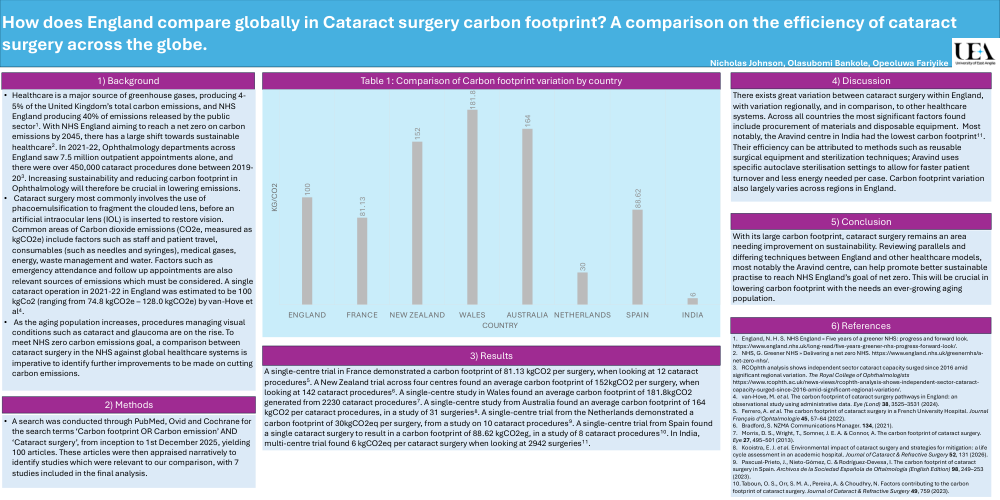
Results: A single-centre trial in France demonstrated a carbon footprint of 81.13 kgCO2 per surgery, when looking at 12 cataract procedures5. A New Zealand trial across four centres found an average carbon footprint of 152kgCO2 per surgery, when looking at 142 cataract procedures6. A single-centre study in Wales found an average carbon footprint of 181.8kgCO2 generated from 2230 cataract procedures7. A single-centre study from Australia found an average carbon footprint of 164 kgCO2 per cataract procedures, in a study of 31 surgeries8. A single-centre trial from the Netherlands demonstrated a carbon footprint of 30kgCO2eq per surgery, from a study on 10 cataract procedures. A single-centre trial from Spain found a single cataract surgery to result in a carbon footprint of 88.62 kgCO2eg, in a study of 8 cataract procedures9. In India, multi-centre trial found 6 kgCO2eq per cataract surgery when looking at 2942 surgeries10.
Discussion: There exists great variation between cataract surgery within England, with variation regionally, and in comparison, to other healthcare systems. Across all countries the most significant factors found include procurement of materials and disposable equipment. Most notably, the Aravind centre in India had the lowest carbon footprint10. Their efficiency can be attributed to methods such as reusable surgical equipment and sterilization techniques; Aravind uses specific autoclave sterilisation settings to allow for faster patient turnover and less energy needed per case. Carbon footprint variation also largely varies across regions in England4.
Conclusion: With its large carbon footprint, cataract surgery remains an area needing improvement on sustainability. Reviewing parallels and differing techniques between England and other healthcare models, most notably the Aravind centre, can help promote better sustainable practise to reach NHS England’s goal of net zero. This will be crucial in lowering carbon footprint with the needs an ever-growing aging population.