296 posters, 7 videos, 13 audios, 14 topics, 10 sessions, 1,019 authors, 260 institutions
ePostersLive by SciGen Technologies S.A. All rights reserved.
RCOphth Annual Congress 2026
18 - 21 May, 2026 | Manchester Central, Manchester

P204
Treat and Extend as a Threshold Search � understanding how different TREX rules behave
Poster Presenter
Authors
Part of Topic
Medical retina
Monte Carlo simulation and Pareto analysis of TREX extension rule choice under trial-derived durability priors in neovascular AMD
Kevin Gallagher FRCOphth
Cwm Taf Morgannwg University Health Board, Wales, UK
Kevin.gallagher@wales.nhs.uk
Background
Treat-and-extend (TREX) is widely used for anti-VEGF therapy in macular disease. The injection interval is extended when disease remains stable and shortened when activity recurs.
Despite widespread use, no principled basis exists for choosing how much to extend or shorten the interval. Longer extensions are intuitive for longer-acting agents, but how large should the increment be?
Four-week adjustments have been shown to be safe and effective (ALTAIR study), but there is no explicit rationale for 4 weeks rather than 3, 5, or 6 weeks or longer. The posology for aflibercept 8 mg allows interval adjustments of 8–16 weeks after loading “at clinician discretion,” but what should guide that decision?
We suggest these questions become clearer if TREX is viewed as a threshold search problem. After loading doses, each TREX visit tests for an unknown threshold between continued control (“dry”) and recurrence (“wet”). Each eye is assumed to have a maximum dry interval (Tmax).
Framed in this way, rules can be compared in terms of the trade-off between speed and risk of overshooting beyond the disease-controlling interval.
Study Questions
Can TREX interval adjustment be modelled as a threshold search problem?
How do commonly used extension rules compare on speed and overshoot under realistic, trial-derived durability distributions?
Are any rules objectively inferior, and does the optimal choice depend on agent durability?
Methods
- Enumerate deterministic TREX pathways for each rule at each Tmax (4–16 weeks, 1-week grid).
- Derive Tmax distributions from published maintenance interval data (TENAYA/LUCERNE, FARIT study, and aflibercept 2 mg real-world cohort).
- Sample Tmax using Monte Carlo simulation (N = 10,000 simulated eyes per prior).
- Extract visits to maintenance interval, cumulative overshoot, and maximum single overshoot.
- Apply Pareto analysis across two objectives: speed (visits to maintenance) and overshoot.
Results
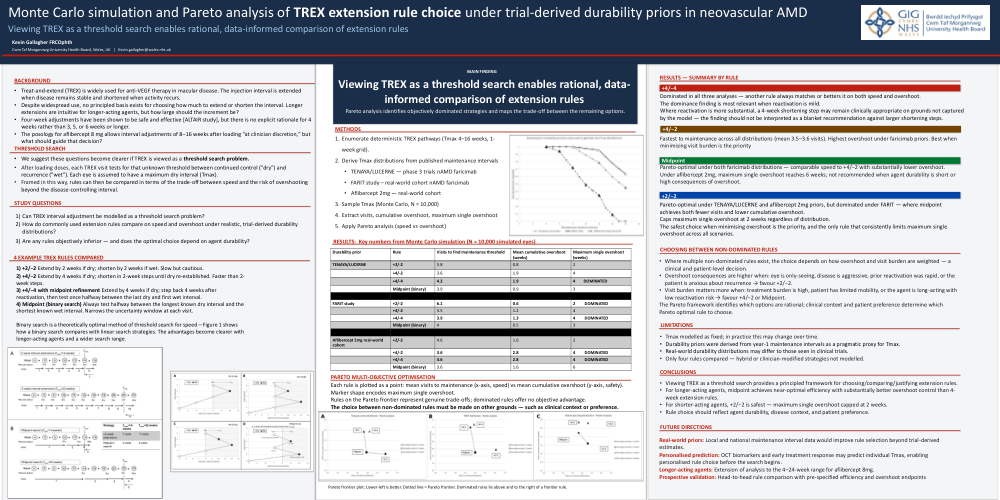
Each rule is represented as a point: mean visits to maintenance (speed) versus mean cumulative overshoot (safety). Marker shape encodes maximum single overshoot.
Rules on the Pareto frontier represent genuine trade-offs; dominated rules offer no objective advantage.
Summary by Rule
+4/−4
Dominated in all analyses: another rule always matches or betters it on both speed and overshoot.
This finding is most relevant when reactivation is mild. Where reactivation is more substantial, a 4-week shortening step may remain clinically appropriate on grounds not captured by the model.
+4/−2
Fastest to maintenance across all distributions (mean 3.5–3.6 visits).
Highest overshoot under faricimab priors.
Best when minimising visit burden is the priority.
Midpoint (binary search)
Pareto-optimal under faricimab distributions: comparable speed to +4/−2 with substantially lower overshoot.
Under aflibercept 2 mg, maximum single overshoot reaches 6 weeks; not recommended when durability is short or overshoot consequences are high.
+2/−2
Pareto-optimal under TENAYA/LUCERNE and aflibercept 2 mg priors, but dominated under FARIT.
Caps maximum single overshoot at 2 weeks regardless of distribution.
Safest when minimising overshoot is the priority.
Choosing Between Non-Dominated Rules
Where multiple non-dominated rules exist, choice depends on weighting of overshoot versus visit burden.
Overshoot consequences are higher when: the eye is only-seeing, disease is aggressive, prior reactivation was rapid, or the patient is risk-averse → favour +2/−2.
Visit burden matters more when: treatment burden is high, mobility is limited, or the agent is long-acting with low reactivation risk → favour +4/−2 or midpoint.
The Pareto framework identifies rational options; clinical context and patient preference determine final choice.
Conclusions
Viewing TREX as a threshold search provides a principled framework for comparing and selecting extension rules.
For longer-acting agents, midpoint achieves near-optimal efficiency with substantially better overshoot control than fixed 4-week extension rules.
For shorter-acting agents, +2/−2 is safest, with maximum single overshoot capped at 2 weeks.
Rule choice should reflect agent durability, disease context, and patient preference.
Limitations
Tmax modelled as fixed; in practice this may vary over time.
Durability priors derived from year 1 maintenance intervals as a proxy for Tmax.
Real-world durability distributions may differ from trial populations.
Only four rules evaluated; hybrid or clinician-modified strategies not modelled.
Future Directions
Incorporation of real-world maintenance interval data to refine priors.
Use of OCT biomarkers and early treatment response to predict individual Tmax and enable personalised rule selection.
Extension of analysis to longer intervals (e.g. aflibercept 8 mg, 4–24 weeks).
Prospective validation with head-to-head comparison of rule strategies.