296 posters, 7 videos, 13 audios, 14 topics, 10 sessions, 1,019 authors, 260 institutions
ePostersLive by SciGen Technologies S.A. All rights reserved.
RCOphth Annual Congress 2026
18 - 21 May, 2026 | Manchester Central, Manchester

P202
THULITE, a Phase II, randomised, double-masked, placebo-controlled trial of BI 1815368 in patients with centre-involved diabetic macular edema: Study design
Poster Presenter
Authors
Sobha Sivaprasad, Charles C. Wykoff, Shailesh Gupta, Brian Jin, Drisana Milsap, Eduard De Cock, Rehna Khan, Roger A. Goldberg
Affiliations
NIHR Moorfields Biomedical Research Centre, Moorfields Eye Hospital, London, UK, Retina Consultants of Texas, Blanton Eye Institute, Houston Methodist Hospital, Houston, TX, USA, Boehringer Ingelheim Pharmaceuticals, Inc., Ridgefield, CT, USA, Boehringer Ingelheim Pharma GmbH & Co. KG, Ingelheim am Rhein, Germany, Bay Area Retina Associates, Walnut Creek, CA, USA,
Part of Topic
Medical retina
Video
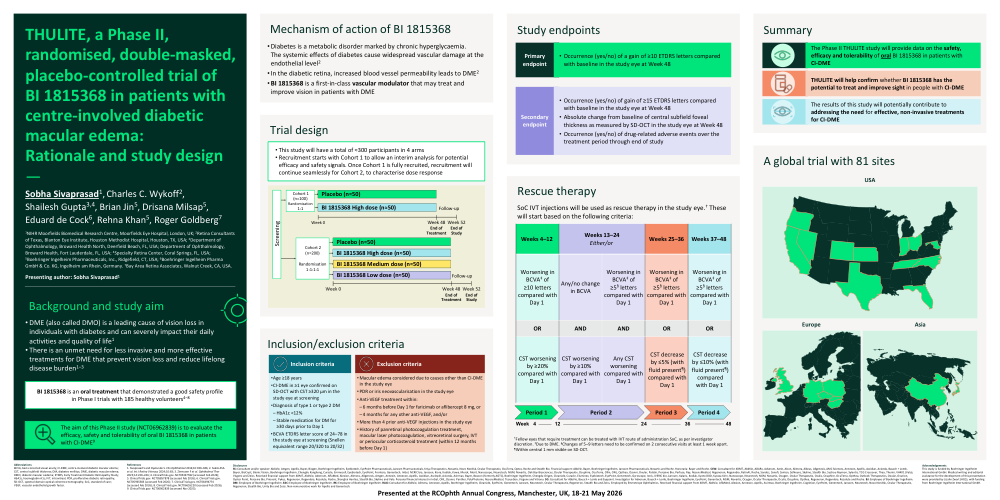
THULITE, a Phase II, randomised, double-masked, placebo-controlled trial of BI 1815368 in patients with centre-involved diabetic macular edema: Rationale and study design
Background and study aim
•DME (also called DMO) is a leading cause of vision loss in individuals with diabetes and can severely impact their daily activities and quality of life
•There is an unmet need for less invasive and more effective treatments for DME that prevent vision loss and reduce lifelong disease burden
BI 1815368 is an oral treatment that demonstrated a good safety profile in Phase I trials with 185 healthy volunteers
The aim of this Phase II study (NCT06962839) is to evaluate the efficacy, safety and tolerability of oral BI 1815368 in patients with CI-DME
Mechanism of action of BI 1815368
•Diabetes is a metabolic disorder marked by chronic hyperglycaemia. The systemic effects of diabetes cause widespread vascular damage at the endothelial level
•In the diabetic retina, increased blood vessel permeability leads to DME
•BI 1815368 is a first-in-class vascular modulator that may treat and improve vision in patients with DME
Trial design
•This study will have a total of ≈300 participants in 4 arms
•Recruitment starts with Cohort 1 to allow an interim analysis for potential efficacy and safety signals. Once Cohort 1 is fully recruited, recruitment will continue seamlessly for Cohort 2, to characterise dose response
Inclusion/exclusion criteria
Inclusion criteria:
•Age ≥18 years
•CI-DME in ≥1 eye confirmed on SD-OCT with CST ≥320 µm in the study eye at screening •Diagnosis of type 1 or type 2 DM–HbA1c
Exclusion criteria:
•Macular edema considered due to causes other than CI-DME in the study eye
•PDR or iris neovascularisation in the study eye
•Anti-VEGF treatment within:
–6 months before Day 1 for faricimab or aflibercept 8 mg, or
–4 months for any other anti-VEGF, and/or
•More than 4 prior anti-VEGF injections in the study eye
•History of panretinal photocoagulation treatment, macular laser photocoagulation, vitreoretinal surgery, IVT or periocular corticosteroid treatment (within 12months before Day1)
Study endpoints
Primary endpoint:
•Occurrence (yes/no) of a gain of ≥10 ETDRS letters compared with baseline in the study eye at Week 48
Secondary endpoint:
•Occurrence (yes/no) of gain of ≥15 ETDRS letters compared with baseline in the study eye at Week 48
•Absolute change from baseline of central subfield foveal thickness as measured by SD-OCT in the study eye at Week 48
•Occurrence (yes/no) of drug-related adverse events over the treatment period through end of study
Rescue therapy
SoC IVT injections will be used as rescue therapy in the study eye. These will start based on the following criteria:
•Weeks 4-12: Worsening in BCVA of ≥10 letters compared with day 1 OR CST worsening by ≥20% compared with day 1
•Weeks 13-24: Either any/no change in BCVA AND CST worsening by ≥ 10% compared with day 1; OR worsening in BCVA of ≥5 letters compared with day 1 AND any CST worsening compared with day 1
•Weeks 25-36: Worsening in BCVA of ≥ 5 letters compared with day 1 OR CST decrease by ≤5% (with fluid present) compared with day 1
•Weeks 37-48: Worsening in BCVA of ≥ 5 letters compared with day 1 OR CST decrease by ≤10% (with fluid present) compared with day 1
Summary
The Phase II THULITE study will provide data on the safety, efficacy and tolerability of oral BI 1815368 in patients with CI-DME
THULITE will help confirm whether BI 1815368 has the potential to treat and improve sight in people with CI-DME
The results of this study will potentially contribute to addressing the need for effective, non-invasive treatments for CI-DME
THULITE is a global trial with 81 sites across the USA, Europe and Asia