296 posters, 7 videos, 13 audios, 14 topics, 10 sessions, 1,019 authors, 260 institutions
ePostersLive by SciGen Technologies S.A. All rights reserved.
RCOphth Annual Congress 2026
18 - 21 May, 2026 | Manchester Central, Manchester

P190
Royal Bolton Hospital nAMD Experience of Aflibercept and Vabysmo
Poster Presenter
Authors
Part of Topic
Medical retina
Audio
Introduction
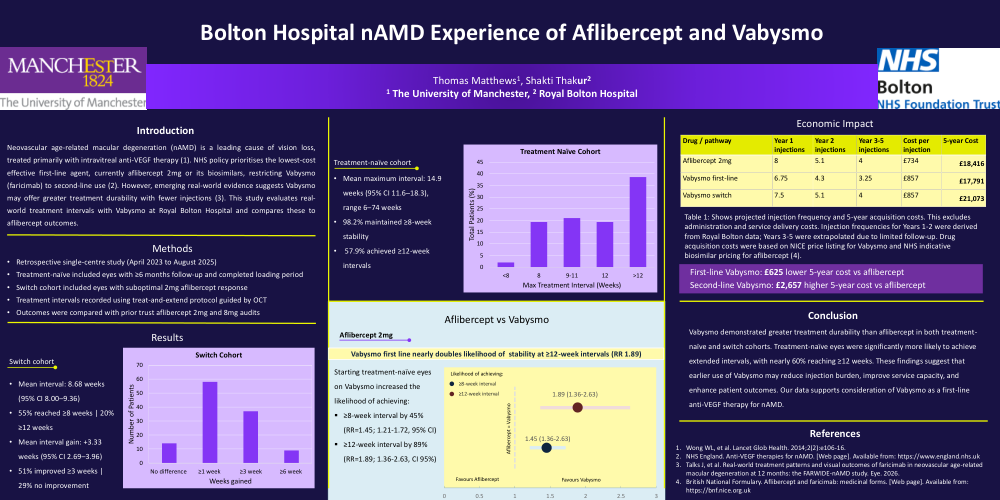
Neovascular age-related macular degeneration (nAMD) is a leading cause of vision loss, treated primarily with intravitreal anti-VEGF therapy (1). NHS policy prioritises the lowest-cost effective first-line agent, currently aflibercept 2mg or its biosimilars, restricting Vabysmo (faricimab) to second-line use (2). However, emerging real-world evidence suggests Vabysmo may offer greater treatment durability with fewer injections (3). This study evaluates real-world treatment intervals with Vabysmo at Royal Bolton Hospital and compares these to aflibercept outcomes.
Methods
• Retrospective single-centre study (April 2023 to August 2025)
• Treatment-naïve included eyes with ≥6 months follow-up and completed loading period
• Switch cohort included eyes with suboptimal 2mg aflibercept response
• Treatment intervals recorded using treat-and-extend protocol guided by OCT
• Outcomes were compared with prior trust aflibercept 2mg and 8mg audits
Results
Switch cohort:
• Mean interval: 8.68 weeks (95% CI 8.00–9.36)
• 55% reached ≥8 weeks | 20% ≥12 weeks
• Mean interval gain: +3.33 weeks (95% CI 2.69–3.96)
• 51% improved ≥3 weeks | 29% no improvement
Treatment-naïve cohort
• Mean maximum interval: 14.9 weeks (95% CI 11.6–18.3), range 6–74 weeks
• 98.2% maintained ≥8-week stability
• 57.9% achieved ≥12-week intervals
Aflibercept vs Vabysmo
Starting treatment-naïve eyes on Vabysmo increased the likelihood of achieving:
• ≥8-week interval by 45% (RR=1.45; 1.21-1.72, 95% CI)
• ≥12-week interval by 89% (RR=1.89; 1.36-2.63, CI 95%)
Economic Impact
First-line Vabysmo: £625 lower 5-year cost vs aflibercept
Second-line Vabysmo: £2,657 higher 5-year cost vs aflibercept
Conclusion
Vabysmo demonstrated greater treatment durability than aflibercept in both treatment-naïve and switch cohorts. Treatment-naïve eyes were significantly more likely to achieve extended intervals, with nearly 60% reaching ≥12 weeks. These findings suggest that earlier use of Vabysmo may reduce injection burden, improve service capacity, and enhance patient outcomes. Our data supports consideration of Vabysmo as a first-line anti-VEGF therapy for nAMD.
References
1. Wong WL, et al. Lancet Glob Health. 2014;2(2):e106-16.
2. NHS England. Anti-VEGF therapies for nAMD. [Web page]. Available from: https://www.england.nhs.uk
3. Talks J, et al. Real-world treatment patterns and visual outcomes of faricimab in neovascular age-related macular degeneration at 12 months: the FARWIDE-nAMD study. Eye. 2026.
4. British National Formulary. Aflibercept and faricimab: medicinal forms. [Web page]. Available from: https://bnf.nice.org.uk