296 posters, 7 videos, 13 audios, 14 topics, 10 sessions, 1,019 authors, 260 institutions
ePostersLive by SciGen Technologies S.A. All rights reserved.
RCOphth Annual Congress 2026
18 - 21 May, 2026 | Manchester Central, Manchester

P162
Evaluation and comparison of in-vivo carotenoid measurement techniques: Skin resonance Raman spectroscopy and macular pigment optical density
Poster Presenter
Part of Topic
Medical retina
Evaluation and comparison of in-vivo carotenoid measurement techniques:
Skin resonance Raman spectroscopy and macular pigment optical density
Pinakin Gunvant Davey1,2, Payal Sangani1
1Western University of Health Sciences, College of Optometry, Pomona, California, USA
2ZeaVision LLC, Chesterfield, Missouri, United States
Introduction
- Carotenoids are naturally occurring pigments which primarily provides photoprotection against the short-wavelength by absorbing it and have added anti-inflammatory, anti-oxidant, and immunity boosting properties.
- Central retina and superficial skin layers accumulates these carotenoids components after its dietary consumption from fruits and vegetables or supplementation formulas.
- Measuring these carotenoids amount in the macula and skin using non-invasive optical methods helps knowing dietary intake status of an individual, its resultant localized accumulation as antioxidant status at the tissue level and estimate of long-term tissue level protection.
Purpose
This study was designed to investigate,
1) Repeatability of skin carotenoid measurements
2) Compare the skin carotenoid measurements with macular pigment optical density (MPOD). and
3) Evaluate the physiological association between skin carotenoids levels and other biological measures.
Materials and Methods
- The skin carotenoid scores (SCS) were measured three times with using the S3 Pharmanex Scanner (NuSkin, Utah, United States) which uses principals of Raman Spectroscopy and MPOD was measured using the Zx Pro (ZeaVision LLC, Chesterfield, Missouri, US).
- The various biological measures included HbA1c measurements, systemic blood pressure, body mass index and retinal evaluation with optical coherence tomography.
Results
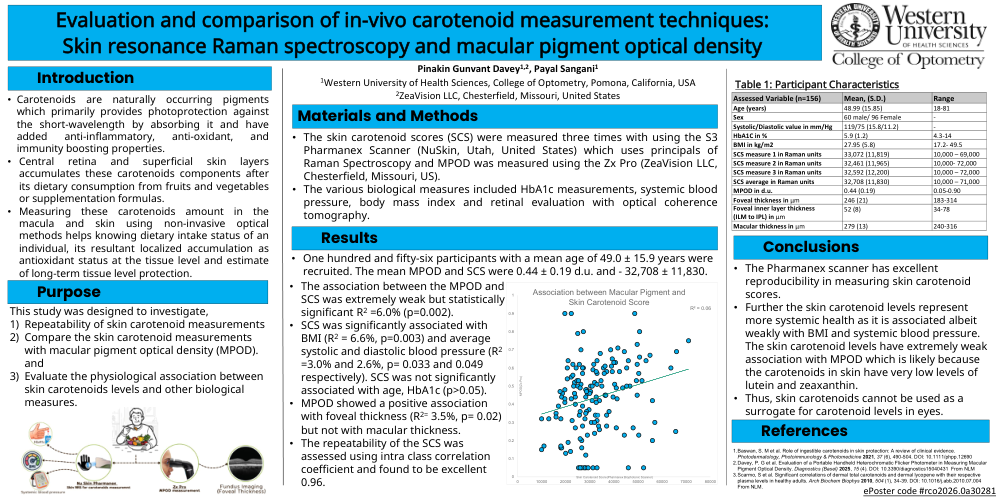
- One hundred and fifty-six participants with a mean age of 49.0 ± 15.9 years were recruited. The mean MPOD and SCS were 0.44 ± 0.19 d.u. and - 32,708 ± 11,830.
- The association between the MPOD and SCS was extremely weak but statistically significant R2 =6.0% (p=0.002).
- SCS was significantly associated with BMI (R2 = 6.6%, p=0.003) and average systolic and diastolic blood pressure (R2 =3.0% and 2.6%, p= 0.033 and 0.049 respectively). SCS was not significantly associated with age, HbA1c (p>0.05).
- MPOD showed a positive association with foveal thickness (R2= 3.5%, p= 0.02) but not with macular thickness.
- The repeatability of the SCS was assessed using intra class correlation coefficient and found to be excellent 0.96.
Conclusions
- The Pharmanex scanner has excellent reproducibility in measuring skin carotenoid scores.
- Further the skin carotenoid levels represent more systemic health as it is associated albeit weakly with BMI and systemic blood pressure. The skin carotenoid levels have extremely weak association with MPOD which is likely because the carotenoids in skin have very low levels of lutein and zeaxanthin.
- Thus, skin carotenoids cannot be used as a surrogate for carotenoid levels in eyes.